

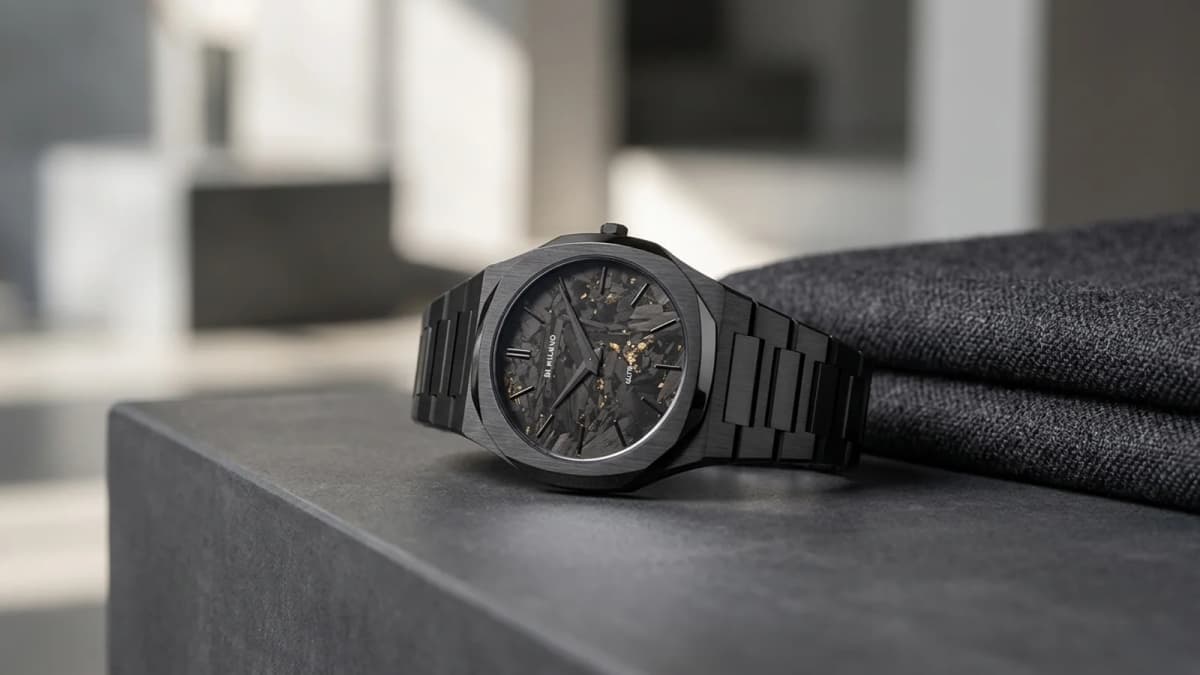
The D1 Milano watch intrigues as much as it divides. Octagonal silhouette, ultra-thin case, minimalist dial: the young Milanese house has built its identity on a striking aesthetic, halfway between sporty-chic watchmaking and contemporary Italian design. But what are these watches really worth in everyday wear, which line to choose, and for which wrist? Here is a complete guide, based on the actual characteristics of the models and on what is observed when wearing them.
D1 Milano in brief: a house born from design, not tradition
Founded in Milan in the mid-2010s, D1 Milano did not seek to imitate the codes of centuries-old Swiss watchmaking. The brand instead embraces a design-first approach: think first of the line, the geometry and the presence on the wrist, then the mechanics. This philosophy explains the immediately recognisable signature of its watches, all gathered on our D1 Milano watches page, at least 25% below the official price.
The result speaks to a specific audience: those who want a watch that stands out for its drawing rather than for a mechanical complication, without tipping into gaudiness. It is an assumed positioning as a watch fashion house, to be grouped alongside other horological fashion houses, but with a far more assertive visual identity than average.
This approach has a direct consequence on the perceived quality ratio. By concentrating effort on the case, finishing and crystal rather than on an expensive mechanical movement, the brand offers a presence on the wrist superior to what its positioning would suggest. This is exactly why a D1 Milano catches the eye in a shop window: the work is put where it shows, on the geometry and surface finishes, not in an invisible calibre.
One must also understand the name. The "D1" refers to the idea of a first model, a starting point, and "Milano" anchors the brand in the Italian capital of design. This Milanese origin is not just a geographical argument: it runs through the entire aesthetic vocabulary of the house, made up of clean lines, controlled contrasts and an assumed certain coldness, very far from the nostalgic warmth of traditional watchmaking.
The D1 Milano signature: octagonal case and Ultra Thin line
It is impossible to talk about D1 Milano without starting with its octagonal bezel. Where the vast majority of watches play the round or cushion case, D1 Milano has made the eight-sided shape its emblem. This geometry is not gratuitous: it captures light through facets, creates sharp relief and places the watch in a lineage of sporty-Montres Outletpieces with angular bezel that enthusiasts identify straight away.
The other pillar is the Ultra Thin line. The name is not just a marketing argument: the actual thinness of the case changes how you wear it. A thin watch slips under a shirt cuff without catching, remains light throughout the day and becomes forgotten on the wrist, whereas a thick chronograph constantly reminds you of its presence. For a man who wants a single watch capable of going from the office to dinner, this thinness is the decisive argument.
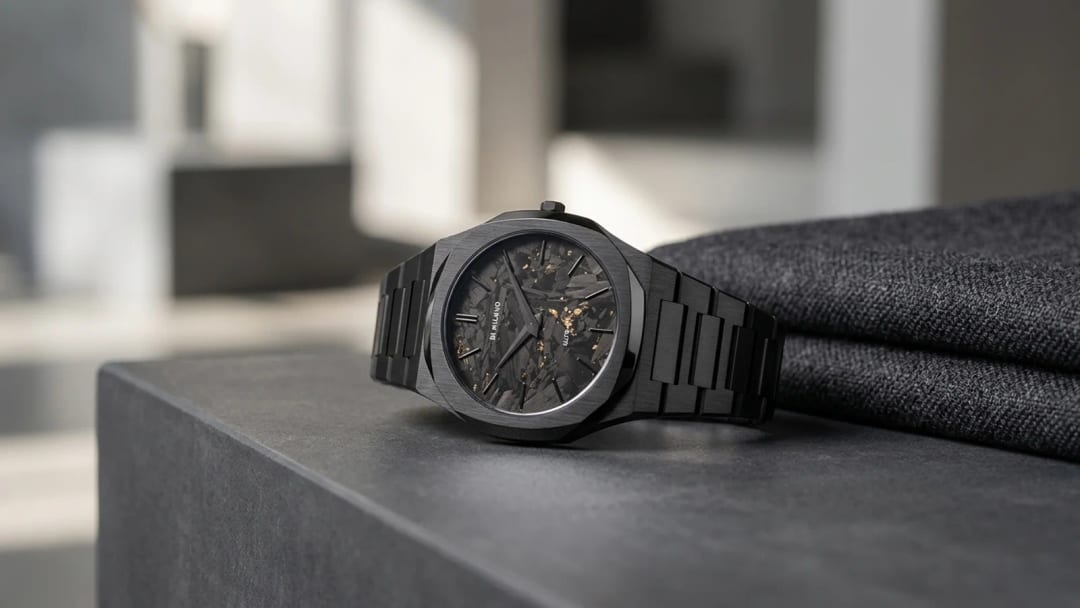
The actual characteristics of a D1 Milano Ultra Thin
Let us move from impressions to facts. Here is what you actually find on the Ultra Thin models of the brand, the most widely distributed line and the one we offer.
| Element | Specification | What it changes in wear |
|---|---|---|
| Case | Stainless steel, 40 mm, octagonal shape | Universal diameter, presence without heaviness |
| Thickness | Ultra-thin profile | Slips under a sleeve, becomes forgotten |
| Crystal | Scratch-resistant sapphire | Far more resistant than common mineral crystal |
| Movement | Quartz | Precision of a few seconds per month, no winding |
| Bracelet | Stainless steel with links | Can be shortened by a watchmaker for precise adjustment |
| Water resistance | 5 ATM (50 m) | Rain and splashes, but not swimming |
Two points deserve to be highlighted because they are often misunderstood. First the sapphire crystal: it is a true quality marker at this price level. Sapphire scratches with difficulty, whereas entry-level mineral crystal scratches with use. Then the 5 ATM water resistance: it corresponds to resistance tested in the laboratory to the equivalent of 50 metres of static pressure. In other words, the watch withstands rain, splashes and hand washing, but it is not designed for swimming. Showers should stay occasional: hot water and soap wear out the seals.
Quartz rather than automatic: a choice that makes sense
Many buyers hesitate when they discover that the Ultra Thin line runs on quartz and not automatic. This is a frequent objection, and it deserves an honest answer rather than a sales pitch.
Quartz has concrete advantages. Its precision is in the order of a few seconds per month, when an entry-level automatic movement drifts by several seconds per day. It requires no winding or daily wear to keep time. And above all, it is quartz that allows this extreme thinness of case: an automatic mechanical calibre, with its oscillating mass, imposes a thickness incompatible with the Ultra Thin spirit. In other words, choosing the Ultra Thin is choosing thinness and ease of use. Those who want the charm of a beating balance wheel will turn to the brand's automatic lines, which are thicker by nature.
The thinness of the case is not an aesthetic detail: it is what determines the quartz choice, and therefore everyday comfort.
The different D1 Milano lines: Ultra Thin, Skeleton, Shadow
The brand declines several families around the same octagonal bezel. Knowing them helps to place what you are buying.
Ultra Thin
The thinnest and most versatile line, with a full dial and refined two or three-hand reading. It is the ideal entry point into the brand's universe, and the one we have selected for its ability to match all outfits.
Skeleton
The open dial version, which lets you glimpse movement components. More demonstrative, it targets those who want to display a mechanical and technical side, even if the spirit remains resolutely design-focused.
Shadow and dark finishes
The versions with blackened cases or very dark textured dials, for a more assertive and monochrome look. They appeal to an audience seeking a statement watch, less versatile than a clear steel base.
Our selection focuses on the Ultra Thin line, the easiest to live with and to coordinate. You will find all available models, for men and women, in our D1 Milano Ultra Thin selection.
D1 Milano versus watches with angular bezel
D1 Milano is often compared to far more expensive sporty-chic watches with geometric bezel. The comparison is flattering but misleading, and it is better to clarify it. The icons of the genre, with octagonal or barrel bezel, rest on manufacture movements and decades of history, which explains prices that are incomparable. D1 Milano does not play in that league and does not claim to.
What the brand offers is the contemporary and accessible expression of a similar aesthetic language: the faceted bezel, the integrated steel bracelet, the minimalist reading. For someone who likes this visual grammar but does not wish to devote a luxury watchmaking budget to it, a D1 Milano is a coherent answer. The mistake would be to expect from it the mechanics and resale value of a manufacture piece. Taken for what it is, a well-executed design watch, it plays its role perfectly.
This honesty of positioning is moreover a good guide when buying: a brand with assured style is worth more than a counterfeit that apes a luxury icon. You are paying for genuine design, genuine sapphire crystal and genuine warranty, not an imitation.
Our honest opinion: who is a D1 Milano for
A D1 Milano is not a watch for everyone, and that is perfectly fine. Here is our reading, without indulgence.
The question that often comes up, notably in English, is "are D1 Milano watches good". The answer comes down to one sentence: yes, provided you buy the watch for what it is, a well-finished design object with sapphire crystal, and not for a mechanical feat that it does not claim.
How to choose your D1 Milano: size, colour, wrist
The choice comes down to three simple parameters.
Case size
The 40 mm diameter of the Ultra Thin line is a versatile format, which suits the majority of men's wrists and many women's wrists thanks to the slimness. On a very slim wrist, the lightness of the watch limits the bulky effect. If your wrist circumference is below 15 cm, opt instead for the unisex versions worn tight.
Case finish and dial colour
This is where style comes into play. The silver and grey bases are the most versatile: they coordinate with a suit as well as with jeans. The rose gold and gold finishes warm the wrist and assert the style. The blue, green or black dials add character without breaking the overall sobriety.
Our recommended models
For a first versatile D1 Milano, a light base is the safe bet.
For a second watch with more presence, go for a warm finish or a dark shade.
Maintenance: making your D1 Milano last
A watch with sapphire crystal and steel case will last through the years without difficulty, provided you follow a few simple habits.
The battery of a quartz movement is generally replaced every two to three years at a watchmaker, who will take the opportunity to check the seals. It is the lightest maintenance there is, one of the concrete advantages of quartz over automatic.
Where to buy an authentic D1 Milano
As with any sought-after design brand, the question of authenticity arises. Always buy from a retailer who guarantees authentic watches, delivered in their original box and covered by the 2-year warranty. Our D1 Milano watches are authentic, guaranteed for 2 years, and dispatched with tracking. You have 14 days to change your mind, return shipping costs remaining at your expense except for defective products.
Frequently asked questions about D1 Milano watches
Are D1 Milano watches good quality?
Is the Ultra Thin line quartz or automatic?
What size is a D1 Milano men's watch?
Can you swim with a D1 Milano?
How to recognise an authentic D1 Milano?
Read next
More in this vein

Brands
Burberry Men's Watch Size Guide: How to Find the Perfect Size

Brands
Burberry Elegance Men's Watch: British Refinement for Special Occasions

Brands
Emporio Armani Gold Men's Watch: The Brilliance of Italian Luxury

Brands
Diesel Mega Chief Men's Watch: Complete Guide to the Icon

Brands
Daniel Wellington Mesh Women's Watch: The Complete Guide to the Milanese Mesh Bracelet

Brands
Tommy Hilfiger Mesh Women's Watch: The Complete Guide to Milanese Mesh Bracelets

Brands
Black Daniel Wellington women's watch: the complete guide to minimalist elegance
Brands