

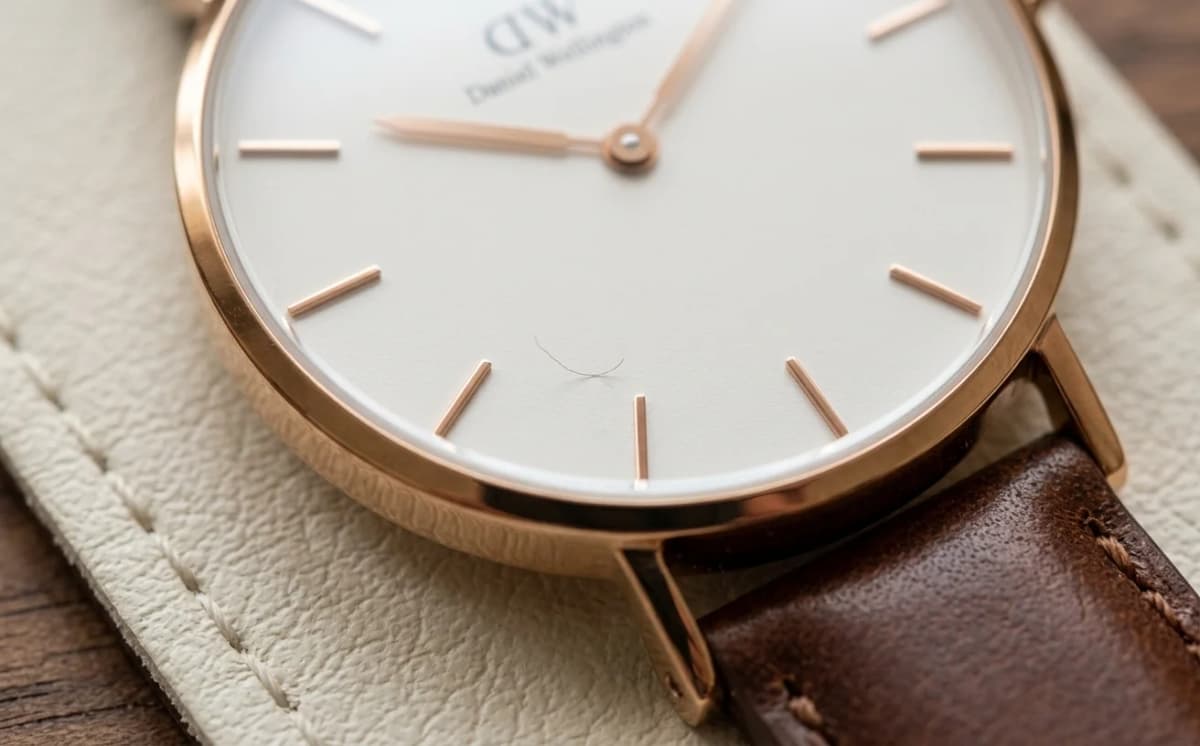
Last week, a customer showed me a watch received a few days earlier, still in its box. Under the crystal, at 7 o'clock, a tiny textile fibre, barely visible to the naked eye but impossible to ignore once spotted. His question was twofold: "is this normal on a new watch?" and "can I remove it myself?". The answer deserves more than a yes or no. Dust under the crystal almost never damages the watch, but it is deeply annoying, and removing it requires knowing exactly what you are doing: the dial is the visually most fragile part of the entire watch, and a clumsy gesture transforms invisible dust into a permanent scratch. In this guide, I explain where this dust comes from (including on new watches), how to make the right diagnosis in 30 seconds, in which cases you absolutely must NOT open the watch yourself, and the complete step-by-step method using tools you can find at home or for very little money at all.
Diagnosis in 5 seconds

Dust on the crystal or under the crystal? Diagnosis in 30 seconds
The test is simple and requires only two accessories: a clean microfibre cloth (the one from your glasses works perfectly) and a direct light source, desk lamp or phone torch.
- Step 1, the microfibre wipe: carefully wipe the crystal, front and edges. If the particle has disappeared or moved, it was on the outside. End of story.
- Step 2, raking light: tilt the watch under the lamp so the light grazes the crystal surface. Dust UNDER the crystal casts a tiny shadow on the dial and remains perfectly still regardless of the wiping angle. A scratch on the crystal, on the other hand, catches the light differently depending on the angle and seems to "float" above the dial.
- Step 3, magnifying glass (optional): a desk magnifier or your smartphone's macro mode confirms the diagnosis. A textile fibre appears as a curved thread; mineral dust as a dark spot; a scratch as a continuous line that crosses the reflections.
One special case deserves to be ruled out straightaway: if what you see looks like a haze, droplets or a halo that appears and disappears depending on temperature, it is not dust but condensation, and the problem is quite different (it concerns water resistance). Our complete guide on misting and condensation in a watch covers this subject in depth.
If the verdict is "under the crystal", the rest of this guide applies to you. But before getting the tools out, two questions determine everything: is your watch under warranty, and what type of caseback does it have?
Where does this dust come from, even on a new watch?
This is the most common question, with a hint of disappointment: "how can a new watch have dust inside?". Here are the real origins, observed in the workshop:
- Factory assembly: a watch is assembled at several stations (movement casing, hand fitting, caseback closure). Despite the filtered air flows in workshops, a glove fibre, a textile fragment or an ambient particle can settle on the dial in the second before the crystal is fitted or the case is closed. Manufacturers carry out visual inspection, but a translucent fibre of 0.3 mm easily slips through, even at major brands.
- A previous battery change: on a second-hand watch or one already repaired, this is the number one cause. A caseback opened in an uncontrolled environment (shopping centre counter, kitchen) literally sucks in ambient particles as it closes.
- A caseback slightly not snapped on properly: a caseback not pressed down evenly leaves an invisible gap, through which fine dust migrates over time, aided by temperature variations that make the case "breathe".
- Static electricity: plastic bezels and certain lacquered dials build up static electricity and attract particles present in the case since assembly. Dust invisible because stuck to the edge can detach months later and land right in the centre of the dial. This is why dust can "appear" on a watch you have owned for a year without it ever being opened.
Remember the essential point: visible dust under the crystal of a new watch is a cosmetic defect covered by warranty. It is neither dangerous for the movement in the vast majority of cases, nor a sign of counterfeiting or a serious defect. But it is precisely because it is covered that you must not touch it yourself.
New watch or under warranty: do not open it, use the warranty
I'll say it plainly because I regularly see the opposite in the workshop: customers who have opened a watch themselves after six months to remove a fibre, have scratched the bezel in the process, and discover that the warranty no longer covers anything. The case back of most watches bears microscopic traces from the first opening, and brand after-sales services know perfectly well how to detect them.
The rule is simple:
- Watch purchased less than 2 years ago (standard the 2-year warranty period): contact the seller or the brand's after-sales service. Dust under the crystal on receipt or appearing during the warranty period is an assembly defect covered by warranty.
- Watch purchased from Montres Outlet: all our watches are covered by the 2-year warranty. Contact our customer service with a photo of the dust (macro mode, raking light: the diagnostic techniques above produce excellent photos). In case of a defective product, return shipping costs are covered, details are on our warranty page.
- Watch out of warranty: you have the choice between a watchmaker (a quick, inexpensive job for simple dust removal, often less than you'd think) and the home method described below, if your watch is suitable.
An honest clarification, because I'm often asked this question: does dust justify a full return rather than an after-sales service visit? If the watch has just been delivered, you have 14 days to change your mind, and an aesthetic defect noted on receipt is handled as a priority with customer service, who will direct you towards the best solution (return, exchange or workshop visit). The worst choice is to say nothing and open the watch yourself three weeks later.
The tools you need: everything can be found at home or for very little money
The classic mistake is thinking you need professional equipment. For simple dust removal on a quartz watch with a snap-on case back, here's the complete list, with the "home" equivalents I've tested:
| Tool | "Home" version | Use |
|---|---|---|
| Air blower (camera blower) | New baby nasal aspirator bulb, or perfectly clean and dry | Blow dust away without ever touching the dial. This is the central tool of the entire operation. |
| Very soft-bristled brush | New make-up brush, or washed and completely dried (48 hours) | Dislodge a particle from the bezel or inside of the crystal. Never on the dial itself. |
| Microfibre cloth | Clean spectacle cloth | Clean the inside of the crystal and external surfaces. |
| Watchmaker's knife (snap-on case back opener) | Thumbnail, guitar plectrum, or thin blunt butter knife blade | Lift the snap-on case back by its notch, using gentle leverage. |
| Masking tape (painter's tape) | The roll from the DIY cupboard | Lift a fibre stuck by static electricity, by simple contact, without rubbing. |
| Clean work surface | White plate + clean non-fluffy cloth, under good lighting | Place parts, locate the gasket, spot a screw or the crown that rolls. |
| Wooden toothpick | The box from the kitchen | Press the winder stem release button (quartz watches). |
And the reverse list, equally important, objects to ban from the work surface:
- Cotton bud: it sheds massively. You'll remove one piece of dust and deposit twelve.
- Paper tissue, kitchen roll: same fibres, same problem, plus real abrasive power on lacquered dials and mineral crystals.
- Compressed air canister (air duster): tempting, but not recommended: the pressure is too strong for hands resting on friction, and the propellant gas can spray micro-droplets of frozen condensate onto the dial.
- Tweezers: reserved for those with experience. Tweezers that slip on a sunburst dial leave a permanent mark. The air blower and painter's tape do the same job without risk.

Step-by-step method: dust a dial on a quartz watch with snap-on case back
This method covers the most common case: a quartz watch (battery-powered) with a snap-on case back, which covers most fashion and dress watches. An anatomical detail to understand the action: the dust you see is resting on the dial, between the dial and the crystal. But you access this space from the back, by removing the movement-dial assembly from the case. It's less daunting than it sounds, but patience makes all the difference here.
Step 1, Prepare the work surface
Clear table, good lighting, clean non-fluffy cloth laid flat (it cushions and prevents parts rolling). Wash your hands and dry them completely. Avoid wool jumpers and cats on your lap: you're creating a low-dust zone, anything that sheds is the enemy. Close the window: a draught is enough to redeposit particles.
Step 2, Open the snap-on case back
Turn the watch over. Look for the small notch on the edge of the case back, usually between two lugs, at the 6 o'clock position. Insert your thumbnail, plectrum or blunt blade into the notch and lever gently, holding the watch firmly flat in your other hand. The case back lifts with a small "click". Place it upside down on the cloth, without touching its interior.
If your case back has no notch but six flats or notches around the edge, it's a screw-down case back: stop here and move to the next section, improvised tools will almost certainly scratch the case back and case.
Step 3, Photograph the interior
Before touching anything, take a clear photo of the interior: position of the gasket (the thin black or translucent ring), direction of the white plastic collar surrounding the movement, position of the battery. This photo is your reassembly plan. Thirty seconds that save ten minutes of doubt when closing up.
Step 4, Release the winder stem
The crown (the button for setting the time) is connected to the movement by a stem that passes through the case: as long as it is in place, the movement cannot come out. On virtually all quartz movements, a tiny release pusher is located on the movement, against the stem, often marked with a small bright dot or an arrow engraved "push". Press it gently with the toothpick whilst pulling the crown outwards: the stem comes out suddenly, along with its crown. Place it on the cloth.
If you cannot find the pusher or if the stem resists, never force it: some movements have a lever that is half-hidden and requires a professional's eye. Close the case back and take the watch to a watchmaker, you will not have damaged anything.
Step 5, Remove the movement
Turn the watch over the cloth, crystal facing upwards first, then tilt it: the movement-dial assembly slides out of the case, held in place by its plastic seating. Catch it in your palm or let it rest on the cloth, dial facing upwards. Two absolute rules: never grasp the movement by the hands, and never place the dial face-down on the cloth. Always hold the assembly by its edge, like a CD.
Step 6, Blow away the dust with the bulb
Hold the movement by its edge, dial tilted downwards (dislodged dust must fall, not resettle). Give several short, firm puffs from the bulb, at two or three centimetres away, sweeping across the entire surface and concentrating where the particle was. In eight cases out of ten, the job is done in ten seconds.
Never with your mouth: breath projects invisible micro-droplets of saliva that dry into halos on the dial, a damage far worse than the original dust, and often impossible to fix without replacing the dial.
Step 7, A stubborn fibre? The masking tape trick
If a fibre remains stuck by static electricity, cut two centimetres of masking tape, hold it by the ends and touch the fibre with the middle of the tape, by simple vertical contact: place, lift. Never rub, never slide. The soft adhesive of painter's masking tape lifts the fibre without leaving residue. The soft brush remains the option for the rehaut (the ring bordering the dial), but on the dial itself, always prefer adhesive contact to sweeping.
Step 8, Clean the inside of the crystal and inspect under raking light
Take the opportunity: the inside of the crystal, which remained in the case, is cleaned with a microfibre cloth (one gentle circular pass), followed by two puffs from the bulb to chase away any fibres the microfibre may have left. Then the inspection that prevents having to start over: under the lamp, in raking light, examine the dial AND the inside of the crystal from several angles. This is when you check, not after you have closed everything back up.
Step 9, Reassemble in reverse order
Replace the movement-dial assembly in the case by aligning the stem opening with the crown tube at 3 o'clock. Reinsert the stem-crown: push it gently until it clicks (on some movements, you must press the release pusher again whilst inserting). Verify that the crown works: pull it, set the time, push it back. Check in your photo that the gasket is properly seated in its groove, without twisting. Position the case back (the notch in the same place as at the start), place the watch crystal-side down on the folded cloth, and press the case back firmly with both thumbs until it clicks. A case back that refuses to clip on one side = a gasket not properly seated: reopen, reposition, try again.
Operation complete. If you have worked calmly, the result is indistinguishable from a professional service. There remains one important point to know, covered a little further down: your watch's water resistance after this opening.

Screw case back, automatic watch, valuable watch: time to see the watchmaker
The DIY method has clear limits, and respecting them makes the difference between a careful owner and a customer I receive with a watch in pieces in a bag:
- The screw case back (hexagonal recess, grooves around the edge, or inscription "screw case back") requires a key adapted to the exact diameter. The screwdriver stuck in the grooves, I see it every week: scratched case back, rounded grooves, and sometimes marked case. The watchmaker opens a screw case back in thirty seconds with the right tool.
- The automatic watch exposes, once the case back is removed, its oscillating weight (the rotor) and, beneath it, the regulating organ. Removing an automatic movement from its case without locking the balance exposes the hairspring, a spring finer than a hair, to permanent damage. Professional service is essential, and it is an opportunity for a more thorough inspection: our guide to automatic watch maintenance details what a service includes and how often to schedule it.
- The valuable watch, antique or sentimental: even if quartz and snap case back, a watch you care about deserves a professional's care. The calculation is quick: a scratched dial on a fine piece is a dial replacement at a substantial cost, if the part still exists.
At the watchmaker's, simple dust removal on a quartz watch takes a quarter of an hour. Take the opportunity to ask for a water resistance test at the same time (usually a modest additional cost): the watch comes back clean AND certified for the summer. If you do not know what the rating engraved on the back of your watch means, our guide to water resistance ratings: ATM, bar and metres gives you the complete reference.
The watchmaker's Do / Don't
Do
- First check that the dust is really UNDER the crystal (microfibre test + raking light).
- Use the warranty if the watch is less than 2 years old: this is a covered defect.
- Work on a clean cloth, hands washed, window closed, under good lighting.
- Photograph the inside before disassembling anything.
- Hold the movement by its edge, dial tilted downwards during blowing.
- Use the bulb in short puffs, and adhesive contact (painter's masking tape) for stuck fibres.
- Inspect under raking light BEFORE closing the case back.
- Give up without forcing at the slightest resistance: close up and take it to a watchmaker, which is a quick, inexpensive job.
Avoid at all costs
- Blowing with your mouth: micro-droplets of saliva create permanent halos on the dial.
- Running a cotton bud, tissue or kitchen roll over the dial: it sheds fibres and scratches.
- Touching the hands, even lightly: they are friction-fitted and bend or slip at the slightest contact.
- Forcing a screw case back with a knife or scissors.
- Opening a watch still under warranty, or an automatic watch, or a dive watch.
- Using a compressed air canister, a hairdryer or any liquid cleaning product inside the case.
- Placing the dial face-down on the table, or grasping the movement with your full hand.
- Leaving the operation dragging on: an open case left on a corner of the table attracts more dust than it had.

After opening: the water resistance reflex
This is the point that almost everyone overlooks, and it matters: the water resistance rating engraved on the back of your watch (3 ATM, 5 ATM, 50 m...) describes the watch as it left the factory, with new gaskets and caseback set in a press. Once the caseback is opened, by you or anyone else, that guarantee is void: the gasket has been deformed, sometimes displaced, and only a proper closing followed by a workshop test can confirm that the watch is still water resistant.
In practical terms, after a home dust removal:
- Dry use (office, city, winter): no problem, wear it normally.
- Hand washing, rain: low risk if the caseback has clicked properly and the gasket was in good condition, but as a precaution, avoid for a few days and watch for fogging.
- Shower, swimming pool, sea: NO until a water resistance test has been done by a watchmaker. The test is inexpensive and takes 20 minutes.
The warning sign to know about: fogging that appears under the crystal when exposed to a thermal shock (coming out of a shower, terrace in winter). If this happens, head to the workshop straight away, our fogging and condensation guide explains why every hour counts once moisture has entered.
Preventing dust from returning
A few simple habits reduce the risk of finding a particle under the crystal to almost zero:
- Store your watch in its box or a closed case, rather than loose in a drawer where textile fibres and household dust accumulate. A caseback "breathes" with temperature changes and can draw in fine particles over the months.
- After a battery change, insist on the caseback test: a caseback properly repositioned and clicked in a press is your best barrier. If the jeweller closes it with a thumb on a corner of the counter, the gasket may be poorly seated.
- A weekly microfibre wipe on the crystal and case removes particles before they find a gap, and lets you inspect your watch regularly, that's how you spot a problem early.
- Watch out for ageing textile and leather straps: they shed fibres constantly. A worn NATO strap that frays near the case is an official supplier of fibres under the crystal.
Watch maintenance obviously doesn't stop at dust. For a complete routine, strap cleaning, daily precautions, service intervals, our dedicated guides cover the subject thoroughly:
Adopt the complete maintenance routine
Our maintenance guides review all the techniques that extend the life of a watch: cleaning, storage, water resistance, servicing.
And if your current watch has finally worn out your patience, dust or otherwise, all our watches come with free delivery to mainland France, subject to our terms, with returns possible within 14 days and a 2-year warranty. Our advice and maintenance section brings together all our practical guides, and our team is available via the contact page for personalised advice.
FAQ: your questions about dust under a watch crystal
Is dust under the crystal of a new watch normal?
It's not "normal" in the quality control sense, but it's a known assembly hazard that affects all price ranges, including major brands: a fibre can settle on the dial in the second before the case is closed at the factory. The good news: it's a cosmetic defect covered by the 2-year warranty. The right approach is to contact the seller or after-sales service with a macro photo, and absolutely do not open the watch yourself, as this would void the warranty. At Montres Outlet, our customer service treats this type of request as a priority, and in the event of a faulty product, return shipping costs are covered.
Can you remove dust under the crystal without opening the watch?
No. If the particle is truly between the crystal and the dial, no product, no vibration or "trick" will dislodge it from the outside: the space is sealed by design. However, first check that it really is inside: in a third of the cases I receive in the workshop, the "dust under the crystal" is actually external dirt that comes off with a microfibre cloth, or a micro-scratch on the crystal that catches the light. The test: wipe the crystal, then tilt the watch under a lamp in raking light. A real internal particle stays perfectly still and casts a small shadow on the dial.
What tool to open a clicked caseback without scratching it?
The dedicated tool is the watchmaker's knife (an entry level purchase), but a strong fingernail, a guitar plectrum or a thin, blunt butter knife blade work perfectly well for occasional opening. Find the small notch on the caseback edge, usually at 6 o'clock, insert the tool and lever gently: the caseback lifts off in one go. Two pitfalls to avoid: using a sharp blade (it slips and scratches the caseback or cuts the gasket) and confusing a clicked caseback with a screwed one, if you see six hollow hexagons or regular notches around the edge, it's a screwed caseback that requires a specific key: don't improvise, that's the watchmaker's job.
Can dust damage the watch movement?
In the vast majority of cases, no: a textile fibre or domestic particle resting on the dial is purely a cosmetic issue, the movement itself being protected under the dial. Two exceptions warrant attention. A particle large enough to migrate under a hand can slow it down or jam it, if your seconds hand stutters or visually catches at a specific point, that's probably it. And massive contamination (watch left open for a long time, building site, sand) can reach the movement components, where particles mixed with oils become abrasive. An isolated particle can therefore wait peacefully until the next battery change to be removed; a dial that becomes speckled with particles signals a poorly closed caseback that needs checking.
How much does dial cleaning cost at a watchmaker?
For a standard quartz watch, expect a modest cost: the operation takes a quarter of an hour for an equipped professional (opening, movement removal, blowing, inspection, closing in a press). On an automatic watch, where the movement must be handled with greater care, the cost rises somewhat depending on the workshop. My advice: take the opportunity to request a water resistance test (a modest extra cost), the watch is already open, the seal is inspected in passing, and you leave with a clean watch AND certified water resistant. It's the best value-for-money service in watch maintenance.
Does opening my watch myself void the warranty?
Yes, in almost all cases. Brand warranty terms explicitly exclude watches opened outside the authorised network, and after-sales services easily detect amateur opening: micro-scratches around the case back edge, seal slightly displaced, internal fingerprints. As long as your watch is less than 2 years old, the calculation is therefore clear-cut: dust under the crystal is handled by after-sales service under warranty, rather than by a home intervention that deprives you of cover for any future problem, including unrelated to the dust (movement, strap). Water resistance, for its part, is not covered by the manufacturer's warranty anyway: hence the importance of keeping to the use the rating allows and of always pushing the crown back in, or screwing it fully down. The method described in this guide is intended for watches outside warranty.
Can I use a compressed air canister (air duster) instead of a manual air bulb?
I advise against it. Compressed air canisters for keyboards deliver pressure well above that of a manual bulb: sufficient to move a hand resting on friction or bend a seconds hand. Used at an angle, they can also spray frozen liquid propellant that leaves condensation marks as it dries on the dial. The manual air bulb (an entry level purchase in a camera shop, or a new baby nasal aspirator bulb) delivers exactly the right pressure, at the pace you control. It's the tool that watchmakers themselves keep permanently on the workbench.
The dust keeps coming back: why?
Dust that reappears regularly under the crystal signals an entry point: the case is no longer hermetic. The most common causes, in order: a case back poorly clipped or closed by hand after a battery change (it requires firm and even pressure, ideally in a press), an aged, flattened or twisted case back seal that no longer acts as a barrier, or more rarely a crystal whose setting seal has shifted after a shock. In all three cases, cleaning only treats the symptom: have the closure and seal checked by a watchmaker (replacing a case back seal costs just a few euros), otherwise you'll clean the dial every six months, and moisture will eventually follow the same path as the dust.
Read next
More in this vein
Care & maintenance
Crystals and rhinestones falling from a watch: why, and how to protect them
Care & maintenance
Casio Water Resist: is your vintage watch water resistant? (A158, A168, LA670)
Care & maintenance
Watch Water Resistance Ratings: ATM, Bar, Metres (Complete Guide)
Care & maintenance
10 ATM on a watch: everything you need to know (swimming pool, sea, snorkelling)
Care & maintenance
5 ATM on a watch: everything you need to know (shower, swimming pool, swimming)
Care & maintenance