
Casio Water Resist: is your vintage watch water resistant? (A158, A168, LA670)

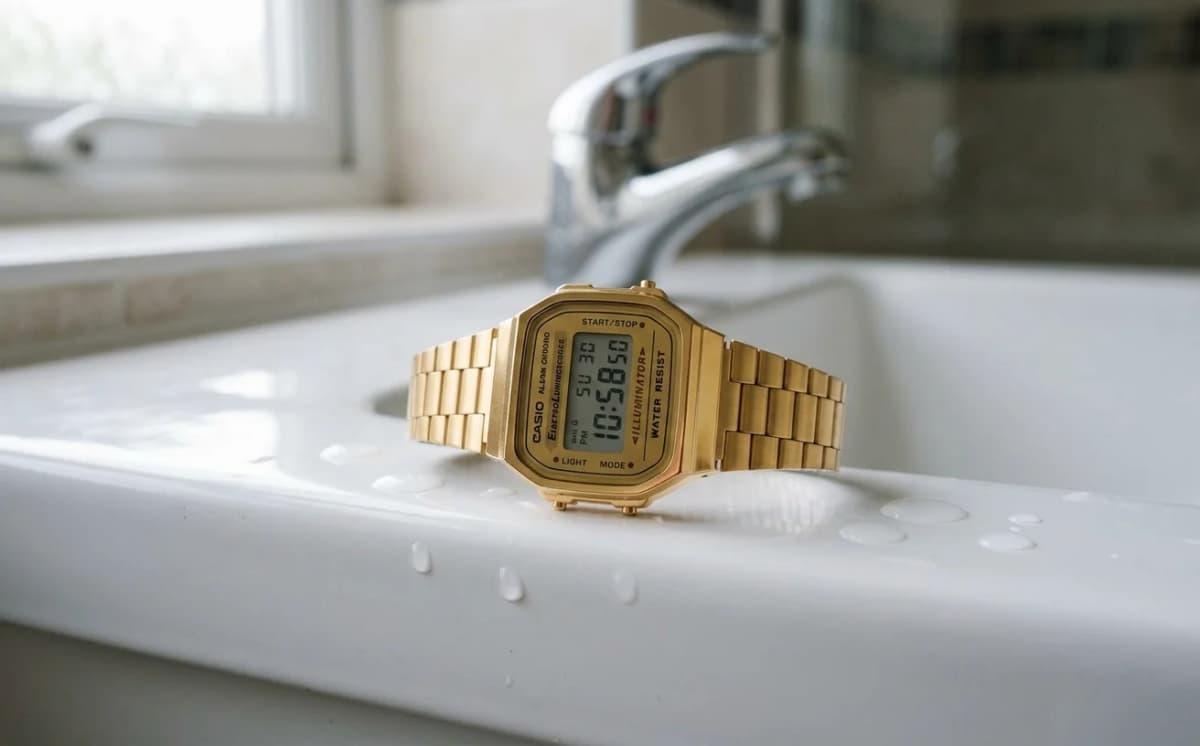
Every summer, it's the same story in my workshop: a gold vintage Casio arrives with condensation under the crystal, a display that no longer shows anything and an owner who doesn't understand. "It says Water Resist on it, I just went swimming with it." At Montres Outlet, the leading cause of service returns on vintage metal Casios (A158, A159, A168, LA670, LA680, A700) is precisely this: a swim with a watch that was never designed for immersion. In this guide, I explain what "Water Resist" really means on these models, why a single swimming session can put them out of service, and what that changes for your warranty.
Diagnosis in 5 seconds

"Water Resist" engraved on a Casio: what it means (and what it doesn't mean)
Let's start with the question everyone asks: are Casio watches waterproof? The honest answer is no, and vocabulary matters. The term "waterproof" (absolutely impermeable) has actually been forbidden in consumer watchmaking for decades, because no watch is impermeable under all circumstances. Manufacturers use "water resistant", a notion always accompanied by precise limits defined by the international ISO 22810 standard.
On a Casio water resistant watch from the vintage family (English-language catalogues write Casio water resistant), the engraving "WATER RESIST" appears alone, without mention of "5 BAR" or "10 BAR". In Casio's official classification, this mention alone designates the first level of protection: the watch withstands accidental splashes, a few raindrops and dust. The official manual for the 593 module (which equips the F-91W and A158) is explicit: hand washing and rain are tolerated, swimming and diving are excluded, and the buttons must never be pressed when the watch is wet.
On our product sheets, you will often see "30 M (3 ATM)" for these models. This is the pressure class rating declared for these cases, measured in the laboratory on a new, stationary watch, in static water at constant temperature. These 30 metres are not a depth of use: in real conditions, an arm movement is not the problem (dynamic pressure in water is ½ρv², roughly 0.5 bar at 10 m/s, far below the test pressures); the problem is immersion itself on a case with a clipped back and through-case buttons, designed for splashes, with seals that age (chlorine, salt, soap, temperature cycles). We detail this mechanism in our guide to water resistance ratings: ATM, bar and metres.
In other words: if you're looking for a water-resistant Casio to swim with, a vintage metal watch is never the right answer, whatever figure is displayed. And if you already own an A168 or LA670, the rule boils down to one sentence: it must never go underwater, neither immersed nor under a jet.
Why vintage metal Casios are so vulnerable to water
The design of these watches dates back to the 1980s, and that's precisely what gives them their charm. At Casio, vintage watch doesn't mean fragile watch: these cases have withstood daily shocks for forty years. Their only real weak point is water. The vintage Casio watch owes its slim silhouette to a case made of chrome-plated resin or thin steel, closed by a back simply clipped on (pressed onto a flat seal), not screwed down like on a diving watch. This type of closure provides a barrier against dust and drops, but it is not designed to withstand immersion, let alone repeated immersion.
Second weak point: the push buttons. An A168 or LA670 has two or three push buttons running through the sides of the case. Each button is a tunnel pierced through the case, made resistant to splashes by a micro-seal. Underwater, pressure acts directly on these tunnels; it only takes pressing a submerged button (to activate the light, for example) to open a direct passage to the module. This is the most common cause of water ingress I observe on Illuminator models.
Third factor, the most underestimated: the age of the design and the thinness of the seals. The seals on these cases are thin, and they dry out over time, even without contact with water. A watch fresh from the factory meets its rating class on test day; three or four years later, without seal replacement, the actual protection has already diminished. On a construction that starts at the "splashes only" level, the safety margin becomes zero.
Finally, the digital module itself is the most fragile component. A wet mechanical movement can sometimes be saved by quick disassembly; a digital electronic module penetrated by water (especially salt or chlorinated) undergoes near-immediate electrolysis between the contacts powered by the battery. The display goes out, segments become erratic, and oxidation eats away at the tracks within days. For more detail on the case and models, consult our complete guide to Casio watches.
Model by model: what your vintage Casio really tolerates
The table below covers the vintage metal references we sell most at Montres Outlet. Whether you wear a vintage Casio men's watch like the gold Casio A168, a vintage Casio women's watch like the LA670, a steel Casio A158 or the Casio F91W in resin (the F-91W, for the official spelling), you will notice one thing: regardless of the marking displayed, the swimming column is uniformly red. This is the data that technical sheets never show side by side.
| Model | Casio Module (manual) | Marking displayed | 🙌 Quick hand wash | 🌧️ Light rain | 🚿 Shower | 🏊 Swimming / pool / sea |
|---|---|---|---|---|---|---|
| F-91W (resin) | 593 | Water Resist | ✓ | ✓ | ✕ | ✕ |
| A158 / A159 | 593 | Water Resist / 30M | ✓ | ✓ | ✕ | ✕ |
| A168 (including Illuminator) | 1572 | Water Resist / 30M | ✓ | ✓ | ✕ | ✕ |
| LA670 (women's) | 3191 | Water Resist | ✓ | ✓ | ✕ | ✕ |
| LA680 (women's) | 3284 | Water Resist | ✓ | ✓ | ✕ | ✕ |
| A700 (ultra-thin) | 3468 | Water Resist | ✓ | ✓ | ✕ | ✕ |
| AQ-230 (analogue-digital) | 305 | Water Resist | ✓ | ✓ | ✕ | ✕ |
| B640 | 3294 | Water Resist | ✓ | ✓ | ✕ | ✕ |
A clarification on the "✓" for hand washing: it means a few drops splashed whilst washing your hands, watch on wrist, away from the jet. Deliberately running the watch under the tap to rinse it does not fall within this tolerance. And the A700, despite its 6.4 mm case praised for its thinness, is probably the most fragile of the lot: less thickness also means less material around the seals.
To put the scope of the issue in perspective in our catalogue: of the sixty or so Casio references currently in stock at Montres Outlet, more than two-thirds belong to this "splashes only" category. Casio watches truly capable of swimming (10 ATM and above) represent just a handful of references, mainly from sport and G-Shock ranges.
Swimming, shower, pool: the three scenarios that come back to customer service
It says Water Resist on it, I just went swimming with it. That's the sentence I hear most often in customer service, and every time the module is already oxidised.
Scenario 1: swimming. This is the most common case at Montres Outlet, with a very sharp peak in July-August. The wearer keeps their watch on to go in the sea or pool, often for less than thirty minutes. Water eventually gets past the clipped case back or the button tunnels (all the more so if a button is pressed underwater), in minimal but sufficient quantity, and the electronics begin to oxidise. Symptoms sometimes appear with a delay of several days: fogging in the morning, screen segments weakening, then black screen. In seawater, salt accelerates electrolysis and a watch not treated within 48 hours is generally unrecoverable.
Scenario 2: the shower. Many think a shower is less aggressive than swimming. The opposite is true for these watches: the direct jet projects water under pressure on the push buttons, hot water expands the case and seals differently, and steam infiltrates through the micro-spaces thus created. A daily shower with the watch on the wrist is a programmed failure in a few weeks or months.
Scenario 3: the chlorinated pool, even without swimming. Staying in the water up to the waist, watch on wrist, already exposes the case to immersion. Chlorine additionally attacks the seals and accelerates their drying out. A watch that has "survived" a few pool visits is not out of the woods: its seals are degraded, and failure occurs at the next exposure.
If your watch already shows fogging under the crystal, do not wait: our fogging and condensation guide details how to distinguish temporary condensation from a real water ingress.

Your Casio has taken in water: the actions that save within 24 hours
Here is the procedure I apply in the workshop and that I recommend to our customers who call after an unfortunate swim. Every hour counts, especially after contact with seawater.
- 1. Remove the watch from the water and do not press any button. Each press can allow more water to enter through the button tunnels.
- 2. Carefully dry the exterior with a soft, dry cloth, paying special attention around the buttons and case back.
- 3. If the watch has been in seawater or pool water, do not rinse it under the tap: you would be adding water to water. Just dry it.
- 4. Place the watch screen-side down in a dry, temperate location, never on a radiator or in the sun behind glass: heat damages the seals and the module.
- 5. Forget the bowl of rice. This smartphone remedy does not remove moisture from a sealed case and wastes the most precious hours.
- 6. Entrust the watch to a watchmaker within 24 to 48 hours for opening, battery removal, module drying and oxidation check. This is the only operation that truly stops the process.
Let's be transparent about the chances of success: on a digital module that has taken in fresh water and been treated the same day, rescue is often possible. After several days, or after seawater, replacing the module (when the part still exists) frequently costs more than the watch's value. That's the real reason why prevention is not excessive caution: it's the only economically rational scenario.

Underwater use: warranty no longer applies
This is the point we want to make crystal clear, because it generates confusion every summer: using a vintage Casio underwater effectively cancels your warranty cover for any resulting damage. Our 2-year commercial warranty covers manufacturing defects in the movement under normal use. However, swimming, showering or immersing a watch classified as "splash-only" does not constitute normal use: it is use contrary to Casio's explicit recommendations.
In practice, water seepage, condensation under the crystal, module oxidation and chain damage to the electronics are among the express exclusions from the warranty, as with virtually all watch warranties on the market. And this is not a theoretical clause difficult to establish: during expert inspection, water entry is immediately recognisable (green or white oxidation traces on the module, corrosion of battery contacts, halos under the crystal). Water damage cannot be confused with a manufacturing defect.
The same applies to the 14-day withdrawal period: it allows you to return a watch in its original condition. A watch that has been in water and returned with an oxidised module obviously does not fall within this scope. In summary: before any intentional contact with water, ask yourself just one question. Does my watch display 10 ATM or more? If the answer is no, it stays dry, and your warranty remains intact.
Adjusting your Casio "water resist" without taking risks
Many readers arrive here via searches for "Casio water resist watch adjustment" or "Casio water resist watch instructions". The full instruction manual depends on the module (the four-digit number engraved on the back, to be found in the table above), but the safety rule is universal: never adjust your watch with wet hands, in the rain or near water. Each button press compresses the micro-seal of the pusher; if there is water on the case at that moment, it can be drawn into the tunnel.
As a reminder, on most vintage modules (593, 1572, 3191): the button at the top left alternates modes (time, alarm, stopwatch), holding this same button in time mode opens adjustment, and the buttons on the right adjust the values that flash. On a Casio Illuminator water resist watch (the A168 is the most well-known example), the dedicated front or side button activates dial illumination: this is precisely the one you must never press with a wet case. If your display shows incomplete segments or no longer responds after contact with water, there's no point persisting with adjustments: the problem is not software, have the module inspected.
Changing the battery without destroying the remaining water resistance
The subject of the battery deserves a word, as it directly intersects with that of water ("change Casio vintage watch battery" is actually one of the most frequent searches on these models). To change the battery of a vintage Casio watch, you must unclip the caseback, remove the button cell (generally a CR2016 or CR1620 depending on the modules), then close by pressing the caseback onto its seal. Three pitfalls await the hastily performed operation:
- The original seal is reused as is. After years of compression, it has lost its elasticity: protection against splashes becomes unreliable.
- The caseback is closed misaligned. On a clipped caseback, a misalignment defect leaves an imperceptible gap.
- No test after closing. A watchmaker with the right equipment can verify case pressure resistance in dry conditions in a few minutes; without this check, you're flying blind.
Our recommendation is simple: have the battery replaced by a watchmaker, explicitly request replacement of the caseback seal, and consider that the watch remains in the "splash-only" category even after the operation. A battery change never transforms a vintage into a swimming watch.
Want to swim with your watch: good Casio alternatives
If you want a watch that goes with you in the water, the solution is not to "be careful" with your A168: it's to choose a model designed for immersion. Casio water-resistant watches do exist, but not in the vintage family: at Casio, water-resistant watch means screw-down caseback, oversized seals and rating clearly displayed. A true Casio water-resistant watch makes it clear on the dial: "10 BAR" or "20 BAR". The threshold to remember is this: 10 ATM for the swimming pool, the sea, light snorkelling and surface water sports; 20 ATM marked Diver's (ISO 6425) for scuba diving. We explain these levels in detail in our guide 10 ATM: pool, sea and snorkelling and our selection of water-resistant men's watches.
In water-resistant Casio men's watch, the 10 ATM analogue sport ranges do the job for swimming; in water-resistant Casio women's watch, it's the compact G-Shocks that fill this role. And for those who want an even sturdier case, this water aptitude is found mainly in G-Shock, whose 20 ATM screw-down caseback cases and protected crown are designed to withstand precisely what vintage watches cannot support. The idea is not to oppose the two families, but to use them for what they do best: the vintage metal for the city and the office, the G-Shock for the beach and the pool.
And if your heart remains with vintage (we understand), the right summer habit comes down to one rule: remove the watch before water and let it wait on the towel. Browse our Casio men's and Casio women's collections to see both families side by side.
Good habits
- Remove the watch before showering, bathing, swimming, sauna.
- Wipe the case with a dry cloth after a splash or shower.
- Have the case back seal replaced each time the battery is changed.
- Adjust the time only with a dry watch and dry hands.
- If water enters: battery removed by a watchmaker within 24 to 48 hours.
- For swimming: choose a model with 10 ATM minimum (20 ATM marked Diver's for scuba diving).
Never do this
- Bathe or swim with a vintage Casio, even "just five minutes".
- Run the watch under the tap to rinse or clean it.
- Press the buttons when the case is wet.
- Dry a wet watch on a radiator or in rice.
- Rely on the warranty after immersion: water damage is excluded.
- Believe that "30M" engraved means diving to 30 metres.
Choose the right Casio for the right use
Vintage metal for everyday style, sport and G-Shock 10 to 20 ATM for water: our two Casio families are in stock, dispatched within 24 to 48 hours. Free delivery to mainland France, subject to our terms, returns within 14 days, 2-year warranty (excluding water damage: we did warn you).
Frequently asked questions about vintage Casio water resistance
Can you swim with a vintage Casio watch (A168, A158, LA670)?
No, never. Vintage metal Casio watches such as the A168, A158, A159, LA670, LA680 or A700 are classified "Water Resist" without a high ATM rating: they tolerate only accidental splashes and dust. Bathing, even briefly and without active swimming, exposes the case to an immersion that the clipped case back and through-case buttons cannot withstand. This is the leading cause of failure in these models that we see in customer service, with a peak each summer. For bathing, you need a watch rated 10 ATM minimum, such as Casio sport models or G-Shock.
What does "Water Resist" engraved on a Casio mean?
"Water Resist" (or "water resistant") means resistant to water within precise limits, defined by ISO 22810 standard, and not waterproof. On vintage Casio watches, this marking appears alone, without "5 BAR" or "10 BAR": in Casio's classification, this is the lowest level of protection, covering accidental splashes, a few raindrops and quick hand washing. Official Casio instructions for these modules explicitly exclude swimming, diving and using the buttons on a wet watch. A waterproof Casio watch in the strict sense does not exist: the term "waterproof", which would suggest total impermeability, is no longer used by any serious manufacturer.
Condensation has appeared under the crystal of my Casio: what should I do?
Condensation signals that moisture has entered the case. Do not press the buttons any more, wipe the outside with a dry cloth, and above all do not try a radiator or a bowl of rice: heat damages the seals and rice removes nothing from a sealed case. Take the watch to a watchmaker within 24 to 48 hours for opening, battery removal and module drying: this is the only way to stop oxidation. Treated quickly after fresh water, a vintage Casio is often recoverable; after salt water or several days of waiting, the module is generally beyond repair. Our dedicated guide to condensation and fogging covers all scenarios.
Does the warranty cover a Casio that has taken in water?
No. Using a watch classified as "splashes only" underwater is use that does not comply with the manufacturer's recommendations: the resulting damage (infiltration, condensation, module oxidation, display failure) is excluded from the commercial warranty, just as water resistance is excluded from virtually all watch warranties. Expert examination identifies water entry unambiguously through oxidation traces on the module and battery contacts: water damage cannot pass as a manufacturing defect. Full details of what is covered and excluded appear on our warranty page.
Which Casio watch should I choose for swimming?
For bathing and snorkelling, choose a Casio rated 10 ATM minimum (100 metres theoretical): this is the threshold below which no manufacturer permits swimming. This threshold also covers regular swimming and surface water sports; scuba diving calls for a 20 ATM watch marked Diver's (ISO 6425). The 20 ATM G-Shocks go further in robustness: their screwed case back, oversized seals and shock-resistant construction are specifically designed for repeated immersion. Keep your vintage metal for the city and the office, and assign water to a model made for it: this is the safest and most economical division of roles over time.
Read next
More in this vein

Care & maintenance
Crystals and rhinestones falling from a watch: why, and how to protect them
Care & maintenance
Dust on a watch dial: how to remove it easily
Care & maintenance
Watch Water Resistance Ratings: ATM, Bar, Metres (Complete Guide)
Care & maintenance
10 ATM on a watch: everything you need to know (swimming pool, sea, snorkelling)
Care & maintenance
5 ATM on a watch: everything you need to know (shower, swimming pool, swimming)
Care & maintenance