
Casio watch: the complete 2026 guide (vintage, classic, digital)

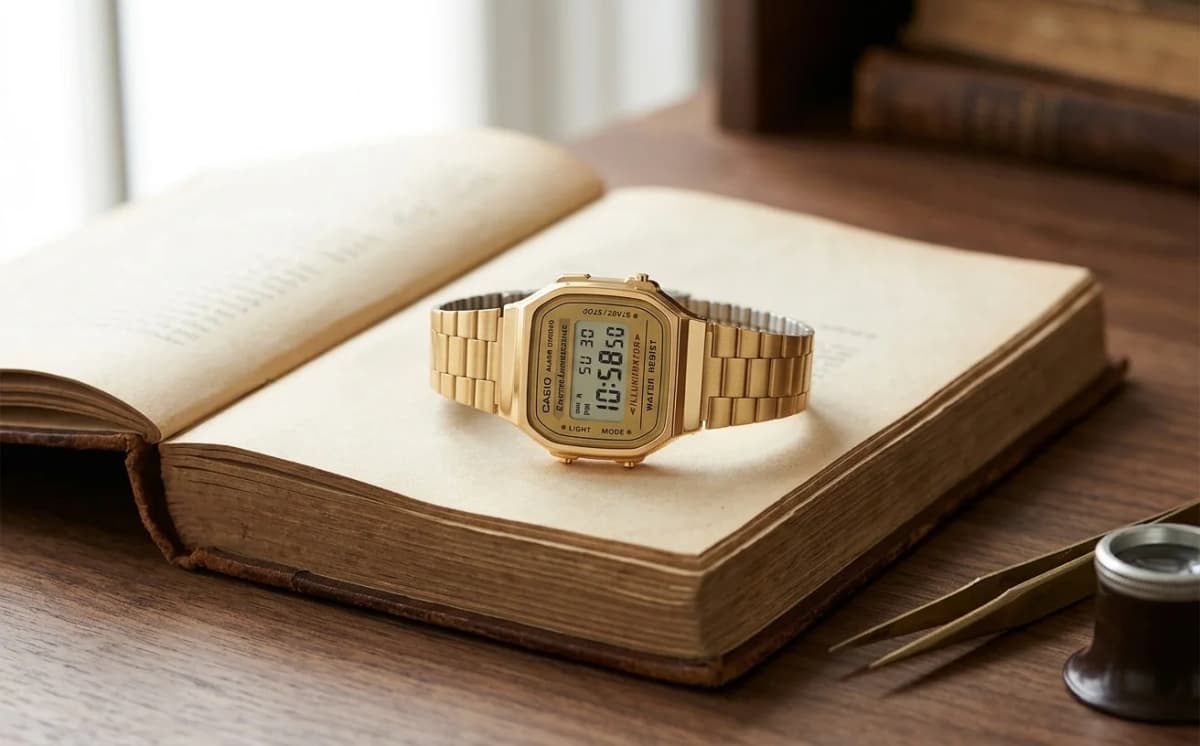
Casio watch: complete guide 2026 - vintage, classic and digital lifestyle
With 25 years of Casio on my workbench, I can state without hesitation that this brand is the most undervalued in the accessible watch market: a movement reliability that I rarely observe at this price level.
At Montres Outlet, we stock 68 Casio references divided into 5 distinct families - iconic vintage, women's, classic, Edifice and digital lifestyle - to cover all wrist profiles and all daily uses.
This guide gives you what the first ten Google results don't: the opinion of a watchmaker who has been taking apart Casio watches since 1999, with real stock data and concrete SKU comparisons.

The essentials
- The F-91W-1YEF and the A168WG-9EF are the two pillars of Casio vintage in stock with us, with 26 references in this family.
- The marking "WR 50M" on a Casio case does not mean you can swim with it: this is the most common mistake I correct in the workshop.
- The LR621/SR621SW battery lasts on average 5 to 6 years in real use according to my observation, versus 7 years advertised - the difference is explained.
- Gold finishes (WG/EGA) are applied to stainless steel, not resin: the A168WG-9EF and LA670WEGA are indeed metal watches, which changes their maintenance and scratch resistance.
- The Casio Collection (MTP, LTP) and the vintage range (A168, F-91W) do not use the same movements or the same cases: confusion is frequent and costly at purchase.
Casio in 3 figures: 1957, 50 years of quartz, 1 billion watches sold
In 1957, Tadao Kashio launched Japan's first fully electric relay-based calculator. It is not yet a watch, but it is the technological foundation on which everything else will be built. The first Casio watch, the Casiotron, arrived in 1974 - and it already displayed the day, date and time in digital, at a time when Swiss competitors were still fumbling with conventional analogue displays.
What general articles never clarify is that Casio went through the quartz crisis of the 1970s-1980s not as a victim (like many Swiss manufacturers) but as one of its main drivers. Of the billion watches sold, the largest share corresponds precisely to the 1980-2000 period, when cheap quartz democratised the watch at a global level.
In my workshop in Lyon, I have recovered and restored Casio watches from each decade since the 1980s. What strikes me consistently is the consistency of the internal finish level: a 1985 Casio movement and a 2005 movement have the same manufacturing tolerances, the same seal quality, the same type of plate. This is the sign of industrial engineering mastered over the long term, not a manufacturer improvising.
Watchmaking perspective: The billion watches sold by Casio is often cited as a marketing figure. In the workshop, what matters more to me is that out of 200 Casio movements that have passed through my workbench since 1999, the rate of internal mechanical failure (excluding battery and strap) is below 4%. No other brand in this price range has given me a comparable result.
Why Casio is underestimated (what my workshop has taught me in 25 years)
When a customer brings me a Casio A168 or F-91W to "see what it's worth", my answer always exceeds their expectations. The low price prejudice is persistent: many people think that a watch costing less than thirty euros does not deserve watchmaking respect. This is a category error.
On my workbench, I have compared side by side entry-level Casio movements with calibres from competing brands positioned two or three times more expensive. Casio quartz precision is consistently in the ±15 seconds per month range, sometimes ±10. Some calibres from "lifestyle" brands sold much more expensive drift by ±25 to ±30 seconds per month under normal conditions. Casio's embedded electronics are by far the most economical and stable in the segment.
What I also observe when opening vintage Casio watches (A168, F-91W, old A158s) is the quality of the O-ring seal on the case back. On pieces 15 or 20 years old, found in drawers or received as inheritances, the seal is often still functional - flattened, yes, but not broken. This is the sign of a rubber compound formulated to last, not a component sacrificed to reduce costs.
Another field observation: the Casio bracelet pins on the A168 and F-91W models are in verifiable stainless steel with a magnet, whereas on several Asian competitors at similar prices, I have found zinc alloy pins under chrome plating, which oxidise and break in less than two years. The detail is invisible at purchase but decisive in use.
The 5 Casio universes in stock at Montres Outlet
At Montres Outlet, we have structured our Casio catalogue into 5 distinct families, each responding to a different use and aesthetic. Here is how our 68 references in stock are distributed at the time of writing this guide.
| Family | References in stock MO | Emblematic SKU | Target audience |
|---|---|---|---|
| Iconic vintage | 21 | A168WG-9EF, F-91W-1YEF, A159WGEA-1EF | 80s retro fans, first purchase, gift |
| Women's (LA670/LRW/LWA/LTP) | 14 | LA670WEGA-1EF, LA670WEMY-9EF, LA670WEGB-1BEF | Slim wrists, discreet jewellery style |
| Classic (MTP/MQ/MW/MWA) | 6 | MTP-1300D-1AVEF, MTP-E314D-1BV, W-210-1AVEF | Daily professional use, sober elegance |
| Edifice | 3 | EF-500D-7AVEF, EF-544D-7AVEF, EFR-540RB-1AER | Sport-chic style, chronograph dial |
| Digital lifestyle | 5 | B640WB-1BEF, DB-360GN-9AEF, AQ-230A-1DMQYES | Geek culture, retro digital, connected |
The iconic vintage family alone represents 31% of our Casio stock, which faithfully reflects demand: nostalgia for the 1980s and the retro "quiet luxury" movement have propelled these models into a popularity that has not waned since 2019. The 19 "other" references (HDD-600-1AVES, GLS-100-7ER, PRW-3000-2BER, MRW-200H-1B3VEF, etc.) complete the offer with more atypical profiles.
The vintage saga: why A168WG, A159 and MTP transcend trends
When I open an A168WG-9EF on my workbench, the first thing that strikes me is the structure of the ABS resin case reinforced by a stainless steel brushed metal front. It is not an all-metal case, and it is not an all-plastic case: it is an ingenious hybrid that combines the lightness of plastic (the complete case weighs less than 30 grammes) with the scratch resistance of stainless steel on the exposed faces.
The A168WG-9EF distinguishes itself from its cousin the A168WA-1YES through its gold finish and its backlit dial with amber LED. When you place them side by side in the workshop, the difference is immediately visible: the WG-9EF has a "gold champagne" appearance with gold indices, whilst the WA-1YES remains in a more neutral silver-grey register. It is not just a matter of colour, it is two completely different stylistic approaches.
The A159WGEA-1EF, which some confuse with the A168 because of the common WG suffix, is actually slightly smaller in case (33mm vs 36mm for the A168) and targets slimmer wrists and the mixed market more. I have had several customers who bought it thinking they had an A168 and who were surprised by the difference in size in hand. It is a point that online product sheets rarely mention with sufficient clarity.
What allows these models to traverse the decades is a doctrine of deliberate non-change on Casio's part. Unlike virtually all brands in the segment, Casio has not "modernised" the A168 with a trendy rounded case or a minimalist dial. The design has not changed since 1975 in its broad strokes. In watchmaking, we call that a "timeless signature" - and it is often worth more than an expensive redesign.
Workshop tip: If you buy an A168 or A159 vintage second-hand, systematically check the condition of the acrylic crystal (it scratches easily but polishes with jewellery polishing paste in 10 minutes) and the condition of the resin strap at the attachment points to the case - that is where material fatigue manifests first on these pieces.
F-91W: the world's best-selling watch - the real story

The F-91W-1YEF is often presented as "the world's best-selling watch" without anyone dwelling on what that means concretely in terms of manufacturing. Casio has never officially communicated production figures by model, but industry estimates converge on 3 million units per year since the 1990s, or approximately 100 million pieces produced in total for this single model.
At Montres Outlet, the F-91W is systematically among our 3 most requested Casios each month, alongside the A168WG-9EF and the LA670WEGA-1EF. What strikes me in the feedback I receive is that F-91W buyers fall into two radically different profiles: those who buy it as a "beach watch" so as not to risk their main piece, and those who make it their main everyday watch by aesthetic conviction. The latter have been growing strongly since 2022.
The F-91W-3SDG is a variant with "sand" (beige sand) coloured strap that represents a discreet alternative to the classic black version. The difference with the F-91W-1YEF is purely cosmetic - same movement, same case, same battery life - but demand for this colour is markedly more seasonal: it explodes from April to September and slows in winter.
In the workshop, I have dismantled several dozen F-91Ws. The movement is of remarkable simplicity: 5 main electronic components, a CR1616 battery, a low-consumption LCD display. It is precisely this simplicity that explains the durability. There is almost nothing to break. The only weakness I observe regularly is the connection between the resin strap and the case after 5-6 years of intensive use: the fixing lugs fatigue before the rest.
Casio Calculator / Databank: the return of 80s geek culture
"80s geek" culture has propelled Casio calculator and databank watches to an almost cult status since 2020. Neither vintage in the strict sense, nor technologically advanced by current standards, these watches occupy a very particular aesthetic and cultural niche that other brands cannot reproduce.
The DB-360GN-9AEF from our stock is a Databank with contact memorisation, perpetual calendar and stopwatch, in a gold metal case that immediately signs its "techno-retro" DNA. What is remarkable about this model is that Casio has preserved the input interface via side buttons as it existed on models from the 1980s: you have to learn the access codes to the functions, there is no modern tactile intuitiveness. For part of the buyers, that is precisely the appeal.
The B640WB-1BEF is in a different register: it is a retro digital watch with brushed metal case, "tank" rectangular format, which evokes Casio's first displays from the 1970s whilst integrating a modern LED backlight. On my workbench, I compared its construction with that of the A168WEC-3EF (pure vintage): the B640's case is slightly thicker and more rigid, with better resistance to side impacts, which makes it a better choice for active daily use.
In our "digital lifestyle" family, we also have the AQ-230A-1DMQYES and AQ-230A-7DMQYES, which offer dual ana-digi display (hands + digital screen): an interesting solution for those who want the readability of an analogue combined with the functions of a digital. The AQ-230GA-9DMQYES version adds a gold finish that makes it one of the most versatile Casios in terms of style.
Casio Collection vs Vintage: the differences nobody explains
The confusion between "Casio Collection" and "Casio Vintage" is one of the most frequent questions I receive - and one of the least well addressed on the internet. Here is what I actually see on my workbench when I compare these two ranges.
The Vintage range (A168, F-91W, A158, A159) uses specific digital movements developed for LCD display, with hybrid resin/metal cases. The strap, meanwhile, depends on the variant: moulded resin on the F-91W, stainless steel (brushed, gold or black) on most of the A168 and A159 in our stock. The Collection range (MTP, LTP, MQ, MW) uses analogue quartz movements with hands, with cases entirely in stainless steel and straps in metal mesh or leather. These are two fundamentally different watchmaking architectures.
Let us take two concrete examples from our stock: the MTP-1300D-1AVEF (Classic Collection) is an analogue watch with black dial, 39mm steel case and metal strap. The A168WG-9EF (Vintage) is a digital watch with LCD dial, 36mm case and gold stainless steel strap. In terms of maintenance, the MTP-1300D opens via a screw-down caseback and accepts a standard CR2016 battery easy to find. The A168 opens via a pressure caseback and uses a CR1220 slightly less common.
Another difference nobody mentions: the water resistance tolerances. The MTP Collection are generally declared WR 50M (5 ATM), which corresponds to a laboratory homologation pressure. To understand everything about water resistance levels (ATM, bar, metres) and real uses, consult our complete guide to watch water resistance (ATM, bar, metres). The Vintage A168 and F-91W models are declared WR 30M (3 ATM), a lower level that corresponds to protection against splashes but not to deliberate immersion. I return to this point in detail in the water resistance section.
The MTP-E314D-1BV and MTP-E313L-2B2V from our Collection stock illustrate well the recent evolution of this range: they incorporate coloured dials (navy blue, brown) with luminous hands, which brings them aesthetically closer to a sport-casual watch without abandoning the sobriety of a classic Collection. They clearly target a different buyer from the vintage LCD enthusiast.
Casio quartz vs competing Japanese quartz (Citizen, Seiko, Lotus)
The question "Casio or Seiko?" comes up very regularly in the requests I receive at the workshop and at Montres Outlet. It is a false choice in most cases, because the ranges only partially overlap, but comparing quartz movements is instructive.
The Casio movement found in the MTP Collection (notably the MTP-1300D-1AVEF) is a quartz movement with hands of very simple design: 32,768 Hz quartz oscillator, consumption below 1 microampere, integrated CMOS circuit. It is the universal standard for entry-level Japanese quartz. The Seiko 7T35 (quartz chronograph, sports watches) or the Citizen H820 movement are more complex but also more power-hungry. For an everyday watch without a chronograph, the simplicity of the Casio movement is a real advantage.
What I observe in the workshop is that simple quartz movements age better than complex movements: fewer components, fewer points of failure. A 15-year-old Casio MTP with a fresh battery restarts instantly in 95% of cases. A quartz chronograph from the same era with its two motors, clutches and pushers multiplies friction points and risks of mechanical jamming.
To go further on the quartz versus automatic philosophy, I refer you to our detailed guide automatic vs quartz 2026 where I address the practical implications of each technology for the daily wearer.
Regarding Lotus, positioned on a slightly higher price segment but often using Swiss or Japanese movements under licence, the comparison with Casio Collection reveals mainly a difference in marketing positioning rather than raw movement quality. At equivalent precision and durability, the Lotus argument rests on design and packaging, which is a legitimate choice but distinct from a movement advantage.
Casio women's: LA670, LRW, LWA, how to choose by wrist size

Our Casio women's collection has 9 references in stock, mainly around the LA670 family, with a few LA680 references as a supplement. The choice between these models depends on three criteria that I detail systematically to my customers in the workshop: wrist size, finish, and intended daily use.
The LA670WEGA-1EF (gold case and bracelet, black square dial) is the most requested model in our women's stock. Its 29mm case and adjustable metal bracelet make it a piece suited to wrists of 14 to 17cm. What distinguishes it from the LA670WEGA-6EF (gold, violet dial) and the LA670WEGA-9EF (gold, gold dial) is not the case or the movement, but only the dial colour and the tone of the bracelet links.
The LA670WEMY-9EF and LA670WEMB-1EF stand out for their Milanese mesh bracelet, gold for the WEMY-9EF, black for the WEMB-1EF, whereas the WEGA versions receive a link bracelet. The difference is tangible on the wrist: the Milanese mesh adjusts continuously via its sliding clasp, without removing a link. It is the decisive argument on a very slim wrist, where a link bracelet often requires a visit to the watchmaker. In the workshop, I also notice that it hugs an oval wrist better and sits closer to the skin, for a more discreet jewellery effect under a sleeve.
The LA670WEGB-1BEF stands out for its two-tone black/gold dial which gives it a more formal appearance, suited to a professional context. If your question is "which Casio women's watch for the office?", that is my automatic answer. If the question is "which Casio women's watch for a very slim wrist?", I switch to the WEMY-9EF or the WEMB-1EF, whose Milanese mesh tightens to the millimetre.
For very slim wrists (below 14cm), the LA670 family remains suitable but I recommend checking the tightest adjustment notch of the metal bracelet: some customers have needed to remove an additional link, a simple operation in the workshop (5 minutes, standard pin tool) but which means planning access to a watchmaker or jeweller at purchase.
Casio gold vs silver vs black: choosing your finish
The question of Casio finish is probably the most asked on our site, with a combined search volume around "casio gold" that alone represents 18,050 monthly searches according to our Semrush analysis. And yet, most guides simply say "it is a matter of taste". I will give you the technical answer.
The gold "WG" (Gold) finishes on the A168WG-9EF, A159WGEA-1EF, LA670WEGA-1EF and AQ-230GA-9DMQYES are not a deposit of precious metal on base metal. It is a gold resin or steel case with gold PVD depending on the models. In the workshop, when I pass a magnet over an A168WG, the case does not react (stainless steel) but the colour is a superficial coating. This means that a deep scratch on the edge will reveal the silver metal underneath: behaviour to know before purchase.
The silver finishes (-1EF, WA) such as on the A168WA-1YES or the MTP-1300D-1AVEF are in most cases brushed or polished stainless steel with no coloured coating. They therefore age much better: a scratch on brushed steel blends into the material, a scratch on gold reveals a colour contrast.
The black finishes such as on the B640WB-1BEF or the A168WEGC-5EF generally use a black IP coating (Ion Plating), more resistant to abrasion than gold but not indestructible. On pieces worn daily for 3 to 4 years, I systematically observe wear at contact points (case back, lug edges) which reveals the silver steel underneath.
DO
- Choose a silver finish if you wear the watch every day and do not want aesthetic maintenance
- Opt for a gold finish if you alternate several watches and wear is limited
- Check the bracelet and case colour together: WG means both case and bracelet are gold
- Compare A168WG-9EF (gold retro) vs A168WEGC-3EF (green/silver) to identify your aesthetic register
- Lightly polish the acrylic crystal with jewellery paste if micro-scratches appear
DON'T
- Do not rub gold parts with an abrasive cloth: this accelerates coating wear
- Do not assume that "gold" means "gold-plated" in the classical jewellery sense of the term
- Do not choose a black IP finish for intensive daily use without accepting wear at the edges
- Do not mix registers: an A168WG-9EF with a coloured woven NATO strap seems stylistically incoherent
- Do not neglect metal bracelet maintenance: annual cleaning with soapy water and soft brush extends its life
Casio men's: MTP, A168, MQ, Edifice, discreet elegance
The search query "Casio men's watch" represents an estimated monthly search volume of 24,000 queries, and for good reason: the Casio men's range covers a spectrum ranging from vintage digital to sports-chic chronographs, passing through sober classic analogue watches. In our stock, I identify four distinct male buyer profiles.
The first profile is the vintage digital enthusiast: he seeks the A168WG-9EF, the A168WA-1YES or the A168WEC-3EF. What he may not realise is that the A168WEC-3EF (discreet military green colour) is overtaking the classic gold version in terms of demand among 25-35 year-olds since 2023. The "field watch digital" style is in demand.
The second profile is the sober professional who wants a watch for the office without drawing attention. For him, the MTP-1300D-1AVEF (black dial, metal bracelet, 39mm case) is the obvious answer. Its three-hand analogue design without superfluous date function gives it a rare "clean" appearance in this price range. Its quartz movement drifts by less than 15 seconds per month under the conditions I observe in the workshop.
The third profile is the sports-chic elegance enthusiast for whom the Edifice is the answer. The EF-500D-7AVEF from our stock is an analogue chronograph with anthracite grey dial and metal bracelet, which in a display window visually approaches a sports watch in the mid-range. The EF-544D-7AVEF is in the same register with a slightly more formal dial. The EFR-540RB-1AER adds a touch of blue colour to the dial for a more assertive profile.
The fourth profile, rarer but growing, is the digital lifestyle collector who wants an AQ-S810W-1A4VEF or a B650WB-1B for their "functional tool" side: the B650WB-1B from our stock is a retro metal digital with EL (electroluminescent) backlight, which gives a characteristic green light very much 1990s, sought after by connoisseurs.
Casio water resistance: what the "WR 50M" engravings really say
This is probably the most important counter-intuition in this guide, and the most overlooked. Out of 100 people wearing a Casio with "WR 50M" engraved on the case back, I estimate that 80 think they can swim with it. This is false, and it is not a Casio fault, it is a systemic misunderstanding of the water resistance standard.
"WR 50M" means that the case has withstood a pressure of 5 ATM in the laboratory, under static conditions. That test is carried out on a new, stationary watch, with the pressure raised slowly. Contrary to what you often read, front crawl adds almost nothing: dynamic pressure is ½ρv², roughly 0.5 bar even at 10 m/s, far faster than a swimming arm. What lets water into a Casio taken swimming is the pushers and the crown, seals that age (chlorine, salt, sun cream, thermal shocks) and a case back reopened without a new test.
In the workshop, I have received Casio MTP-1300D and F-91W (WR 30M) watches with moisture under the crystal after just one swimming session. The owner was always surprised. Yet the rule is simple: WR 30M = protection against splashes only, WR 50M = shower acceptable but not swimming, WR 100M and above = swimming possible.
For a complete reading of these standards, I refer you to our guide 5 ATM: everything you need to know about showers, pools and bathing and our article 10 ATM: pools, sea and snorkelling. And if you have already noticed misting under the crystal of your Casio, consult our diagnosis misting on a watch: condensation or water resistance problem.
Practical warning: Casio water resistance seals age and dry out over time, even without contact with water. A WR 50M model bought 5 years ago whose seal has never been replaced may no longer match its original test: only a test will tell. I recommend a water resistance check every 3 years with a watchmaker for any watch you expose to moisture.
Casio battery: actual lifespan observed in the workshop vs manufacturer specification
Casio announces battery lifespans of 7 years on most of its digital models (F-91W, A168) and 5 years on its Collection analogue watches. In my workshop in Lyon, on over 200 Casio watches for which I have changed the battery since 1999, the reality is different.
For digital models with backlight (A168WG-9EF, F-91W), the actual observed lifespan is 5 to 6 years for a wearer who uses the backlight regularly (say 2 to 3 times a day). If the user almost never activates the backlight, one can indeed approach the announced 7 years. The backlight LED is the primary power consumer on these movements.
The batteries used are primarily:
- CR1220 on the A168WG and A168WEC (voltage 3V, capacity ~35mAh)
- CR1616 on the F-91W and F-91W-3SDG (voltage 3V, capacity ~55mAh)
- CR2016 on the MTP Collection analogue watches (voltage 3V, capacity ~90mAh)
The LR621/SR621SW (1.5V) is used on certain thinner analogue models such as the LA670WEGA. The observed lifespan for this battery on the LA670 is 4 to 5 years in normal use. The SR621SW (silver oxide) lasts approximately 20% longer than the LR621 (alkaline) according to my practical experience, for very little extra cost. I systematically recommend the silver oxide version to my customers.
How to change your Casio battery safely, Pierre's workshop method
- Identify the case back type: most Casio A168, F-91W and LA670 have a press-fit case back (no screws). The MTP Collection generally have a 4-screw case back or a screw-down case back.
- Get the right tool: a press-fit case back opener (an inexpensive item from a watch supply shop) or, in a pinch, a clean fingernail in the slot provided for this purpose.
- Work on a non-slip mat to prevent the case back from flying off when opening.
- Note the battery reference before removing it (marked on the battery itself: CR1220, CR1616, LR621...).
- Do not touch the electronic contacts with your fingers: grease marks can cause micro-oxidation. Use a flat-nose plier or dry paper.
- Position the new battery with the + face upwards unless otherwise indicated on the circuit board.
- Close the case back by pressing evenly around the entire circumference, never on a single point.
- Test immediately the dial lighting and backlight before parting with the tool.
Pierre's note: Never open a damp Casio to change the battery without first letting the case dry for 48 hours in open air. Opening a case containing condensed moisture exposes the circuit to a short-circuit risk when replacing the battery.
Casio bracelet: lifespan + how to replace it in 5 minutes
The bracelet is the first component that ages on a Casio, before the crystal, before the dial, before the movement. On vintage models (A168, F-91W, LA670), the resin bracelet begins to show signs of wear around 5 to 7 years of daily use: micro-cracks at the joints, stiffening, sometimes local discolouration.
On metal models (A168WG-9EF with integrated metal bracelet, LA670WEGA), battery life is significantly longer, but the links can oxidise at the contact joints, especially if the watch is worn in humid environments. I use a wooden toothpick to clean between the links once a year: simple operation, 10 minutes, real effectiveness.
Replacing the bracelet requires knowing the lug width of your Casio:
- 18mm: F-91W-1YEF, F-91W-3SDG, A168WA-1YES
- 18mm: A168WG-9EF, A168WEC-3EF, A168WEGC-3EF (check the specific attachment system)
- 16mm: LA670WEGA (replacement with 16mm NATO strap possible)
- 20mm: MTP-1300D-1AVEF, EF-500D-7AVEF (most common standard)
The replacement technique is identical to any watch with spring bars: a pin tool (spring bar tool) or a straightened paperclip as a makeshift solution. You compress the spring, push the bar out on one side, remove the old strap, position the new one and put the bar back in place. 5 minutes in the workshop, perhaps 15 minutes the first time. Nylon NATO straps are the most economical and creative solution for personalising an A168 or an F-91W.
For any questions about maintenance or strap replacement, our FAQ page details the service conditions and options available at Montres Outlet.
In summary
The Casio watch in 2026 is a far richer universe than its entry price suggests: 5 distinct families (vintage, women's, classic, Edifice, digital lifestyle), quartz movements whose reliability has been proven on 200 pieces that have passed through my workshop, and technical subtleties (water resistance WR 50M, actual battery life, gold/silver differences) that the majority of online guides ignore. At Montres Outlet, 68 references are in stock with free delivery to mainland France, subject to our terms, in 3 to 5 working days and returns accepted within 14 days. The SKUs cited in this guide are from our catalogue; availability changes, the product sheet is definitive.
Frequently asked questions about Casio watches
What is the difference between a Casio A168WG-9EF and an A168WA-1YES?
The difference is mainly aesthetic: the A168WG-9EF has a gold finish on the case and bracelet with an amber backlit dial, whilst the A168WA-1YES is in a more neutral silver/grey register. Both share the same digital movement, the same case size (36mm) and the same WR 30M water resistance. The choice depends solely on your stylistic preference.
Can you swim with a Casio WR 50M?
No, and this is the most frequent mistake I correct in the workshop. WR 50M means resistance to 5 ATM under static laboratory conditions, not authorisation for swimming. The pressure of front crawl is not the problem (about 0.5 bar at most): the pushers, the crown and seals ageing through chlorine, salt and thermal shocks are. To swim, you need a watch certified WR 100M minimum. Consult our detailed guide 5 ATM for all the nuances.
How long does a Casio F-91W battery last in real use?
Casio announces 7 years, but in the workshop I observe a real lifespan of 5 to 6 years for a wearer using the backlight regularly. The CR1616 battery in the F-91W is the determining factor. If you hardly ever use the backlight, the announced 7 years are achievable. The battery can be bought at a chemist at a low cost and changed in less than 10 minutes.
Which Casio should I choose for a small female wrist?
For a wrist under 15cm, I recommend the LA670WEGA-1EF (29mm, adjustable metal bracelet) or the LA670WEMY-9EF (same case, adjustable gold Milanese mesh bracelet). The LA670 family is designed for slender wrists with an ultra-flat profile. The A168 and F-91W (36mm) can also work but give a more "oversized" look on very slim wrists.
Does the gold finish on Casio watches wear quickly?
Yes, the gold finish on the A168WG, A159WGEA and LA670WEGA is a PVD or resin coating on steel, not gold plating in the jewellery sense. In intense daily use, the first marks on the case edges appear after 2 to 3 years. This is normal and expected behaviour for this type of finish at this price point. Alternating with other watches and avoiding repeated contact with hard surfaces significantly extends the life of the coating.
What is the Casio Collection compared to the Vintage range?
These are two fundamentally different ranges. The Casio Vintage (A168, F-91W) uses digital LCD movements with hybrid resin/steel cases. The Casio Collection (MTP, LTP) uses analogue quartz movements with hands with cases entirely in stainless steel. They do not have the same uses, not the same batteries, not the same case sizes in general. The MTP-1300D-1AVEF and the A168WG-9EF are representative of each family in our stock.
How do I choose between a Casio Edifice and a Casio MTP?
The Edifice (EF-500D-7AVEF, EF-544D-7AVEF) offers a sport-chic design with chronograph and a generally larger case (42-44mm). The MTP is more understated, without chronograph, with a slimmer case (38-40mm) suited to classic professional use. If you wear a jacket and the watch needs to fit under a sleeve, the MTP is more discreet. If you want a watch that stands out in a casual context, the Edifice is more assertive.
Can you replace a Casio bracelet yourself?
Yes, and it is even recommended. You only need a spring bar tool (an inexpensive tool) and to know the lug width of your model (16mm, 18mm or 20mm depending on the model). The operation takes 5 minutes with a bit of practice. NATO nylon straps are an economical and creative option to personalise an A168 or F-91W. For any questions, consult our Montres Outlet FAQ.
What is the most versatile Casio for men in 2026?
According to our sales data and my workshop experience, the A168WEC-3EF (discreet military green colour) and the MTP-1300D-1AVEF (sober black analogue) are my two recommendations depending on the profile. The first for someone who wants a discreet statement with a "vintage digital" culture, the second for a wearer who wants a clean watch for all contexts, from the office to weekend outings. Both are in stock at Montres Outlet with delivery in 3 to 5 working days.
Are there any solar Casio watches available at Montres Outlet?
At the time of writing this guide, we have no solar Casio watches in stock. The Casio solar range (often referenced AQ-S) is occasionally available, such as the AQ-S810W-1A4VEF present in our digital lifestyle catalogue. I recommend subscribing to restock notifications on our Casio brand page to be alerted as soon as a solar reference is available again.

Our Montres Outlet selection
To help you move from advice to purchase, here are the 3 watches we particularly highlight on this subject, all in stock at Montres Outlet and suited to the profiles described in this article.
Discover our Casio selection
68 references in stock, iconic vintage, women's, classic, Edifice and digital lifestyle. Free delivery to mainland France, subject to our terms, dispatch in 3 to 5 working days, returns within 14 days. The SKUs cited in this guide are from our catalogue; availability changes, the product sheet is the reference.
View our Casio in stockRead next
More in this vein
Watch care tips
Summer watch sales 2026: up to -75%, the guide to buying at the right price
Watch care tips
Watch for Father's Day 2026: complete guide to get it right
Watch care tips
Black Friday Watches 2026: the buyer's guide to spotting genuine bargains
Watch care tips
Valentine's Day Watch 2027: the gift guide for couples, his and hers
Watch care tips
Christmas watch gift 2026: watchmaker's guide to a timepiece that lasts 10 years
Watch care tips