
Crystals and rhinestones falling from a watch: why, and how to protect them

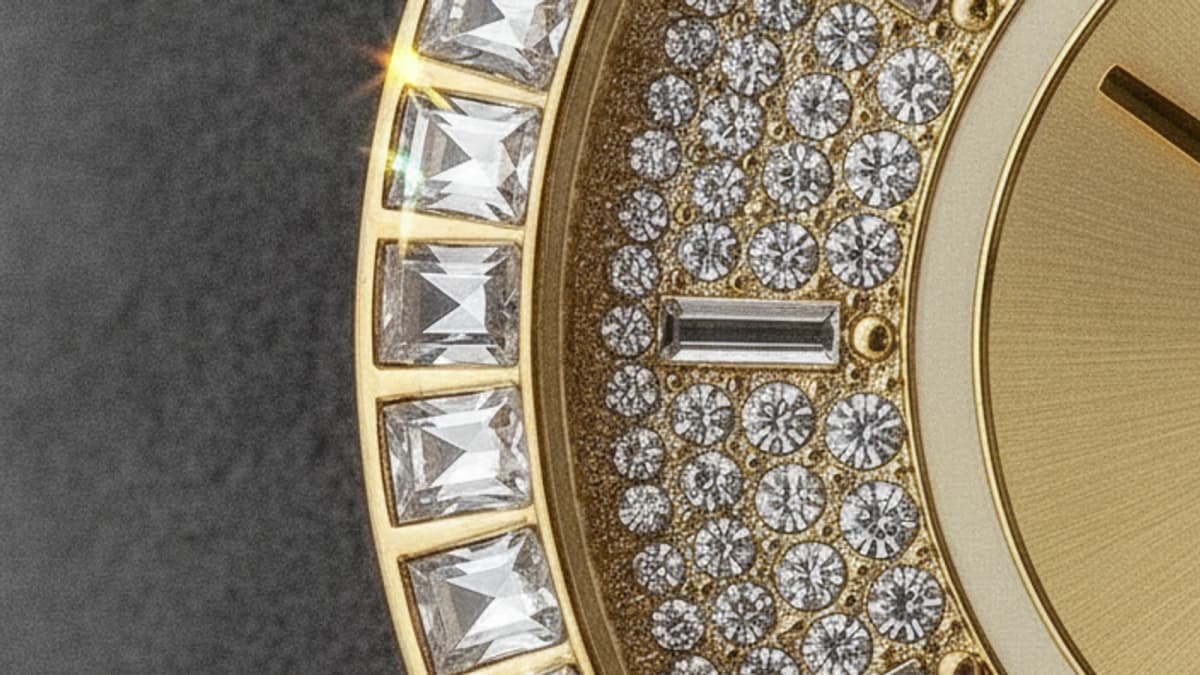
A stone is missing. Just one, on the bezel or around the dial, and the eye sees nothing else. It's the question that comes up most often with our customer service team on set watches, and the honest answer comes in two parts: it's almost never a manufacturing defect, and it's never covered by warranty, at any brand. The good news is that the loss of a watch crystal is very largely avoidable, provided you understand what actually holds these stones in place and adopt three or four simple habits. I'm a gemmologist, I spent twelve years in a shop re-gluing, reassuring and sometimes refusing, and here's what I tell my customers.
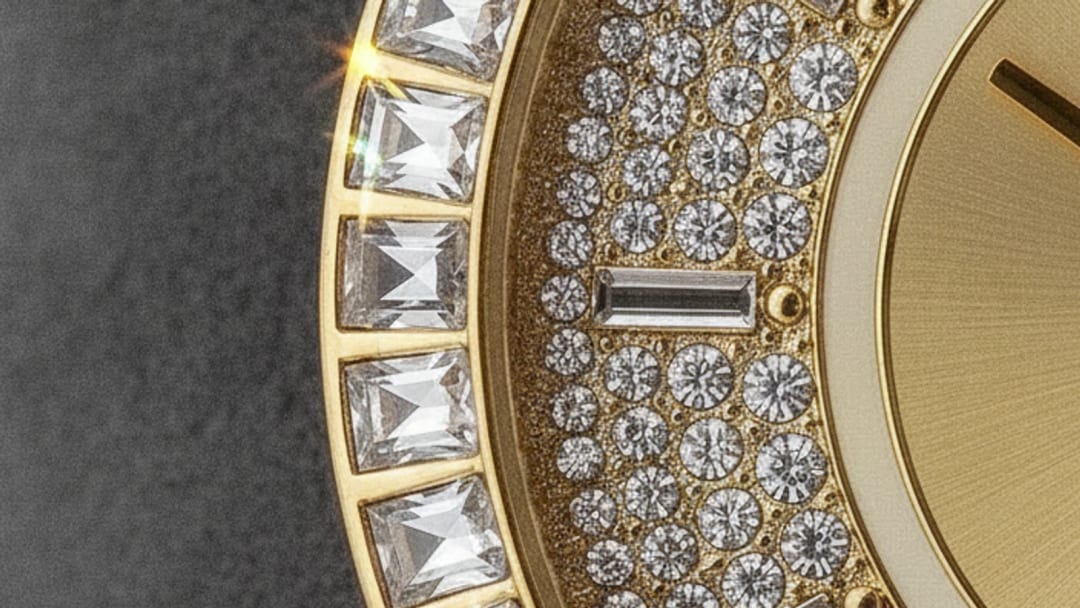
Where are your stones? The answer changes everything
What glitters on your watch is almost never a diamond
Let's start with the point that rankles, because it determines all the decisions that follow. On watches in the accessible market, the stones belong to three families, and the third is rare.
Cut glass crystal. It's the most common. Glass with a high oxide content, cut with facets, often backed on the reverse with a thin reflective metallic layer that multiplies the sparkle tenfold. This backing layer is also its Achilles heel: as soon as moisture gets underneath, it oxidises and the stone turns grey, without having fallen at all.
Zirconium oxide, which everyone calls zircon. Harder than glass, closer to diamond to the eye, it scratches far less. It's what you find on the most carefully finished dial pavés.
True diamond, finally, in the form of very small fragments on a few high-end models. It is then counted in fractions of a carat, and the product sheet always mentions it explicitly, because it's a selling point. If it's not written, it isn't.
What our own catalogue says
To give figures that don't come out of a brochure, we counted. Of the 3,944 watches currently in stock with us, 206 have set stones, or just over one in twenty. Their profile is remarkably uniform.
| Characteristic | Share of 206 set watches in stock | What this implies |
|---|---|---|
| Women's watches | 89 % | Setting remains a marker of the women's segment |
| Stainless steel bracelet | 85 % | The setting metal is therefore steel, gilt or not |
| Water resistance of 3 ATM or less | 47 % | Splash resistance, nothing more |
| Water resistance of 5 ATM | 41 % | Hand washing and rain, not repeated showers |
| Quartz movement | 98 % | No regular case opening |
| Mineral crystal | 83 % | The crystal scratches before the stone gives way |
Two figures deserve attention. Eight set watches in ten have a bracelet and case in steel, which brings us directly to the heart of the matter. And 88 % are rated at 5 ATM or less, in other words none is designed for water use, which we detail in our guide to water resistance ratings ATM.
Why a stone holds less well on steel than on gold
It's the explanation that nobody gives, and yet it's the one that makes everything else obvious. Setting, whatever its form, rests on a single principle: deform metal so that it comes to grip the stone and imprison it. Everything therefore depends on how this metal deforms.
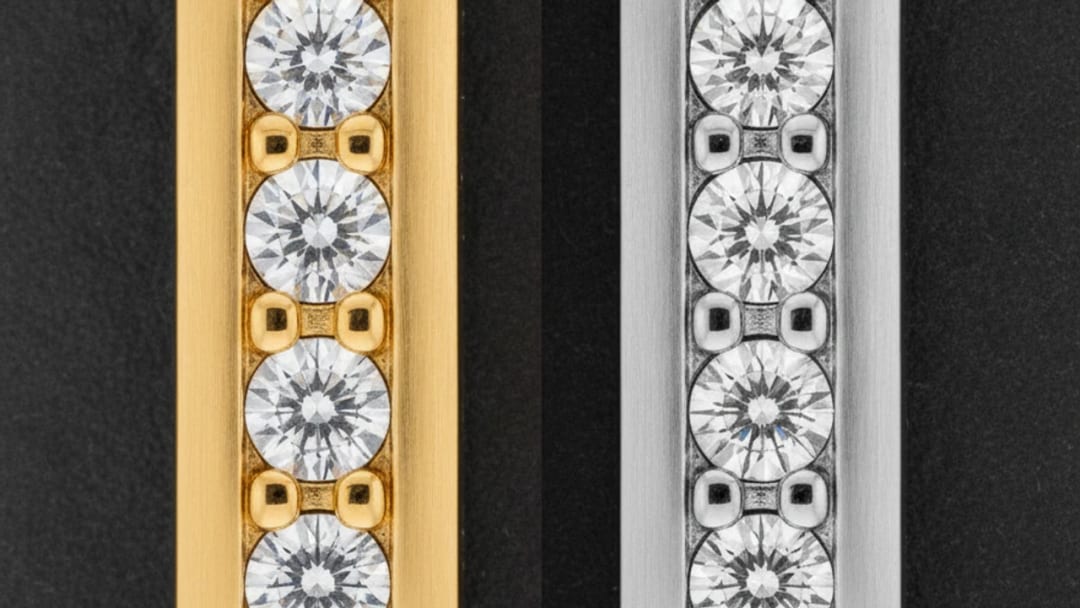
Gold and silver are soft metals. Under the setter's burin, the material flows, allows itself to be pushed back into a small rounded grain over the edge of the stone, and it stays where you pushed it. The setter can go back to it, retake a claw, tighten it by a tenth. It's a metal that forgives.
Stainless steel, on the other hand, resists and takes its revenge. It is considerably more rigid, it work-hardens, that is to say it hardens as it is deformed, and it retains a degree of elastic recovery: the grain that has just been pressed down onto the stone springs back very slightly once the tool is removed. This almost nothing, a few hundredths of a millimetre, is enough to leave a microscopic gap between the stone and its setting. And a microscopic gap, on a wrist that moves ten thousand times a day, becomes a proper gap.
| Gold, silver, soft metals | Stainless steel | |
|---|---|---|
| Behaviour under the tool | Flows and stays in place | Hardens, resists, springs back slightly |
| Technique used | Hand setting: grain, claws, closed | Pressed setting in series, or adhesive |
| Can it be repaired? | Yes, a jeweller can tighten a claw | Rarely, the steel breaks before it bends |
| Consequence for you | A stone that moves can be caught | A stone that moves eventually falls out |
Industrial consequence, and this is where it all comes down to: on a steel watch produced in tens of thousands of units, nobody sets stones by hand. The stones are placed by machine in stamped settings, held in place by calibrated mechanical pressing, and a significant proportion of them is simply glued, with adhesive applied by micro-dosing. A well-adjusted pressed setting holds very well. Gluing also holds, as long as the adhesive has not encountered hot water, soap or solvent.
You already grasp the issue: your set-stone watch does not have a quality problem, it has an exposure problem. And exposure depends entirely on you.
The six real reasons a crystal falls out
In twelve years behind the counter, I have never seen a stone fall out on its own on a new watch that was worn properly. There is always a cause, and it belongs to this list.
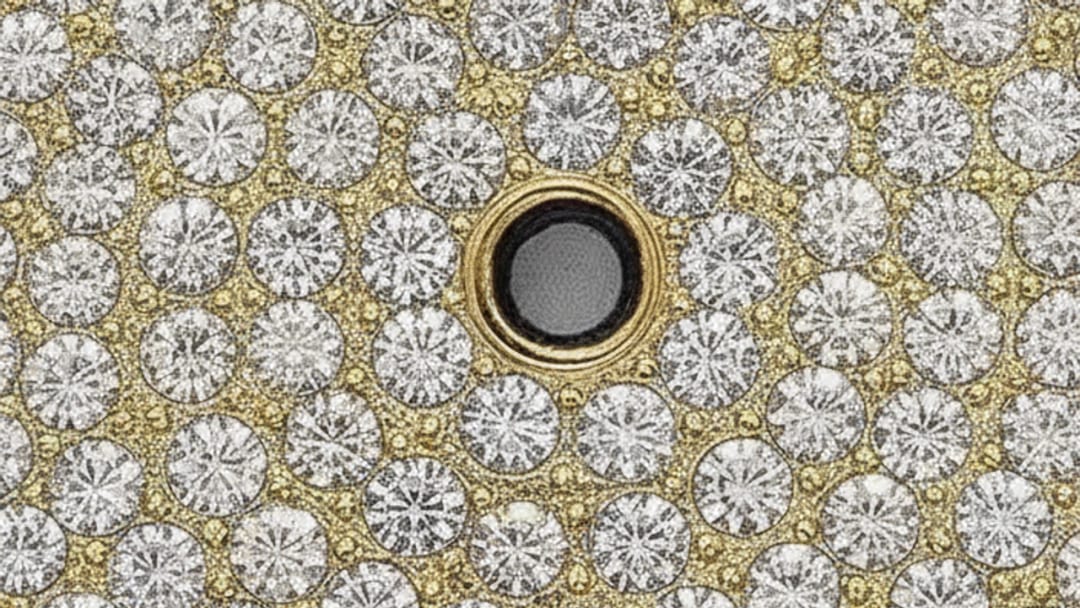
1. Impact, and it is almost always unnoticed. A door frame, a desk corner, the car door. The stone takes the hit first because it protrudes. The grain holding it opens just a fraction, it develops play, and it will fall out three weeks later when putting on a coat. The person then searches for what they did that day, and finds nothing: the real culprit is long gone.
2. Water, soap and anything that foams. The crucial point, and the most misunderstood. A watch rated at 5 ATM does not take water in the shower, that is true. But the water resistance rating qualifies the water resistance of the case, measured in static pressure, and it says absolutely nothing about the setting, which is on the outside. Shower gel, shampoo and liquid soap are alkaline surfactants: they seep by capillarity into the gap surrounding each stone, attack the adhesive, and leave behind a residue when drying that pushes the stone upwards. Add pool chlorine or sea salt, and the process accelerates. Our 5 ATM guide allows an occasional lukewarm shower for a classic watch. For a set-stone watch, the answer is no, quite simply.
3. Temperature cycles. Metal, crystal and adhesive do not expand at the same rate. A hot shower followed by a cold rinse, a hand washed in scalding water, a summer car left in the sun: each cycle stresses the interface between the stone and its setting. In isolation, it does nothing. Repeated twice a day for a year, it fatigues the adhesive just as you break a wire by bending it repeatedly.
4. The ultrasonic bath. The great destroyer, and unfortunately a frequent gift. These small cleaning baths implode micro bubbles at the surface of the object: it is devastatingly effective on grime, and equally effective on a glued stone, which it dislodges in minutes. On a crystal with a foil backing, it also detaches the reflective layer. A set-stone watch never goes in an ultrasonic bath, not even on "gentle mode", not even for thirty seconds.
5. Cosmetics and alcohol-based gels. Perfume, hairspray, sunscreen, hand sanitiser: all contain alcohol or solvents that soften adhesives and dull crystals. The gesture of perfume sprayed on the wrist with the watch on is the most damaging of all because it is daily.
6. Slow abrasion. A jumper sleeve, the edge of a keyboard, a bag strap. The metal grains holding a stone measure a few tenths of a millimetre. They wear away. This is the only truly unavoidable cause, and it is also the slowest: it is measured in years, not months.
Protecting crystals with clear varnish, step by step
Here is the method everyone talks about without ever explaining how to do it properly. It has been used since time immemorial on costume jewellery, and it works. You just need to understand what it does: clear nail varnish is a lacquer in solution in a solvent. Applied at the edge of the metal, it is drawn by capillarity into the gap surrounding the stone, then the solvent evaporates and leaves a continuous film that adds mechanical retention and, above all, that seals the entry point for water and soap.
Choosing the right varnish
Use a clear varnish, or better still a top coat, which dries harder and yellows less. Avoid anything coloured, pearlescent or glittery: particles lodge between the stones and never come out again. Also avoid gel or semi-permanent varnishes, which require a UV lamp and form a layer that is far too thick. A recent bottle is preferable: old, thickened varnish will not penetrate into the gap, it will form a ball on the surface.
Clean and dry the watch thoroughly
This is the step everyone skips, and it is the most important. Anything remaining under the stone at the moment of varnishing stays trapped there for good: sebum, dust, soap residue. Use a dry microfibre cloth, then a cotton bud barely dampened on the metal only, never by soaking. Insist on the perimeter of each stone with a soft, dry brush. Then leave the watch to dry flat, in the open air, for at least two hours. If your watch has dust under the crystal, that is another matter and it is dealt with beforehand, we explain it in our guide to dust on a dial.
Use the right tool, never the brush from the bottle
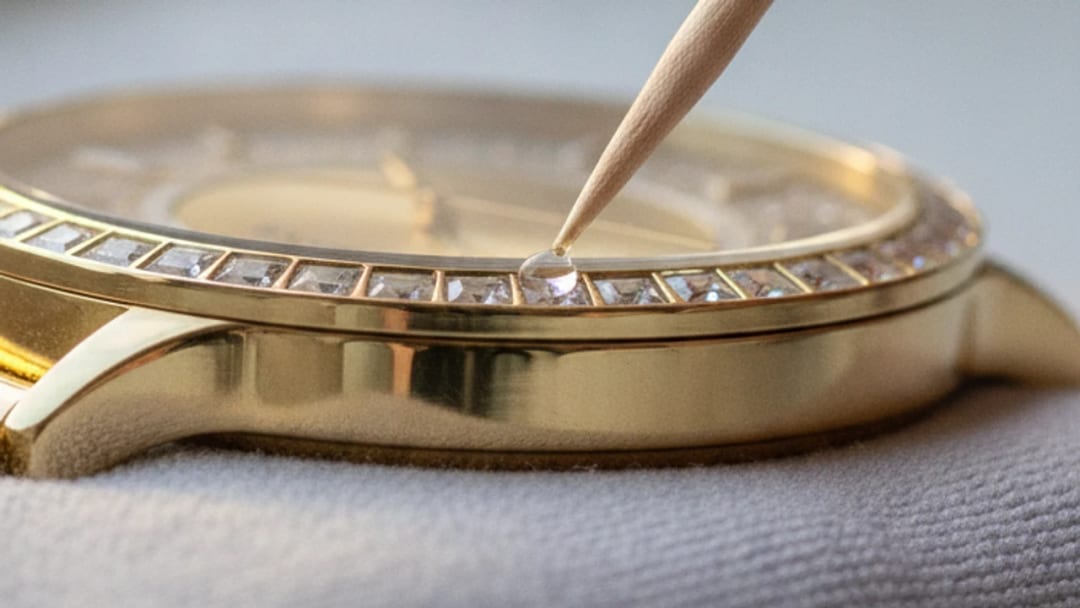
The brush supplied in the bottle deposits twenty times too much product. Pour a drop of varnish onto a saucer or a piece of aluminium, and work with the tip of a wooden toothpick, a needle, or a very fine retouching brush. The aim is a barely visible drop, the size of a pinhead, no more.
Apply at the metal edge, never on the stone
Place the watch flat, dial facing up, on a cloth. Bring the tip to the joint between the stone and the metal, and let the drop be drawn into the gap. It should disappear almost instantly: if it remains as a ball on the surface, you have applied too much, wipe immediately with a cotton bud before drying. Never cover the table of the stone, the upper face: the film would be visible there, it would dull the shine and yellow over time.
Areas never to touch: the watch crystal, the dial, the crown and its tube, the pushers, the case back and anything near a water resistance seal. Varnish that runs into the crown tube hardens and blocks the time adjustment. Mask the crown with a small piece of masking tape if it is close to the stones.
Leave to dry flat, without wearing the watch
Allow one hour before handling, and twenty-four hours before wearing the watch. Varnish is dry to the touch long before it is hard at the core, and a film that is not fully polymerised will tear at the first brush of a sleeve. Leave the watch flat, dial facing up, at room temperature, away from dust. Do not blow on it to speed up drying, the moisture from your breath will whiten the lacquer.
Repeat two to four times a year
The film is not permanent. It wears away through friction, and it is dissolved by acetone, alcohol from hand sanitiser gels and certain perfumes. Allow three to six months depending on your usage, and systematically repeat the operation after contact with a solvent. A quick wipe with a cloth is enough to prepare for reapplication, it is not necessary to remove the old film.
What you must never do
Half of the watches I have seen arrive damaged were damaged by an attempted rescue, not by the original accident.
Do
- A clear varnish in a very thin film, at the metal edge
- A micro dose of two-part epoxy glue, if you must replace an isolated stone and you have a steady hand
- Entrust an open setting or a missing stone to a jeweller, who will replace and tighten it
- Clean dry, with a microfibre cloth and soft brush
- Photograph the watch on receipt, pavé included, before first wear
Never do
- Cyanoacrylate glue, known as super glue or strong glue: its vapours whiten the crystal and stones irreversibly, and it spreads everywhere by capillarity
- The ultrasonic bath, under no circumstances and at no power setting
- Acetone or solvent on the watch: it attacks the setting adhesive, plastics and plating
- Soak the watch, even for a few seconds, even in clear water
- Press on a stone to "reset" it: you will open the grain further
- Polishing paste on a pavé, which becomes embedded between the stones and dulls them permanently
One more word about super glue, because it is the number one reflex. Cyanoacrylate releases vapours as it polymerises, which deposit on all the cold, shiny surfaces nearby, and veil them with a milky white haze. On your watch crystal and on the neighbouring stones, this veil does not disappear. This is the mechanism used in forensic science to reveal fingerprints: very effective, and entirely undesirable here.
As for polishing paste, it has its place on a smooth steel case and nowhere else on a set watch. We detail what it actually removes in our guide to polishing paste and in the complete guide to polishing by crystal and metal type.
No warranty covers the loss of a stone
This is the point on which I prefer to be unpleasantly clear rather than pleasantly vague, because it is the one that creates the most disappointment.
No watch manufacturer guarantees set stones. Not Guess, not Michael Kors, not Fossil, not Swarovski, nor any of the brands we distribute. Their warranty booklets cover manufacturing defects in the movement under normal use, and specifically exclude the strap, crystal, case, dial, hands, crown, clasp, water resistance, shocks and wear. Rhinestones and decorative stones belong to this second list. Our own 24-month warranty follows exactly this scope, and states it in black and white: the loss, detachment or dulling of a rhinestone, stone or set index is not covered, regardless of how long ago the purchase was made.
The reason is not commercial, it is logical. A set stone is an element exposed permanently to friction, to the shocks of daily life and to cosmetics. Its condition depends directly on the conditions of wear, and no seller or manufacturer can know, six months later, whether the watch spent the summer at the swimming pool or in a drawer.
In other words: beyond the first few days, the preservation of the stones is in your hands, and only in your hands. It is frustrating to read, and that is precisely why this article exists. Ten minutes of varnish and four habits are worth more than any claim.
A stone has fallen: what to do in the hour that follows
The useful reflex is not to find someone to blame, it is to prevent the second one from falling.
- Remove the watch immediately. A stone gone means that its neighbours have been working under the same conditions. Each additional day of wear causes more to fall.
- Search for the stone. It is found more often than you might think: in the links of the bracelet, in a sleeve cuff, in the sheets, at the bottom of a bag. A recovered original stone saves the jeweller a lot of time, because the difficulty is not in gluing it back, it is in finding the same diameter and size.
- Take photographs. An overall view and a macro of the empty setting. If the watch is recent, this is the essential piece of any exchange with the seller.
- Contact the seller if the purchase is recent, keeping in mind the framework set out above. Our after-sales service will respond and guide you, even when the answer is that it is a paid service.
- Otherwise, head to the jeweller. Resetting a single stone is a common and quick task for an equipped professional. What costs is replacement with an identical stone when the stone is lost, and the operation becomes tricky if the setting is deformed.
- Have the others sealed while you are there. Whether by the jeweller or by yourself, the day a stone falls is the right day to protect all the others.
A particular case deserves to be mentioned: a stone that comes loose on the dial, under the crystal. It cannot come out of the watch, so it moves around inside, on the dial, and it scratches. Do not shake the watch, lay it flat, dial facing up, and have it opened in the workshop. Opening a case also compromises its water resistance until the gaskets are replaced, which we explain in relation to misting in a watch.
The gestures that make a set-stone watch last
Nothing demanding, and the effect is spectacular. These are the same rules as for a piece of jewellery, applied to an object that tends to be treated as a technical accessory.
- Last thing on, first thing off. The watch goes on after perfume, cream and hairspray, and comes off before everything else. This single rule eliminates half of the chemical causes.
- Never water, regardless of the water resistance rating. No shower, no swimming pool, no sea, no sauna, no hammam, no washing up. The rating qualifies the case, not the setting.
- Never sport, DIY or gardening. Repeated low-intensity impacts open the claws as surely as a major impact.
- Remove the watch for sleeping. A night of sheets catches the claws more effectively than a day at the office.
- Dry cleaning only. Microfibre cloth, soft brush, cotton bud barely damp on the metal. Never soak, never ultrasonic.
- Storage flat and isolated. In a box or pouch, alone, never loose in a drawer with other jewellery that will scratch it. See our watch box guide and that of travel pouches.
- A properly adjusted bracelet. A watch that floats swings and knocks. If you have a Milanese mesh, our adjustment method takes five minutes.
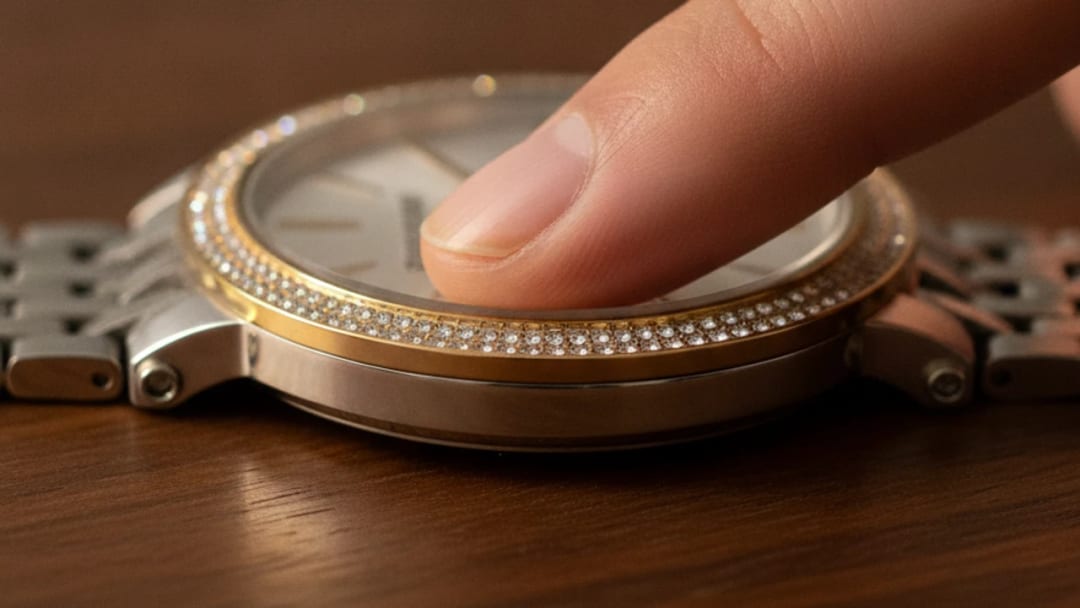
- The monthly fingernail check. Run your fingernail flat over the stone bed, without pressing. A stone that catches or clicks has come loose. Also listen to the watch near your ear by tilting it gently: a small rattling sound signals a stone already loose inside.
You are looking for a set-stone watch that lasts
All our set-stone watches come with a 24-month warranty on the movement, and this guide in the box, literally: our advisers send it with each relevant order.
Frequently asked questions
Does clear nail varnish damage the watch?
Can I use strong glue instead of varnish?
My watch is 5 ATM, can I still wear it in the shower?
Are the crystals on my watch real diamonds?
Is the loss of a rhinestone covered by the warranty?
Can a fallen stone be replaced with an identical one?
A stone-set watch is not a fragile object, it is an exposed object. The difference is enormous: fragility is something you suffer, exposure is something you manage. Ten minutes of varnish twice a year, a monthly check with your fingernail and the rule of last on, first off are enough to make a pavé of crystals last well beyond what most people imagine. To choose your next piece with full knowledge of the facts, our guides Michael Kors women's watches and Guess watches detail the stone-set collections of each brand, and our guide to the ceremonial watch addresses the subject from the angle of the occasion.
Read next
More in this vein
Care & maintenance
Casio Water Resist: is your vintage watch water resistant? (A158, A168, LA670)
Care & maintenance
Dust on a watch dial: how to remove it easily
Care & maintenance
Watch Water Resistance Ratings: ATM, Bar, Metres (Complete Guide)
Care & maintenance
10 ATM on a watch: everything you need to know (swimming pool, sea, snorkelling)
Care & maintenance
5 ATM on a watch: everything you need to know (shower, swimming pool, swimming)
Care & maintenance