
How to Change a Watch Battery: a Watchmaker's Method, and the Step Almost Everyone Forgets

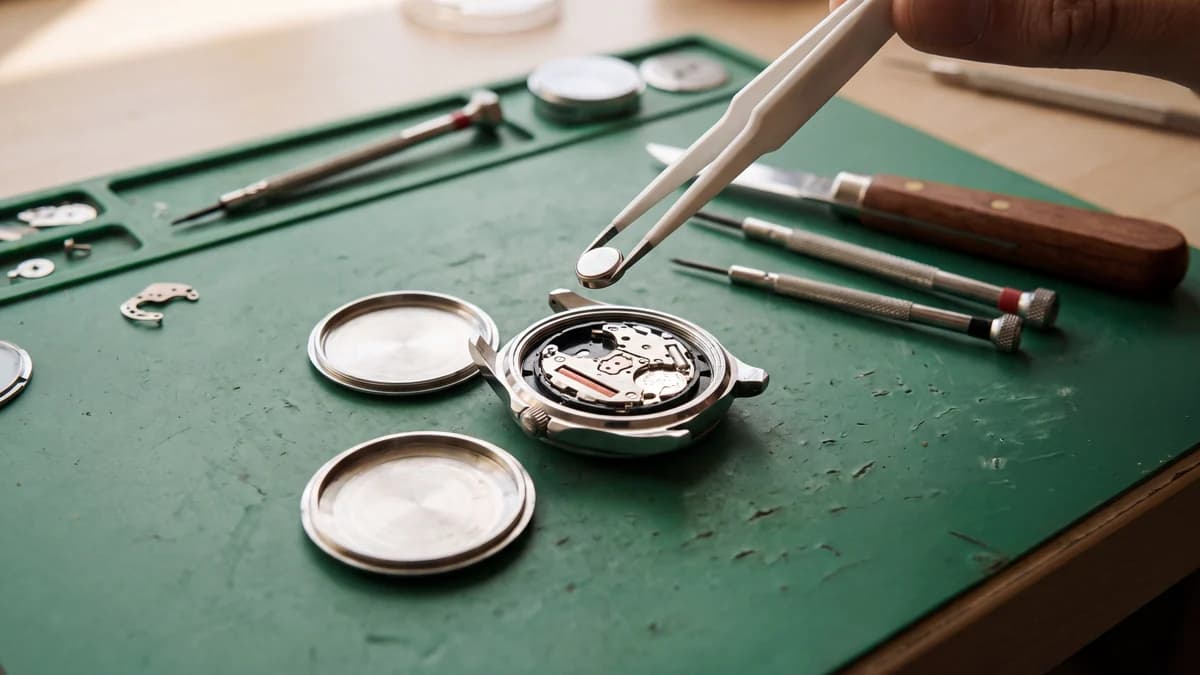
When a quartz watch stops, the battery is almost always the culprit. The job looks trivial: open it, swap the cell, close it. Yet it is one of the operations that damages the most watches, not because of the battery itself but because of everything around it: a forced case back, a pinched gasket, a crystal cracked by pressure in the wrong place, and above all water resistance that nobody checks any more. This guide explains how to change a watch battery properly, how to find the right cell without mixing up references, and when a watchmaker is the better choice.

Watch stopped: is it really the battery?
Before opening anything, watch the seconds hand. On many quartz calibres, the battery warns you before it dies: instead of moving one second at a time, the seconds hand jumps two or four seconds at once. This is the end-of-life indicator built in by the manufacturer. If you see it, the watch still runs, but the battery has only days or weeks left.
An automatic watch has no battery at all. If it stops, it simply has not been worn long enough to wind its mainspring: wind it, as shown in our film How an automatic watch works. A solar watch has no ordinary battery either: it stores light energy in a rechargeable cell that lasts far longer (more on that below). Our guide automatic vs quartz explains how these families differ.
5-second diagnosis
Which battery for my watch: reading a reference correctly
This is the first question people ask, and the most common source of mistakes. People look for a battery "for Swatch", "for Casio" or "for Fossil", as if each brand had its own. It does not: the battery depends on the movement (the calibre), not on the brand. Two watches from the same brand can take different cells, and one cell fits thousands of models from different brands. The only reliable sources are the reference engraved on the old battery, or the calibre documentation (its number is often engraved on the movement itself).
With the old battery in hand, the reference reads in two systems. The first is the standard IEC code, for example the SR626SW battery. SR means silver oxide (the chemistry used in analogue watches) and the digits give the size: about 6.8 mm across and 2.6 mm thick. The SW suffix marks a low-drain cell for analogue watches; W alone marks a high-drain cell for digital watches with backlight, alarm or stopwatch. The second system is the manufacturers' three-digit number: a 377 battery and an SR626SW are exactly the same cell, named in two ways. Here is our watch battery size chart for the cells you meet most often.
| IEC code | Manufacturer number | Diameter x height | Where you find it |
|---|---|---|---|
| SR626SW | 377 battery | 6.8 x 2.6 mm | The most common: a great many analogue watches, men's and women's |
| SR621SW | 364 battery | 6.8 x 2.1 mm | Slim watches and small women's cases |
| SR920SW | 371 battery | 9.5 x 2.1 mm | Medium to large analogue watches |
| SR927SW | 395 battery | 9.5 x 2.7 mm | Quartz chronographs and multi-function watches |
| SR936SW | 394 battery | 9.5 x 3.6 mm | Large cases, higher-consumption watches |
| SR521SW | 379 battery | 5.8 x 2.1 mm | Very small women's watches |
| CR2016 / CR2025 / CR2032 | (3 V lithium) | 20 x 1.6 / 2.5 / 3.2 mm | Mostly digital watches; never in a compartment designed for an SR cell |
Two traps to know about when buying watch batteries. First, an alkaline button cell (LR or AG codes, such as LR626 or AG4) has the same size as an SR626SW, but it is not equivalent: its voltage sags over its life, its capacity is lower and it is more prone to leaking. In an analogue watch, always stay with silver oxide. Second, a CR2016, CR2025 or CR2032 lithium cell delivers 3 volts, twice the voltage of an SR cell: it never replaces a silver oxide battery, even if it seems to fit.
How to open a watch back: identify it before touching anything
How you open a watch back depends entirely on its type, and looking at it, watch turned over, is how you decide whether the job is sensible at home. There are five cases, each needing a different tool, so identify yours before buying a watch back removal tool or a watch case opener. The wrong tool means a guaranteed scratch, and sometimes a distorted back that will never seal properly again.
| Back type | How to recognise it | Tool | At home? |
|---|---|---|---|
| Battery hatch | Small separate disc with a slot, in the centre or to one side | A coin | Yes, that is what it is for |
| Snap-on back with a notch | Smooth back, small notch on the edge, often near a lug | Case knife (short, rigid blade) | Yes, carefully, and with a press to close it |
| Screw-down back | Regular notches all around the back | Adjustable case wrench | Not advised: high torque, risk of slipping and scratching |
| Screwed plate | 4 to 6 small screws around the edge | Watchmaker's screwdriver of the right size | Yes, if the screws are not seized |
| Monocoque (no back) | No notch, no grooves, no screws: the back is one piece with the case | Opened through the crystal, with specific tools | No: watchmaker only |
The case that puzzles people most is a watch with no visible notch. Before concluding it is a monocoque, look under the lugs, back towards you, with a lamp: the notch is sometimes tiny and hidden by the strap. If you really find nothing, do not force it: a watch with no notch has to be opened from the front, by removing the crystal, which is workshop work.

How to replace a watch battery, step by step
Here is how to change a watch battery on a quartz watch with a snap-on or screwed-plate back, the most common case for a job at home. Allow a quarter of an hour, a well-lit table and a clean cloth under the watch.
1. Prepare and open
- Remove or move the strap aside if it blocks access to the back.
- Lay the watch dial down on a folded microfibre cloth so the crystal does not get scratched.
- Slide the blade into the notch at an angle and lever gently. The back should give in one clean movement. If it resists, do not force it: a slipping blade gouges the back, or your hand.
- Photograph the inside before touching anything: the position of the gasket and battery will help when reassembling.
2. Remove the old battery
- Find the battery and what holds it: a small metal clamp, sometimes held by a tiny screw, or a simple side spring.
- Free the battery with plastic tweezers or a wooden toothpick. Metal tweezers can touch both the top and the side of the cell and short-circuit it.
- Copy down the engraved reference, then check the compartment: a whitish or greenish deposit means the battery has leaked, and the movement then needs cleaning by a watchmaker.
3. Fit the new battery
- Hold it by the edge with the tweezers, "+" side up in the vast majority of cases (check your photo).
- Do not touch it with your fingers: skin oil reduces contact and speeds up oxidation.
- On some Swiss movements, a contact marked "AC" must be briefly connected to the battery's + side to reset the circuit: the calibre documentation says so. If the watch does not restart, this is often the missing step.
- Check that the seconds hand is moving before closing.
4. The gasket, then closing
- Check the case back gasket: it should be supple, round, with no cracks or flattened sections. A flattened or cracked gasket no longer does its job.
- Seat it properly in its groove. A gasket pinched while closing means a watch that lets water in at the first shower.
- A snap-on back is closed with a case press and the right die. Pressing with your thumbs, or worse on a table, puts all the pressure on the crystal and dial: that is how mineral crystals crack.
Do
- Note the reference of the old battery, or the calibre number.
- Use a silver oxide cell (SR…SW) in an analogue watch.
- Handle the battery with plastic tweezers.
- Check, and if needed replace, the case back gasket.
- Close a snap-on back with a press.
- Have water resistance tested if the watch is rated 5 ATM or more.
Never
- Choose the battery from the brand of the watch.
- Replace an SR626SW with an alkaline LR626 or AG4.
- Force a screw-down back with a knife or scissors.
- Close the back by pressing on the crystal.
- Leave a dead battery in the watch for months.
- Put the watch back in water after opening it, without a test.
The step almost everyone forgets: the water resistance test
This is the heart of the matter, and it is what separates a successful watch battery replacement from a watch lost a few weeks later. As soon as a case back has been opened, the water resistance stated on it is no longer guaranteed until it has been checked. The gasket has moved, sometimes slightly twisted, and the back may not have returned exactly to its seat. None of this is visible, which is precisely why it is tested: the watchmaker puts the watch in a machine that pressurises it (or creates a vacuum) and measures whether the case flexes or lets air through.
This matters a great deal for the watches we sell. In our stock, 96% of watches are quartz, so battery-powered, and seven quartz watches in ten are rated 5 ATM or more (about one in seven even reaches 10 ATM). For all of them, a battery change without a water resistance test means unknowingly giving up what is engraved on the back. To understand what these ratings really mean, our guide 5 ATM: shower, pool, swimming and the film water resistance is a pressure, not a depth explain what the test checks.
The first sign of compromised water resistance is not always a drop of water: it is often a light mist under the crystal after a hot shower. Our guide to misting in a watch helps tell harmless condensation from a leak. And if, while closing, you notice dust on the dial, our guide to dust under the crystal explains how to remove it safely.
Where to have it done, and what each option really includes
The cost of a watch battery replacement varies widely from one place to another, and not by chance: you are not paying for the same service. Rather than prices that change quickly, here is what really distinguishes the three levels of service.
| Where | What is done | What is often missing | Price level |
|---|---|---|---|
| Quick-service counter (key cutter, shopping centre kiosk) | Opening, new battery, closing | Gasket check, proper press, water resistance test | Entry tier |
| Jeweller-watchmaker | Battery, gasket check, closing with a press | Water resistance test, sometimes optional | Mid tier |
| Watchmaker with a test machine | Battery, new gasket, compartment cleaned, water resistance test | Nothing: the complete service | Accessible premium tier |
For a simple watch, not water resistant or rated 3 ATM and kept away from water, the quick-service counter is enough. For a watch rated 5 ATM or more that you wear in the shower or at the pool, a battery change only makes sense if it includes a checked gasket and a water resistance test. Otherwise, the saving is paid for later.
What we do at Montres Outlet
A few concrete rules, which apply to every watch bought from us:
- The battery is a consumable, as on any electronic device: replacing it is not covered by the 24-month warranty, which covers the movement.
- If the battery dies less than a month after your purchase, send us the invoice for its replacement and we will refund it. A watch may have waited in stock with its original battery, and you should not bear that cost.
- Our workshop replaces the battery together with the gasket, to preserve water resistance, and offers a water resistance test. Everything is requested from our after-sales page.
- If a new battery fitted by a professional does not restart the watch, say so in the after-sales form: it may be a movement fault, which is covered.
A battery to change, a water resistance test to book?
Our after-sales form directs your request in a few questions: battery, gasket, water resistance or movement warranty.
How long does a watch battery last, and why does it leak?
An SR626SW typically lasts two to three years in a three-hand watch. Several things shorten that: a chronograph left running uses noticeably more, as do small women's watches, which house smaller and therefore less charged cells. Conversely, a watch stored with its crown pulled out (the watch stopped) saves its battery, because the seconds motor no longer turns.
A dead battery is not inert. Over time its casing can release a corrosive electrolyte that attacks the contacts and the movement's circuit. A leaking battery can turn a simple battery change into a movement replacement. If a watch has stopped and you do not plan to restart it soon, at least have the battery removed.

After the battery: resetting a chronograph to zero
On a quartz chronograph, the chronograph hands sometimes no longer return exactly to zero after a battery change. This is not a fault: the movement has lost its reference position. Most calibres provide a reset procedure, usually with the crown pulled out and the pushers pressed in a set order, described in the instructions. Good workshops do it systematically before handing the watch back.
Watches without a battery: automatic, solar, and their own kind of cell
If changing batteries annoys you, there are watches without one. An automatic men's watch winds itself with the movements of your wrist: no battery to change, but a service roughly every five years, depending on the manufacturer.
Solar watches do have a "battery", but of another kind: a rechargeable cell, constantly topped up by light, that typically lasts around ten years, sometimes more. When it finally wears out, the watch no longer holds its charge overnight: it is replaced with an original part, such as the 3023-34R cell for Seiko solar watches or the MT621 rechargeable cell used in many solar watches. Never fit an ordinary battery instead: it is not rechargeable and can leak.
Changing a watch battery remains a simple job, provided you respect the order: the right reference, the right tool for the right back, a gasket in good condition, and a water resistance test whenever the watch is going back near water.
Frequently asked questions
How do I know which battery my watch needs?
Read the reference engraved on the old battery (for example SR626SW or 377, which are the same cell), or the calibre number engraved on the movement. The brand of the watch is not enough: two models from the same brand can use different batteries.
Can I change my watch battery myself?
Yes, on a battery hatch, a snap-on back or a screwed plate, with the right tools and a press to close it. On a screw-down back, a monocoque case, a watch rated 5 ATM or more, or a valuable watch, it is better to use a watchmaker who checks the gasket and tests water resistance.
Is my watch still water resistant after a battery change?
Not until it has been tested. Any opening of the back can move or pinch the gasket. Since the warranty never covers water resistance problems, a workshop test is essential before putting a water-resistant watch back in water.
My watch does not restart with a new battery: what should I do?
First check the reference and the orientation of the battery. On some movements, an "AC" contact must be briefly connected to the + side to reset the circuit. If a new battery fitted by a professional is not enough, the movement is at fault: for a watch bought from us less than 24 months ago, use our after-sales form.
How long does a watch battery last?
Usually two to three years in a three-hand watch. A frequently used chronograph, or a small women's watch battery, lasts less. A dead battery should be removed quickly: as it ages, it can leak and damage the movement.
Read next
More in this vein
Care & maintenance
Crystals and rhinestones falling from a watch: why, and how to protect them
Care & maintenance
Casio Water Resist: is your vintage watch water resistant? (A158, A168, LA670)
Care & maintenance
Dust on a watch dial: how to remove it easily
Care & maintenance
Watch Water Resistance Ratings: ATM, Bar, Metres (Complete Guide)
Care & maintenance
10 ATM on a watch: everything you need to know (swimming pool, sea, snorkelling)
Care & maintenance
5 ATM on a watch: everything you need to know (shower, swimming pool, swimming)
Care & maintenance