

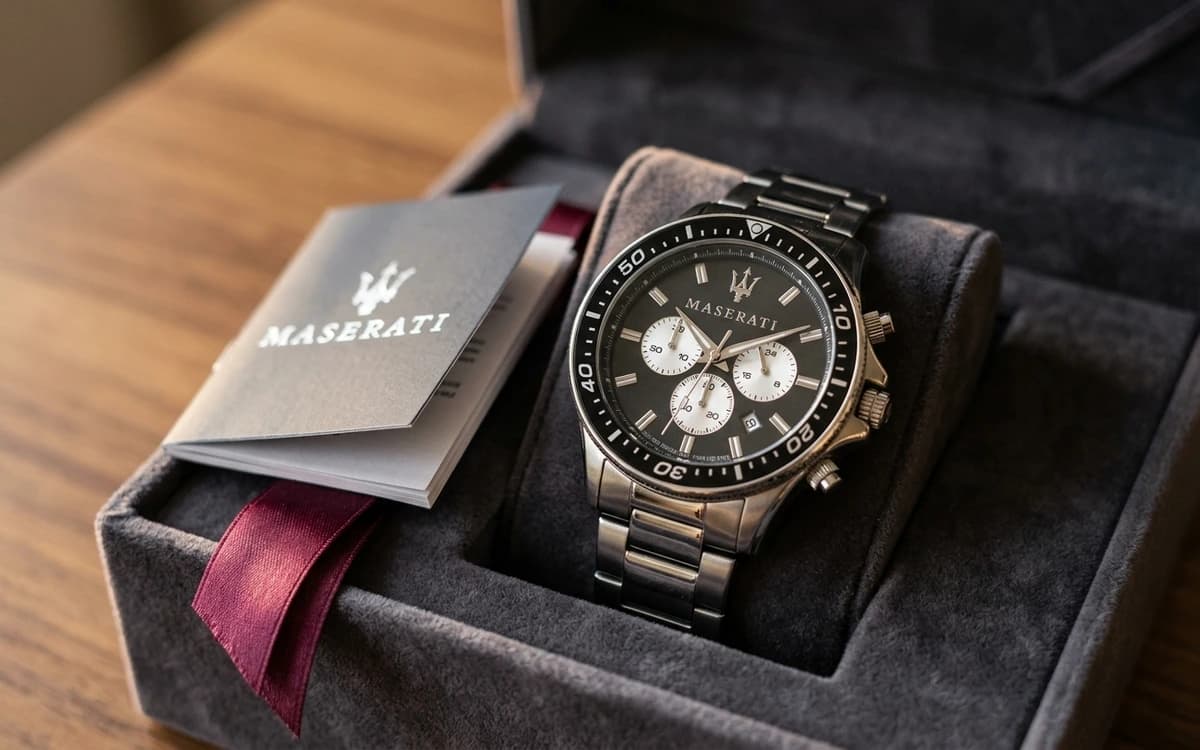
The Maserati men's watch is not simply a branded automotive watch: it is a timepiece built around a coherent philosophy, that of a manufacturer which since 1914 has placed performance and design above all else. Wearing the Trident on your wrist is to display an affiliation with a precise universe, that of Italian sport-luxury, with timepieces designed to last and to be seen.
Diagnosis in 5 seconds

The history of Maserati: from automobiles to watchmaking
Alfieri, Ettore, Carlo, Bindo and Mario Maserati founded their workshop in Bologna in 1914. The Trident brand entered racing in 1926, won the Indianapolis 500 in 1939 and 1940, and launched its first road car, the A6, in 1947. The logic has always been the same: design mechanics capable of going faster, better, with more style than the competition.
The move into watchmaking came in 2005. This is not opportunistic diversification: the two disciplines share the same fundamental requirements. Mechanical precision, resistance to vibrations, design conceived to be read at a glance, materials resistant to real stresses. A tachymetre on a dial is not an ornament at Maserati: it is a direct reference to the instrument panel.
The Trident itself comes from the Neptune fountain, Piazza Maggiore in Bologna. On the dials, it is engraved, stamped or screen-printed with a precision that immediately distinguishes an authentic piece from an imitation: the proportions of the symbol are protected and controlled at each production.
The five emblematic collections: characters and uses

Potenza: maximum presence
The Potenza lives up to its name (power, in Italian). Cases range between 44 and 46 mm, designs own their volume without compromise. The target is precise: the man who wants his watch to make an impact, whether with casual wear or a tailored suit.
The distinctive points of the Potenza:
- Cases 44-46 mm, marked thickness
- Systematic chronograph complications
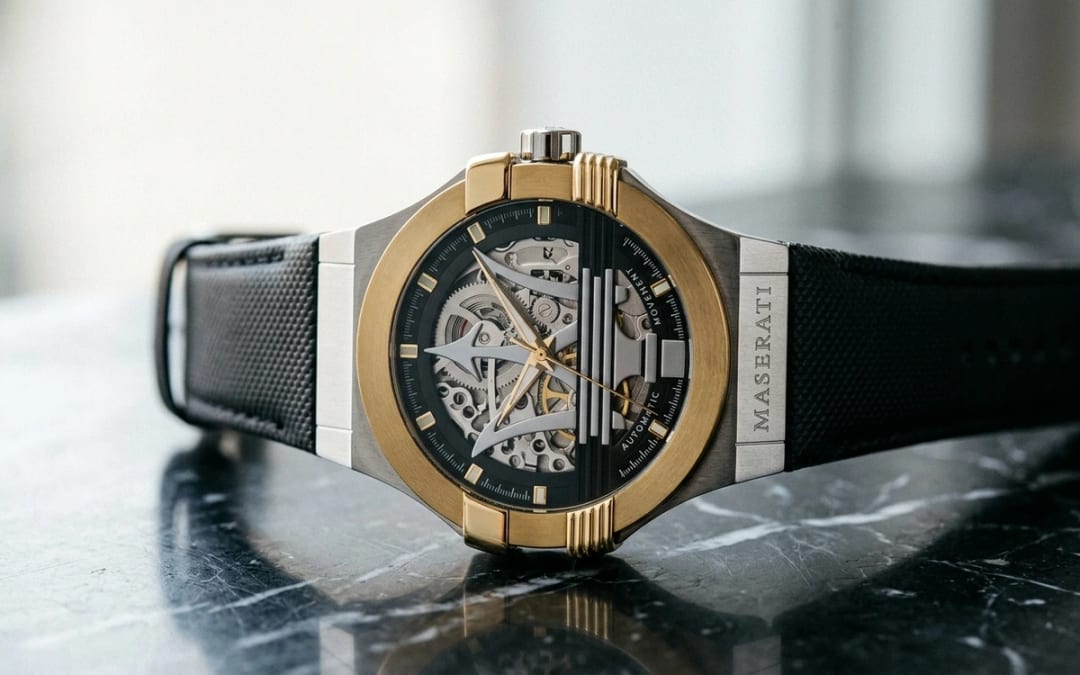
- Sporting finishes: black PVD, two-tone steel/gold
- Rubber or solid steel bracelets
- Wide luminescent indices, immediate readability
The parallel with the V8 engines of the GranTurismo is not gratuitous: the Potenza dials often take up the radial layout of the instrument panel, with a visual hierarchy readable to the naked eye, even in motion.
Successo: formal elegance
The Successo targets professional environments and formal occasions. Cases move to 42-44 mm, finishes include yellow gold and rose gold options in PVD, quality leather straps replace rubber. This is the watch for meetings and business dinners.
What technically sets it apart: the dials use polished baton indices rather than sporting relief indices. The sobriety is calculated so the watch accompanies an outfit without dominating it.
Velocità: chronograph and speed
The Velocità is built around the chronograph and tachymetre. It explicitly addresses automotive enthusiasts. The design is aerodynamic, the pushers are wide to be operated without removing the watch, the integrated tachymetres actually allow you to measure a speed.
Traguardo: versatile daily use
Traguardo means "finish line" in Italian. It is the most versatile collection in the range: cases 40-44 mm depending on the references, designs balanced between sport and classicism, optimal quality-to-finish ratio for daily wear. If you are looking for a single Maserati watch that covers all situations, the Traguardo is the logical starting point.
Epoca: classic heritage
The Epoca collection pays homage to Maserati from the 1950s-60s, the brand's golden period in competition. Cases return to classic diameters (40-42 mm), dials adopt assumed vintage designs with baton-shaped indices, dauphine hands, leather straps with contrasting stitching. For classic watch enthusiasts who want an automotive reference without ostentation.
Quartz and automatic movements: choosing with knowledge
To see concretely what the move to automatic means at Maserati, we dissected a specific model: the Sfida R8823140004 with open heart, Seiko NH70 calibre, with dial macros and comparison against its quartz twin.
The quartz movement: field reliability
The quartz movements equipping Maserati watches are predominantly of Japanese origin (Miyota and Seiko Instruments calibres). The principle: a quartz crystal oscillating at 32,768 Hz regulates a stepper motor that advances the hands. The precision achieved is in the order of ±15 seconds per month, or a drift of less than 3 minutes per year.
Practical advantages for the wearer:
- No daily manipulation (no manual winding)
- Battery to be changed every 2 to 5 years depending on the model
- Precision maintained regardless of wearing conditions
- Shock resistance superior to automatic (fewer moving parts)
The automatic movement: mechanical and prestige
Maserati automatic references use rotor-winding movements: wrist oscillations charge a mainspring that powers the movement. No battery, but a requirement for regular wear (approximately 40 hours of power reserve on most calibres used).
Points to anticipate with automatic:
- Lower precision: ±15 to ±30 seconds per day depending on the calibre
- Complete overhaul recommended every 5 years (cleaning, lubrication)
- Purchase price higher than equivalent quartz models
- Winder to be considered if worn irregularly
Comparative table quartz vs automatic
| Criterion | Japanese quartz | Automatic |
|---|---|---|
| Precision | ±15 s/month | ±15-30 s/day |
| Autonomy | 2-5 years (battery) | Unlimited if worn |
| Routine maintenance | Battery change | Winding or regular wear |
| Overhaul | Optional | Every 5 years recommended |
| Shock resistance | Superior | Adequate |
| Entry price | More accessible | Higher |
| Collector interest | Standard | High |
To explore the subject further, our automatic vs quartz guide details the design differences and selection criteria according to real usage, including in conditions of high vibrations, frequently encountered whilst driving.
Materials and finishes: what really determines durability
Stainless steel: the durable reference
Stainless steel 316L (surgical steel) equips the vast majority of Maserati cases and bracelets. Its composition (16-18% chromium, 10-14% nickel, 2% molybdenum) gives it excellent corrosion resistance, including in saline environments. It is the material that ages best with minimal maintenance.
Maintenance comes down to monthly cleaning with a soft brush and warm soapy water. Contrary to what many wearers think, micro-scratches on brushed steel can often be minimised at home with a microfibre cloth, reserving professional polishing for serious cases during an overhaul.
PVD coatings: gold, rose gold, black
PVD technology (Physical Vapour Deposition) consists of depositing in a vacuum chamber a layer of material (titanium-nitride for black, gold alloy for gold) onto steel. The adhesion obtained is superior to conventional electroplating and wear resistance is significantly better.
Three variations in the Maserati range:
- Yellow gold PVD: warm and classic appearance, suits formal and elegant casual wear
- Rose gold PVD: contemporary shade, associated with champagne or mother-of-pearl white dial finishes
- Black PVD: sporty monochrome appearance, particularly resistant to fingerprints
Titanium, ceramic, carbon: specific materials
Titanium appears on high-end sport references. Its density is 45% lower than steel for comparable mechanical resistance. Practical result: a 44 mm titanium watch is worn without fatigue over a long day. It is also hypoallergenic, making it relevant for skin sensitive to nickel.
Technical ceramic (zirconia) reaches 8 to 8.5 on the Mohs scale versus 5 to 6 for steel, a real advantage against everyday scratches. Its often underestimated limit: where steel dents under localised impact, ceramic cracks cleanly, which I have observed on several cases in the workshop. The manufacturing surcharge is therefore justified, provided you accept this compromise.
Carbon equips the most radical references in the range: on the models I have handled, the cross-woven fibres remain visible under the varnish and the weight gain compared to steel is immediately perceptible on the wrist. It is the direct transposition of structural parts from sports cars.
Bracelets: choose according to real usage
Steel bracelet: versatility and longevity
Three types of links in the Maserati range:
- Milanese mesh: fine link mesh, fluid and elegant appearance, continuous adjustment by sliding
- Butterfly links: classic links with deployant clasp, affirmed classicism, very resistant
- Solid links: continuous surface, optimal wearing comfort, adapts well to muscular wrists
Steel bracelet maintenance does not require much: a soft brush and soapy water once a month is enough. Insist in the gaps between the links, where sweat and residue accumulate first.
Leather bracelet: refinement and maintenance
The leather used by Maserati covers three levels:
- Smooth calf leather: supple from the start of wear, progressive patina, absorbs marks of use
- Calfskin leather: fine grain, softness on the skin, slightly stiffer initially
- Crocodile grain leather (printed): distinctive appearance, more formal positioning
Absolute rule with leather: avoid prolonged exposure to water. Prolonged sweat (intense sport, heat) degrades seams and causes cracking. A nourishing balm applied every 2-3 months preserves suppleness and delays ageing.
Rubber bracelet: sport without compromise
Vulcanised rubber or silicone is essential for physical activities: insensitive to water, lightweight, resistant to temperature variations and cleanable in seconds (a rinse with clear water after exposure to chlorine or salt water). Unlike leather which degrades after 3 to 4 swims, it shows no premature wear. On the Potenza and Velocità, it also reinforces visual coherence with the sporty aesthetic of these references.
Functions: chronograph, water resistance, useful complications
The Maserati chronograph: reading and use
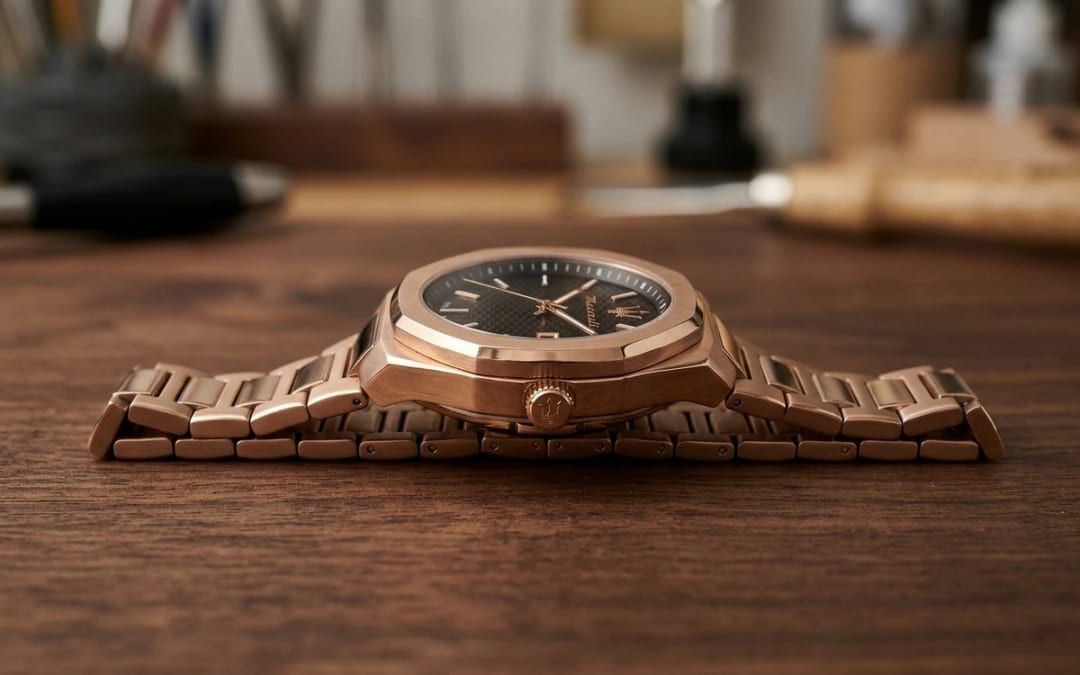
A chronograph measures durations independently of the display of the current time. On Maserati watches, the organisation is standard: a pusher at 2 o'clock starts and stops the measurement, a pusher at 4 o'clock resets to zero. The auxiliary counters display elapsed minutes and hours.
The tachymetre integrated on the bezel or dial allows you to calculate an average speed over a known distance. For automotive use: start at a kilometre marker, stop at the next one, read the speed directly on the scale. This is a complication consistent with the brand's DNA.
Water resistance: understanding real levels
| Rating | Recommended real use | Inadvisable use |
|---|---|---|
| 3 ATM / 30 m | Rain, light splashes | Shower, swimming |
| 5 ATM / 50 m | Hand washing, light shower | Swimming, diving |
| 10 ATM / 100 m | Swimming, snorkelling | Scuba diving |
| 20 ATM / 200 m | Recreational diving | Technical diving |
Additional complications
The date function (window at 3 o'clock or 6 o'clock) is present on the majority of Maserati references: the most useful in daily life, the most consulted. The day/date window appears on certain Potenza and Traguardo models. The 24-hour window is available on a few specific models to distinguish day from night, useful when travelling across time zones.
How to choose your men's Maserati watch: the four filters
Filter 1: dress style
Classic and professional style: Successo or Epoca with black or brown leather strap, silver or discreet gold finish. These watches pass under a cuff without issue and respect formal codes. Against all expectations, the Epoca often convinces better than the Successo in very formal contexts, thanks to its slightly thinner case.
Modern and assertive style: Potenza with black PVD or rose gold finish, solid steel bracelet. The watch is visible, it owns its volume and reinforces a contemporary silhouette.
Sport and casual style: Velocità with rubber strap, or Traguardo in two-tone version. These models go with casual outfits without appearing out of place.
Filter 2: wrist size
| Wrist circumference | Recommended case diameter | Suitable collection |
|---|---|---|
| Less than 16 cm | 40-42 mm | Epoca, compact Traguardo |
| 16-18 cm | 42-44 mm | Traguardo, Successo |
| 18-20 cm | 44-46 mm | Potenza, Velocità |
| More than 20 cm | 46-48 mm | Potenza large model |
The thickness of the case also comes into play. A two-counter chronograph often exceeds 13 to 14 mm in thickness, compared to 9 to 10 mm for a three-hand watch like the Epoca. On a slim wrist, this difference is felt directly when passing under a cuff.
Filter 3: intended use
Daily wear in all situations: Traguardo steel, quartz movement, water resistance 50 m minimum. On the Maserati watches I have tested daily, this combination best withstands shocks, perspiration and forgotten showers, without ever flinching.
Special and formal occasions: Successo rose gold with leather strap. The finishes on this model are significantly superior to the steel Traguardo: sharper brushed edges, better set indices, visible care at 20 cm that justifies its positioning.
Sports and outdoor activities: Velocità with rubber strap and 100 m water resistance. Resistance to the elements takes priority over aesthetics.
Filter 4: budget
The men's Maserati range is positioned in accessible luxury. As an indication:
- Mid-range: three-hand watches, quartz, steel, Traguardo and Epoca collections
- Accessible upper range: quartz chronographs, PVD finishes, Velocità and Potenza collections
- Upper range: automatic movements, premium materials (titanium, ceramic), refined finishes
At Montres Outlet, the outlet model allows us to offer these watches at significantly lower prices than boutique prices, without compromise on authenticity or warranty.
To prioritise
- Check the exact case diameter before ordering (not just the collection)
- Choose water resistance suited to your actual practice, not theoretical practice
- Prefer the steel bracelet for a first purchase: the most versatile, the simplest to maintain
- Buy with the intact 2-year warranty
- Customer reviews are available on Temovio.
To avoid
- Choosing based solely on the photo without checking exact dimensions
- Buying a black PVD watch thinking it resists scratches like ceramic
- Ignoring water resistance specifications and using a 3 ATM under the shower
- Going through unauthorised sellers to save on price: the counterfeit risk is real
- Storing the watch with the crown unscrewed: this compromises water resistance
Authenticity: recognising and buying with confidence
The five control points
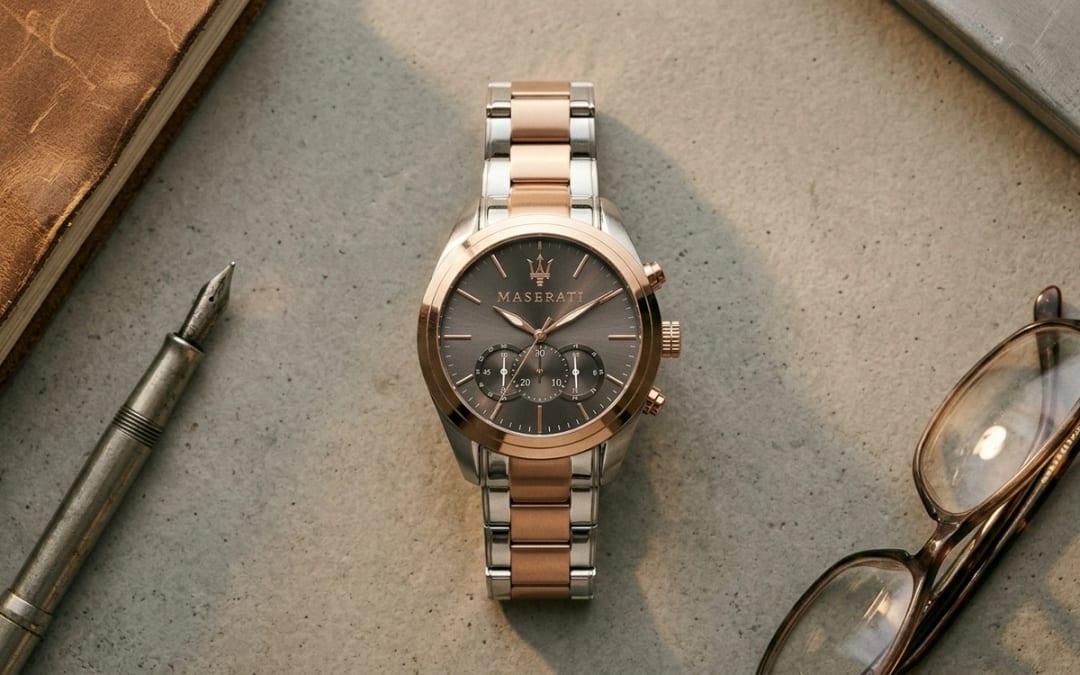
1. The Trident logo: three teeth at strictly increasing height, centred handle, stable proportions from one piece to another within the same collection. In eight years of examining Maserati watches, any asymmetry or tooth of equal height has systematically signalled a counterfeit or assembly defect.
2. The serial number: engraved on the case back, present on all authentic Maserati watches. The number corresponds to the documents supplied with the watch. Absence of number or superficial number (sticker, shallow marking): immediate refusal.
3. The quality of finishes: on an authentic piece, the transitions between polished and satin surfaces are sharp, the indices are perfectly aligned, the dial text is regular without printing burrs.
4. Weight: an authentic Maserati steel watch has considerable mass. Counterfeits generally use lightweight and low-density alloys to reduce costs.
5. Packaging and documentation: each Maserati watch is delivered with its branded case, the warranty certificate (dated at purchase), the instruction manual in several languages and the protective film on the case.
Maintenance: complete protocol to extend lifespan
Daily maintenance
Systematically wipe the watch with a microfibre cloth after each wear. Sweat is slightly acidic and gradually attacks the finishes, seals and polished surfaces. This simple habit significantly extends the condition of PVD finishes and dial legibility.
Apply perfumes, creams and sun care products before putting on the watch. The chemical compounds in these products (alcohol, synthetic oils, UV filters) attack water-resistance seals, PVD coatings and leather straps.
Monthly maintenance according to strap type
Steel bracelet: soft brush and warm soapy water, rinsing, immediate drying. Focus on link articulations, where 80% of sweat and sebum deposits accumulate and dull the overall appearance.
Leather strap: cleaning with a slightly damp cloth. Application of a leather conditioning balm every 2-3 months. Do not immerse, do not leave to dry in direct sunlight (accelerated cracking).
Rubber strap: rinse with clear water after exposure to seawater or chlorine. Complete drying before storage to prevent mould development.
Professional servicing
Recommended schedule:
- Battery replacement (quartz): every 2-3 years, depending on movement consumption and activated complications
- Water-resistance test: every 2 years, systematically after any significant impact to the case
- Complete overhaul: every 5 years for automatics, optional but recommended for quartz watches 10 years and older
Signs requiring prompt intervention:
- Condensation or misting under the crystal (see our guide on condensation and water resistance)
- Delay or gain exceeding the normal drift of the movement
- Crown difficult to screw or turning in empty space
- Deep scratches reaching the metal beneath the PVD
Our after-sales service remains available to guide you towards Maserati authorised watchmakers and answer technical questions. You can also consult the maintenance advice section for detailed guides on each type of care.
Maserati vs other brands: real positioning
Maserati vs Hugo Boss
Hugo Boss builds its watches on a German fashion identity: clean lines, classic colours, designs that work independently of any particular brand universe. This is a strength in terms of versatility, but the absence of automotive storytelling removes the "belonging to a universe" dimension that Maserati sells with its dials. If you are looking for sober elegance without sporting reference, Hugo Boss may be relevant. Our guide to Hugo Boss men's watches develops this positioning.
Maserati vs Emporio Armani
Emporio Armani is a fashion brand that makes watches: collections follow seasonal trends, designs adapt to current dress codes. Maserati is an automotive brand that makes watches: collections have internal consistency dictated by performance values. These are two different logics. Our guide to Emporio Armani men's watches presents the range in detail.
Maserati vs Diesel
Diesel explicitly targets a young audience with oversized designs and bright colour finishes. Prices are generally lower, but finishes and movements are in a more marked entry-level range. Maserati addresses a buyer who accepts a higher budget and expects in return brand consistency and superior manufacturing quality.

Find your Maserati men's watch
Our entire selection of authentic Maserati men's watches, with a 2-year warranty and free delivery to mainland France, subject to our terms. Returns accepted within 14 days.
What is the difference between a Maserati watch and a classic luxury watch?
Are Maserati men's watches water-resistant?
Which watch movement should you choose for a Maserati men's watch?
How to maintain and clean a Maserati watch?
Is a men's Maserati watch a good investment?
Which strap to choose for a men's Maserati watch: leather, metal or rubber?
How much does a men's Maserati watch generally cost?
Where to buy an authentic and reliable men's Maserati watch?
Read next
More in this vein

Brands
Burberry Men's Watch Size Guide: How to Find the Perfect Size

Brands
Burberry Elegance Men's Watch: British Refinement for Special Occasions

Brands
Emporio Armani Gold Men's Watch: The Brilliance of Italian Luxury

Brands
Diesel Mega Chief Men's Watch: Complete Guide to the Icon

Brands
D1 Milano: reviews, models and buying guide

Brands
Daniel Wellington Mesh Women's Watch: The Complete Guide to the Milanese Mesh Bracelet

Brands
Tommy Hilfiger Mesh Women's Watch: The Complete Guide to Milanese Mesh Bracelets

Brands