

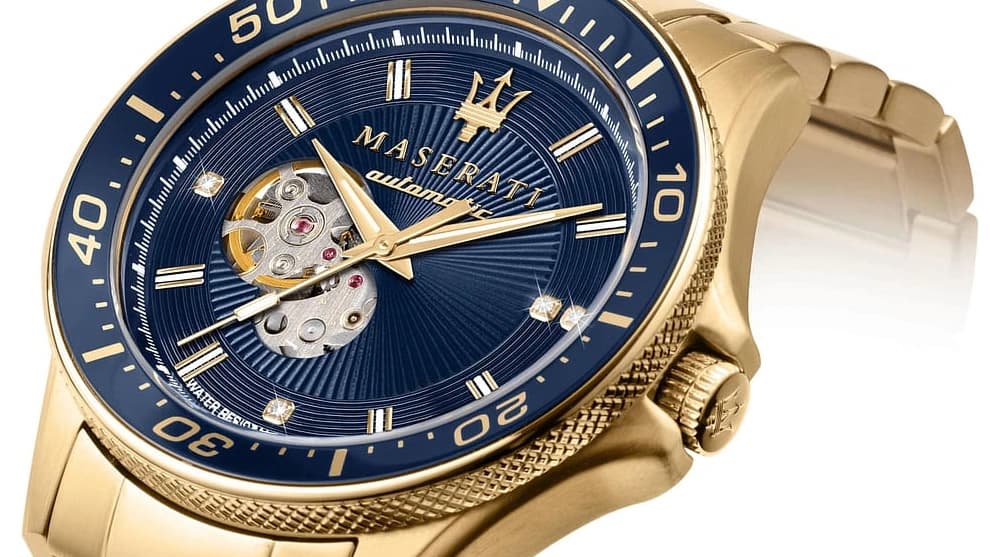
On the counter, two Maserati Sfida side by side. Same 44 mm case, same gold-plated steel, same midnight blue dial, same 10 ATM water resistance. One sells at an entry-level price, the other commands nearly triple. The visible difference lies first in an opening at 8 o'clock. Here is precisely what is inside, what this hole really costs you, and the three elements that the technical sheet forgets to mention.
I have been selling Maserati watches long enough to know the question that comes up every time with reference R8823140004: why is this one so much more expensive than its twin? The answer comes down to one word, automatic, but that word explains nothing until you have looked through the opening. So let us look, literally, by enlarging the visuals where detail matters.
A point of vocabulary before we begin, because it conditions everything else: this watch is not a skeleton watch, contrary to what most product sheets on the market claim, including some of ours in the past. It is an open heart. If the distinction between full skeleton, open heart and skeletonised dial is not familiar to you, our complete skeleton watch guide details it in three levels. Here, we go down a notch: we are no longer talking about the category, we are dissecting a model.
What the opening at 8 o'clock really reveals
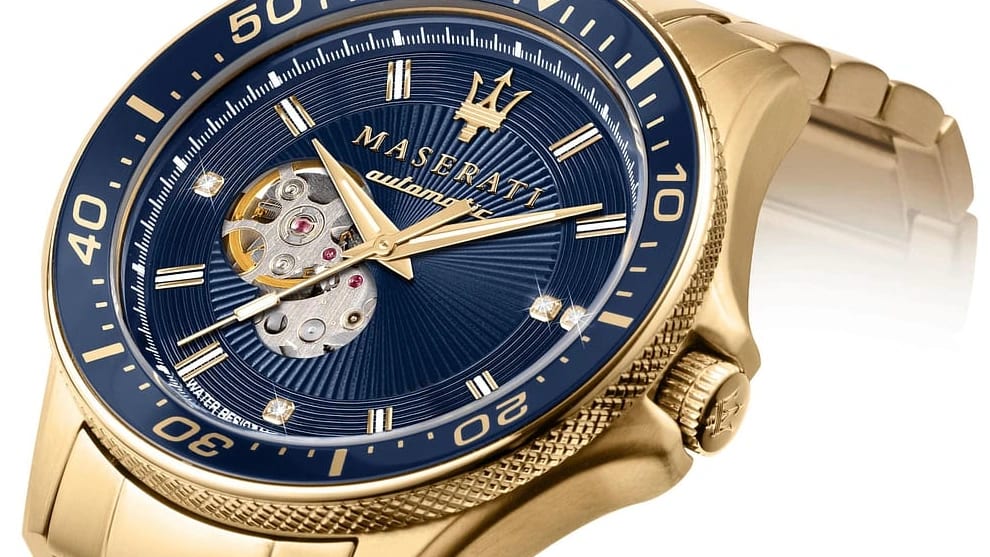
First correction to the usual marketing discourse. You read everywhere that an open heart "lets you see the balance wheel". On many models that is true, the opening being then pierced at 12 o'clock or at 9 o'clock just above the regulating organ. On this Sfida, that is not the case. The opening is off-centre at the bottom left, around 8 o'clock, and what it reveals is different.
What you actually see in this window, starting from the centre: a golden arc-shaped bridge, which is the treated brass piece now holding the gear train axes; a perlage-finished plate, that rippling of small concentric circles obtained with abrasive; and above all four rubies, those red discs set into the metal. Two are clearly visible at the centre of the opening, two others appear in the lower part, under the minute hand.
These rubies are not decorative, and that is the point that almost no product sheet explains. They are synthetic corundum bearings. Each gear train axis rotates in them rather than in bare brass. Corundum has a hardness of 9 on the Mohs scale, compared to about 3 for brass: friction drops, wear becomes negligible, and lubricating oil stays in place by capillarity instead of leaking. It is an invention from 1704 that remains the reason why a well-maintained mechanical watch lasts for decades, provided you respect the servicing intervals of an automatic watch.
There is, however, a second window, and it is far more generous: the case back is glazed, that is, pierced with a crystal that lets you see the entire back of the movement, oscillating weight included. That is where, and not on the dial, you will observe the rotor turn when you move your wrist. A detail that product sheets rarely mention and which greatly changes the pleasure of use: flip the watch over, and you have the real mechanical spectacle.
In other words, if you buy this model hoping to see something move in the window, you will be disappointed. What you are buying is the view of the construction, not the animation. It is a nuance I prefer to lay out from the start rather than let you discover after delivery.
The three circles of the dial, and why they matter
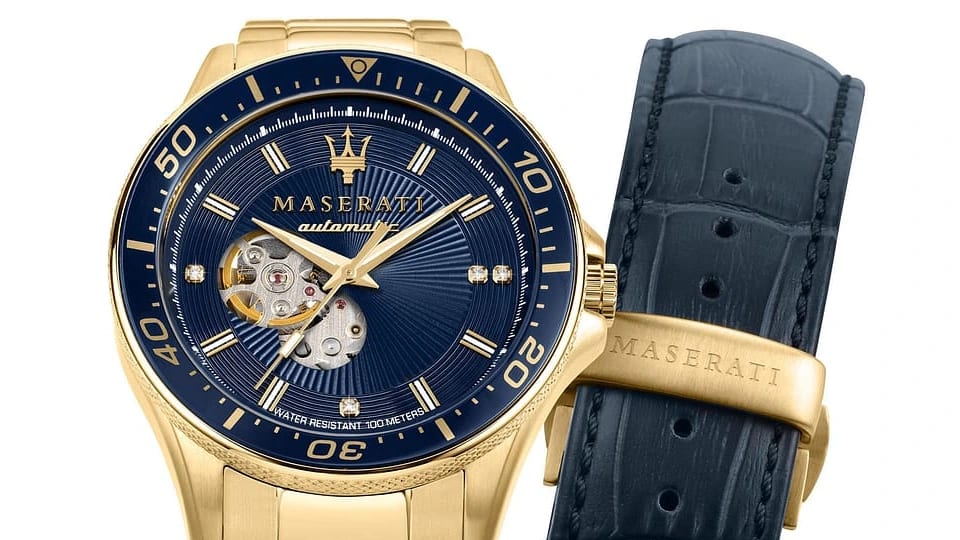
This front view is the one that reveals the most. To the naked eye, you see "a blue dial". Under magnification, you discover a three-tier construction that the brand's entry-level price does not suggest.
The first circle is the bezel, graduated from 10 to 50 with a triangular marker at 12 o'clock containing a disc. It is a dive watch grammar, borrowed here on a watch that is not one. I come back to that below, because it is the real debatable point of the piece.
The second circle is the rehaut, that sloped ring which connects the bezel to the dial. It bears a railway track minute track, that fine graduation which allows you to read the minutes with precision. On the macro, you can clearly see that the lines are printed on a sloped surface, not flat: that is what gives this impression of depth when you tilt your wrist.
The third circle is the dial proper, sunburst guilloché. The rays fan out from the centre and catch the light differently depending on the angle, which explains why this blue looks almost black indoors and frankly electric in the sun. The "MASERATI automatic" text and the trident are in gold applied indices, that is, separate pieces fixed on, not printing.
A detail I did not expect on a men's watch: several indices are set with diamonds, perfectly visible in the front photo. That is what justifies the "limited edition" designation of this reference, and an assumed aesthetic choice, rather rare in this category. Worth knowing before giving this watch to someone who hates anything that shines: here, it really shines.
Another element supplied with the watch and which weighs in the balance: the box contains a second strap in blue alligator-style leather, with Maserati-signed keeper. You therefore have two watches in one, the gold-plated steel for the sporty and flashy register, the blue leather for a distinctly more formal look. That is visible in the photo above, and it is rarely highlighted even though it doubles the use. This versatility actually makes it defensible as a formal occasion watch, provided you fit the leather: in full gold-plated steel, it remains too showy for a classic wedding.
The NH70 calibre: what it is, what it is worth
The movement that powers this Sfida is a Seiko NH70, also designated NH70A. It is the "open heart" member of the NH family, the range that Seiko Instruments produces for the watch industry rather than for its own watches. You find it under the dial of dozens of brands that do not always mention it.
| Parameter | Value | What this means in practice |
|---|---|---|
| Type | Automatic with manual winding possible | Winds at the wrist, but also via the crown if the watch has stopped |
| Frequency | 21,600 beats per hour (3 Hz) | The seconds hand advances in 1/6 second increments, giving smooth sweep motion |
| Power reserve | ≈ 41 hours | Set down Friday evening, the watch stops Sunday morning |
| Jewels | 24 | Including those visible through the opening |
| Stated accuracy | −20 to +40 s/day | Wide tolerance, typical of this industrial category |
| Seconds stop (hacking) | No | Impossible to freeze the hand for precise second-level time setting |
Two lines in this table deserve closer attention, because they are systematically overlooked.
Accuracy. A tolerance of −20 to +40 seconds per day means that at worst, your watch can drift by four minutes in a week. In practice, a well-regulated NH70 runs closer to +10 to +20 s/day, or one to two minutes per week. By comparison, the quartz movement in the neighbouring Sfida drifts by about 15 seconds per month. If accuracy is your buying criterion, automatic is objectively the wrong choice. You don't buy a mechanical movement for precision, you buy it despite its imprecision. We detailed this trade-off in our automatic versus quartz comparison.
The absence of hacking. On a movement with seconds stop, you pull the crown and the seconds hand freezes, allowing you to synchronise to the exact time. The NH70 doesn't have this function: the hand keeps running while you set the time. You'll always be off by a few seconds. Unimportant in daily use, annoying for those who like ritual precision.
The compromise you need to face: mineral crystal
I prefer to state this plainly rather than bury it in a list of specifications, because it's the real compromise of this piece and many buyers discover it three months later, with a scratch across the dial.
Is it a deal-breaker? That depends entirely on your wrist and your work. Desk work, a watch worn in the evening and at weekends: mineral will last years without a mark. Manual work, regular DIY, a tendency to knock door frames: you'll see the first scratch quickly, and it will be permanent.
There is an honest counterpoint to mineral, rarely mentioned: it is more resistant to impact than sapphire. Sapphire is very hard but brittle; mineral is softer but absorbs a direct impact better without shattering. The choice by brands in this price category is therefore not purely economic. It's worth noting that in the same Maserati family, the Ingegno and Traguardo models receive a mineral crystal with anti-scratch treatment, which this Sfida does not have.
Good news in case of accident: unlike sapphire, a light scratch on a mineral crystal can often be reduced by polishing, whereas a scratched sapphire must be replaced. Our polishing guide by crystal and metal type details the method and its limitations, including on the gold-plated steel of this case, which requires far more care than standard brushed steel. Before polishing anything, also read what polishing compound actually removes: on a gold coating, it removes material, not just the scratch.
Diver's bezel, 10 ATM, open heart: the accepted paradox
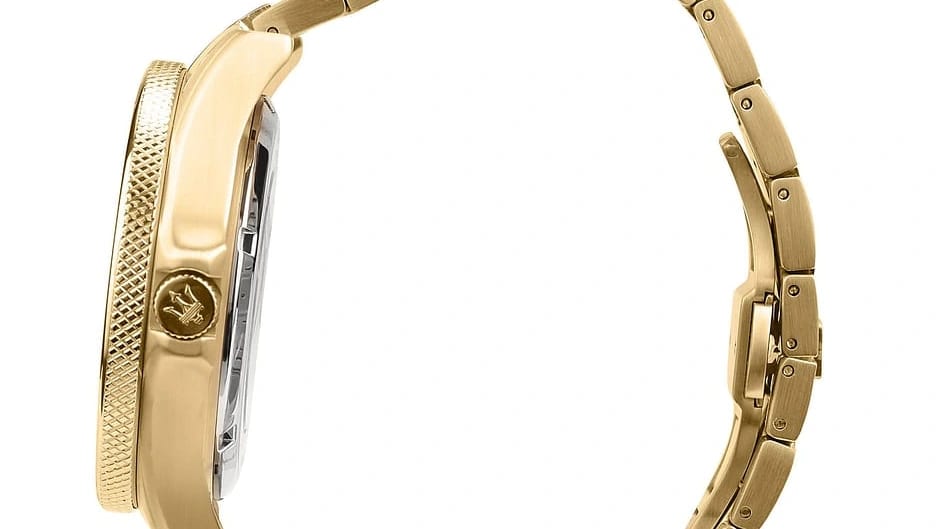
This Sfida accumulates all the outward signs of a diver's watch: 60-minute graduated bezel with marker at 12 o'clock, knurled crown protected by shoulders, "WATER RESISTANT 100 METERS" printed on the dial, 44 mm case. Everything says diver.
And yet, it is not a diver's watch, for three cumulative reasons.
| Use | Verdict | Why |
|---|---|---|
| Rain, hand washing, splashes | No problem | Well within the seal's limits |
| Shower | Acceptable | Warm rather than very hot: heat and soap wear the seals over time |
| Surface swimming, pool | Acceptable | Stays within the 10 ATM margin |
| Sea, diving in, surface water sports | Acceptable, crown pushed home | A dive adds almost nothing (about 0.5 bar at 10 m/s): the real risk is a pulled-out crown or worn seals |
| Scuba diving | No | ISO 6425 standard not met: no unidirectional bezel, no DIVER'S marking |
The first technical point is that this watch's bezel rotates in both directions, or doesn't rotate depending on the example. A true diver's bezel is unidirectional, locked anticlockwise. The reason is vital: if the bezel shifts accidentally, it can only shorten the displayed dive time, never lengthen it. A bidirectional bezel can make you think you still have air.
The second point is the mineral crystal mentioned above, which the ISO 6425 standard would not accept for a certified diver's watch.
The third, most decisive point, is the open heart itself. Piercing the dial doesn't affect water resistance, which depends on the case and seals. But it permanently reveals the movement's interior: if moisture ever enters, you'll immediately see it condense on the bridges. It's an excellent fault detector and a visual reminder that this piece is made to be admired dry. If you see mist appear one morning, our article on mist in a watch will tell you whether it's benign condensation or a seal needing urgent replacement.
The subject deserves more than a table: we've devoted an entire feature to it, 10 ATM, everything you need to know about pool, sea and snorkelling, which details the five mistakes that destroy a 10 ATM watch in the sea and the protocol to follow after every swim. If you're looking for a general reading of ATM, bar and metre ratings, our definitive water resistance guide covers it from scratch. And for genuine diving practice, you need to switch to a 200 m water-resistant watch, which is a different category of object.
My position as a seller on this is straightforward: these diver codes are an aesthetic language, not a functional promise. Bought for its looks, this watch is successful. Bought to go underwater, it's a casting error, and that needs to be said before the sale rather than after.
44 mm across 13 mm thickness: which wrist will it suit
The raw figures: 44 mm diameter, 13 mm thickness, lug-to-lug distance of 22 mm. This is a large watch, and the 22 mm lug-to-lug distance makes it wide as much as large, which weighs more heavily on the visual impact than diameter alone. If the question of proportions interests you beyond this model, our ultimate guide to men's watches devotes an entire section to measuring wrist circumference.
| Wrist circumference | Rendering | Recommendation |
|---|---|---|
| Less than 16 cm | Lugs protruding on the sides | Not recommended, look for 40-42 mm instead |
| 16 to 17.5 cm | Watch very prominent, bold | Possible if you like an imposing style |
| 17.5 to 19 cm | Correct proportions | The natural target for this model |
| More than 19 cm | Balanced, never excessive | Ideal |
The point that matters more than diameter: 13 mm thickness. This is the direct consequence of the automatic movement, whose oscillating weight adds height that a quartz does not have. In practical terms, this watch will not fit under a fitted shirt cuff. It catches. If you wear a suit and shirt five days a week, this is a real daily constraint, not a technical specification detail.
The second leather strap mitigates the problem without eliminating it: leather hugs the wrist better than links and gains one or two millimetres of comfort under the sleeve. The case thickness, however, does not change.
Quartz or automatic: the real choice at Maserati
Here is the most useful exercise I can offer you, because it isolates exactly one variable. We have in stock the Sfida R8873640008: same collection, same 44 mm case, same gold-plated steel, same blue dial, same 10 ATM water resistance, same mineral crystal. The only difference lies in the movement, quartz on one side, automatic NH70 with open heart on the other.
| Criterion | Sfida quartz | Sfida automatic open heart |
|---|---|---|
| Movement | Battery quartz | Seiko NH70A automatic |
| Accuracy | ≈ 15 s/month | ≈ 15 s/day in real use |
| Power reserve | 2 to 3 years, then battery change | Unlimited if worn, 41 hours when stopped |
| Dial | Solid | Open at 8 o'clock to the movement |
| Thickness | Thinner | 13 mm, thicker |
| Maintenance | Battery every 2-3 years | Service recommended every 5 to 7 years |
| Limited edition | No | Yes |
| Price positioning | Entry-level | Mid-range |
A figure I can give you because these are our own sales numbers, and which probably contradicts what you expect: at our store, Maserati quartz watches sell far better than automatics. The average basket for the brand hovers around half the price of this automatic Sfida, and our two biggest volumes are quartz Competizione models. Our analysis of Maserati prices and their value for money details the range structure collection by collection.
I am not hiding this figure to push you towards the high end. I am giving it to you because it says something useful: the automatic with open heart is a purchase of passion, not a purchase of reason. The majority of Maserati buyers want the design and the trident at the best price, and they are absolutely right. A minority wants the mechanics, and accepts paying more for an object that is less accurate, thicker and that stops if it sits in a drawer for two days.
Living with this watch day to day
A few practical points that nobody details and which make the difference between satisfaction and disappointment.
Restarting the watch. If the watch has stopped, do not just shake it. Wind it via the crown, approximately thirty turns clockwise, then set the time. The NH70 accepts manual winding, which is not the case for all entry-level automatics. You start with a full power reserve rather than with the bare minimum.
Intermittent wear. With 41 hours of power reserve, a watch worn only on weekdays will be stopped Monday morning. This is the main complaint made about automatics by those who alternate several watches. A watch winder solves the problem, but ask yourself about the cost relative to the watch. We have a dedicated guide to choosing a watch winder if the subject interests you.
Magnetism. This is the most common and least known fault. A mechanical movement placed on a speaker, a bag with a magnetic clasp or an induction hob can have its hairspring magnetised and start gaining several minutes per day. The diagnosis is immediate at any watchmaker and demagnetisation takes thirty seconds. If your watch suddenly starts to drift, think of this before concluding it is a serious fault.
Service. Allow five to seven years before a first disassembly, cleaning and re-lubrication. A point of transparency I owe to my customers: on this category of movement, the cost of a complete service represents a very significant portion of the price of a new watch. In practice, many owners have the movement replaced entirely rather than serviced, which remains less expensive. This is not heritage watchmaking, and it is better to know it when buying.
Our verdict on the R8823140004
This is a watch coherent in its brief and honest in its execution, provided you know what you are buying.
What it does very well: a dial of real visual richness, in three concentric levels, with a sunburst guilloché that changes character depending on the light and an opening that gives access to finishes, perlage and jewels, that you do not usually see in this range. The dial construction is clearly above what the price positioning suggests. Add the frosted caseback that shows the rotor in action and the second leather strap in the box, and the whole becomes much more coherent than the raw specification sheet suggests.
What it does less well: untreated mineral crystal on a watch meant to be looked at closely, accuracy that remains that of an industrial calibre, 13 mm thickness incompatible with fitted cuffs, and diver codes that promise a use that the watch cannot deliver.
To whom I genuinely recommend it: to someone who wants their first visible automatic watch, who loves bold Italian design, who has the wrist to wear 44 mm, and who accepts the idea of an imperfect mechanical object. To that person, it will give much pleasure.
To whom I advise against it: to someone who seeks accuracy, who wears a suit every day, who works with their hands, or who absolutely wants to see the balance wheel oscillate on the dial side. In these four cases, there are better choices, including at Maserati. For this last point, let us clarify that the frosted caseback more than makes up for it: the mechanical spectacle is on the back, not on the dial.
If automatic appeals to you but the 44 mm case seems too imposing, or if you prefer a silver dial, two alternatives in the same spirit are worth exploring.
To broaden your search, our complete guide to men's Maserati watches reviews the Competizione, Traguardo, Potenza and Sfida collections, whilst our full Maserati collection available and our selection of men's Maserati watches allow you to compare models in stock. If budget is your main criterion, our guide to affordable automatic watches broadens the search beyond the Italian brand.
Frequently asked questions about the Maserati Sfida R8823140004
Is the Maserati R8823140004 a true skeleton watch?
No, it is an open heart. A skeleton watch in the strict sense has its movement entirely skeletonised, bridges and plate hollowed out, visible from both sides. Here, the dial is solid and simply pierced with a window at 8 o'clock that reveals part of the gear train, its gold-plated bridges and four rubies. The difference is real, both in watchmaking craftsmanship and in price.
What movement powers this Maserati and is it reliable?
It is a Seiko NH70A, automatic at 21,600 beats per hour, 24 rubies and approximately 41 hours of power reserve. It is a very widespread Japanese industrial calibre, renowned for being robust and easy to service anywhere in the world. Its stated accuracy, from −20 to +40 seconds per day, remains broad nonetheless: you do not buy it for precision.
Can you swim with this watch?
Swimming, the pool and the sea remain within the limits of 10 ATM water resistance, provided the crown is pushed fully home. Showering is fine, warm rather than very hot, as heat and soap wear the seals over time. Diving in adds almost nothing to the pressure: what lets water in is a pulled-out crown or aged seals. Scuba diving is ruled out: despite its appearance, this watch does not meet ISO 6425 standard, lacking a unidirectional bezel and the DIVER'S marking.
Is the crystal fragile?
The crystal is mineral, rated around 5 to 6 on the Mohs scale, against 9 for sapphire. It can therefore be scratched by a key, a belt buckle or a metal door frame, and the scratch is permanent. In return, mineral withstands a direct impact better than sapphire, which is harder but more brittle. For office and evening use, it will remain unmarked for years; for manual work, it is a genuine point of concern.
Does the box contain a second strap?
Yes. The watch is supplied with its steel gold-plated bracelet fitted, plus a second strap in blue alligator-style leather with Maserati-branded keeper. With a 22 mm lug width, the change is straightforward without special tools if the bars are spring-loaded. In practice, you have two registers: sporty and flashy with the steel, considerably more formal with the leather.
Read next
More in this vein

Buying guides
200m Water Resistant Watch: The ideal companion for diving
Buying guides
The materials making a comeback in both watchmaking and creative jewellery

Buying guides
Swarovski watch: crystal, Swiss Made, what you're really paying for
Buying guides
Skeleton watch: the complete guide from a watchmaker (men's, women's, automatic)
Buying guides
Rolex-style watch: Submariner, Datejust and affordable homages
Buying guides
Rectangular watch: from the Cartier Tank to affordable alternatives
Buying guides
Snake watch: from Bulgari Serpenti to Just Cavalli, the complete guide
Buying guides