
The materials making a comeback in both watchmaking and creative jewellery

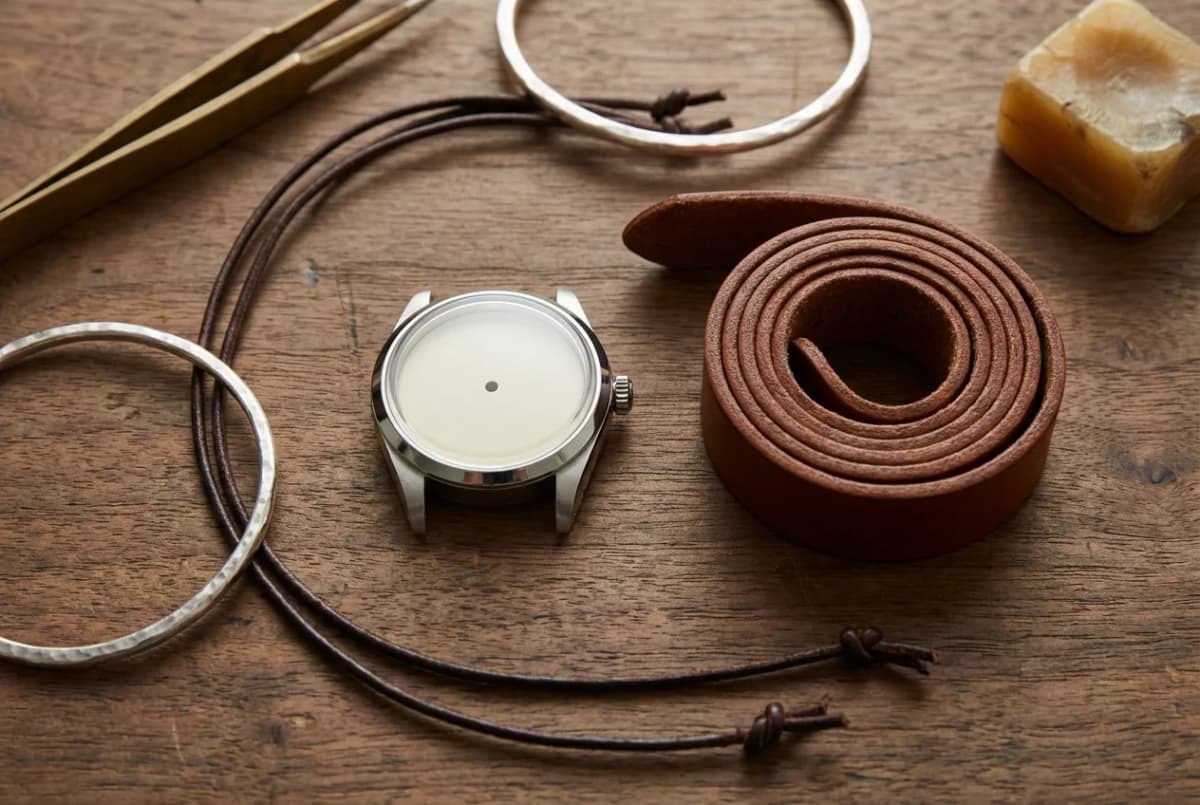
Watchmaking and artisanal jewellery often regard each other from a distance. The former speaks of mechanics, water resistance and tolerances to the hundredth. The latter speaks of gesture, unique pieces and patina. Yet when you open the materials drawer, both trades draw very widely from the same stock: steel, gold, leather, stones, mother-of-pearl, ceramic.
Understanding what each material becomes on one side and the other concretely changes the way you pair a watch and a piece of jewellery. Here are the six families that circulate between the two worlds, and what they entail when worn.
Stainless steel, the common denominator
It is by far the most shared material. Watchmaking has established 316L steel, an austenitic stainless steel chosen for its corrosion resistance and excellent skin tolerance. Contemporary jewellery has followed suit, particularly for pieces intended for daily wear.
The practical benefit is obvious: a 316L watch and a 316L bracelet age at the same rate, react the same way to perspiration and scratch in the same proportions. It is the only pairing where you can ignore the question of differential wear.
The point to watch concerns the finish, not the alloy. Mirror-polished steel reflects light and catches the eye; brushed steel diffuses it. Pairing a polished case with a brushed bracelet works very well, but the reverse in the same field of view creates a gap that you notice straight away. Milanese mesh bracelets illustrate this play of finishes well, and moreover require precise adjustment at the clasp to sit just right on the wrist.
Gold and its alloys: it all comes down to colour
Since pure gold is too soft, it is systematically alloyed. 18-carat gold contains 750 parts per thousand of fine gold, the rest varying depending on the desired shade: copper to lean towards rose, silver and palladium to go towards white, silver and copper in balanced proportions for classic yellow gold.
This recipe explains why two pieces labelled "rose gold" can visibly not be the same colour. The proportion of copper is not standardised, and each workshop has its own. An industrial rose gold watch case and a piece of rose gold crafted by hand are therefore likely to match approximately rather than perfectly.
In mass-market watchmaking, you mostly encounter plating and gold PVD. These surface treatments give a very stable and very saturated shade, often cooler than solid gold worked in a workshop. If you wear artisanal jewellery in gold or vermeil, it is better to compare the two pieces in daylight before deciding: our guide to gold finishes details the colour differences from one treatment to another.
Leather, a living material on both sides
Leather is the only material on this list that changes appearance over its lifetime. This is what makes it the best bridge between a watch and a handmade piece of jewellery.
On the watchmaking side, calf remains the reference for straps, with alligator on high-end pieces. On the creative jewellery side, you mostly see vegetable-tanned leather, thicker, more matte, which darkens as it catches the light and contact with skin. The behaviour of a leather watch strap over the months gives a good idea of what awaits a cord worn just beside it.
These two leathers do not patina at the same rate, but they patina in the same direction. After a few months, a watch strap and a cord worn together end up resembling each other more than on the first day, which is exactly the desired effect. It is also the material that acts as a buffer: slipped between two metal pieces, a leather strap eliminates contact and thus micro scratches.
On leather work in jewellery, independent workshops are often more interesting than large houses, because they work in small series and can afford non-standard tanning. The site Ma Passion documents this type of artisanal manufacturing well, and gives a good idea of what you can expect from a handmade piece compared to industrial production.
Stones: from dial to set stone
Stones circulate in both directions, but with opposite uses.
In jewellery, the stone is the subject: it is cut, set, and the piece is built around it. In watchmaking, it is most often a surface. A dial in lapis lazuli, malachite, onyx or aventurine is a plate of natural stone cut into a thin slice, which explains why two examples of the same model are never strictly identical.
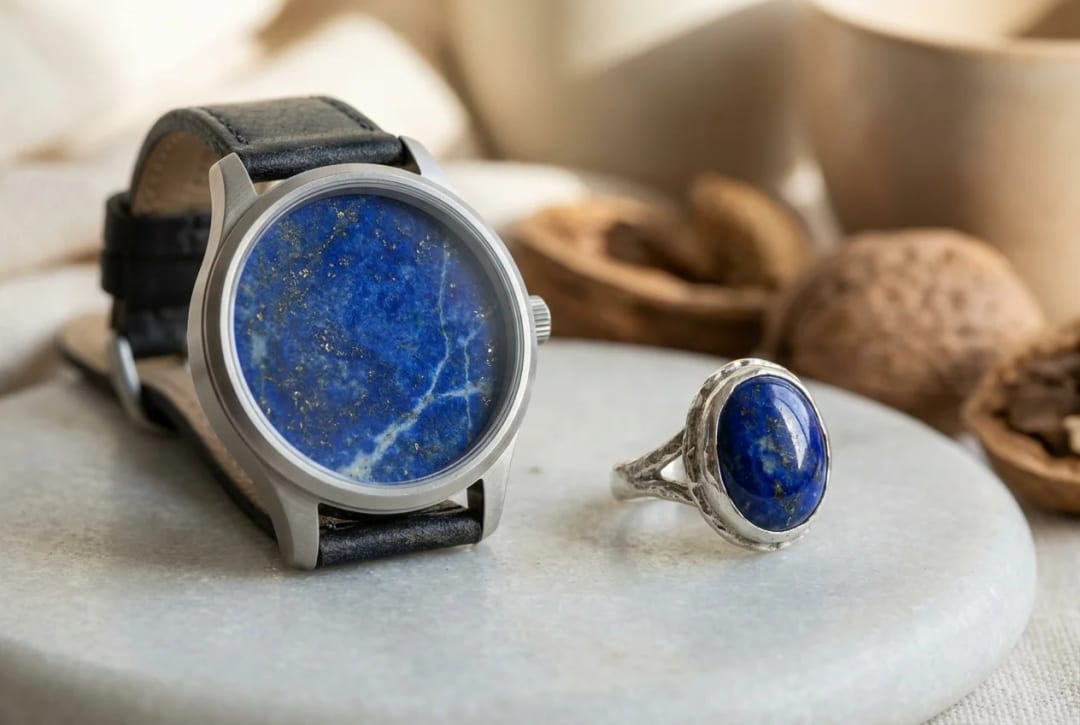
This difference has a direct consequence when worn. A stone set on a piece of jewellery protrudes and rubs; a stone on a dial is protected by the crystal. If you pair a bracelet of raw stones with a watch, place it preferably on the opposite wrist or separate it from the case, as most hard stones scratch a mineral crystal with ease and, even more so, a plating.
Ceramic and titanium: arrived via the watch, adopted by jewellery
These two materials took the opposite path from the previous ones. They established themselves first in watchmaking, before being taken up by contemporary jewellery.
Technical ceramic, obtained by sintering zirconium oxide, has hardness far superior to that of steel. It barely scratches in normal use, retains its colour indefinitely and remains pleasant to the touch. Its limitation is well known: it is brittle. A sharp impact on an edge will cause it to shatter where steel would simply be marked.
Titanium, often grade 5, offers another compromise: approximately 40 per cent lighter than steel for comparable strength, and excellent skin tolerance. Its slightly dark grey shade is not confused with any steel, which makes it a material difficult to match by halves. Either you pair it with other titanium pieces, or you frankly assume the contrast.
Mother-of-pearl and organic materials
Mother-of-pearl is the most elegant meeting point between the two trades. It serves as a dial in watchmaking, cut into thin plates whose reflections change depending on the angle, and as a set or inlaid piece in jewellery.
Like stone, it is natural, so never identical from one example to another. Unlike stone, it is fragile: its hardness is low, it fears household products, perfumes and chlorinated water. A watch with a mother-of-pearl dial and a piece of mother-of-pearl jewellery require exactly the same precautions, which simplifies maintenance when you wear both together.
You also come across wood, horn and raw brass. These materials patina quickly and irregularly, which appeals in artisanal jewellery but remains rare in series watchmaking, where consistency of appearance is a commercial criterion.
What changes when you pair a watch and jewellery
Once these families are identified, the pairing is built on three criteria, in this order.
Hardness first. It is the only criterion that has irreversible consequences. A stone against a crystal, a steel bracelet against a plated case: the softer piece will pay. Separate them, or change wrists.
Finish next. Polished against polished, brushed against brushed, matte against matte. Consistency of finish matters more than exact identity of materials, and this is the most frequent mistake.
Colour last. It is the most visible criterion, but also the easiest to correct. A mix of metals repeated twice in an outfit reads as a choice; the same mix appearing only once reads as a mistake.
In practice, the strongest pairings do not seek resemblance but compatibility. A brushed steel case with a hand-hammered silver piece of jewellery, a vegetable leather strap with a leather strap watch, black ceramic with a patinated brass piece: in each case, the two objects will age together without one damaging the other. This is ultimately the best criterion for harmony between watchmaking and creative jewellery.
Read next
More in this vein
Buying guides
200m Water Resistant Watch: The ideal companion for diving
Buying guides
Swarovski watch: crystal, Swiss Made, what you're really paying for
Buying guides
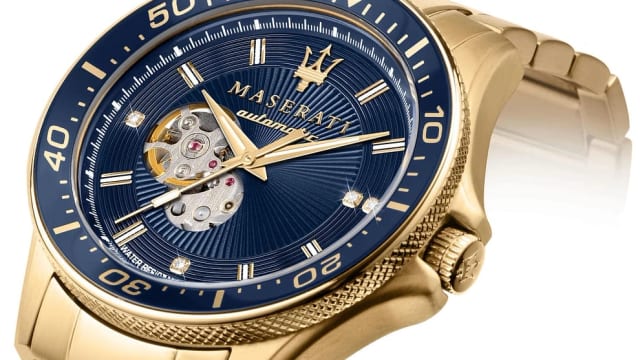
Maserati Sfida R8823140004: autopsy of an open heart NH70
Buying guides
Skeleton watch: the complete guide from a watchmaker (men's, women's, automatic)
Buying guides
Rolex-style watch: Submariner, Datejust and affordable homages
Buying guides
Rectangular watch: from the Cartier Tank to affordable alternatives
Buying guides
Snake watch: from Bulgari Serpenti to Just Cavalli, the complete guide
Buying guides