
Swarovski watch: crystal, Swiss Made, what you're really paying for

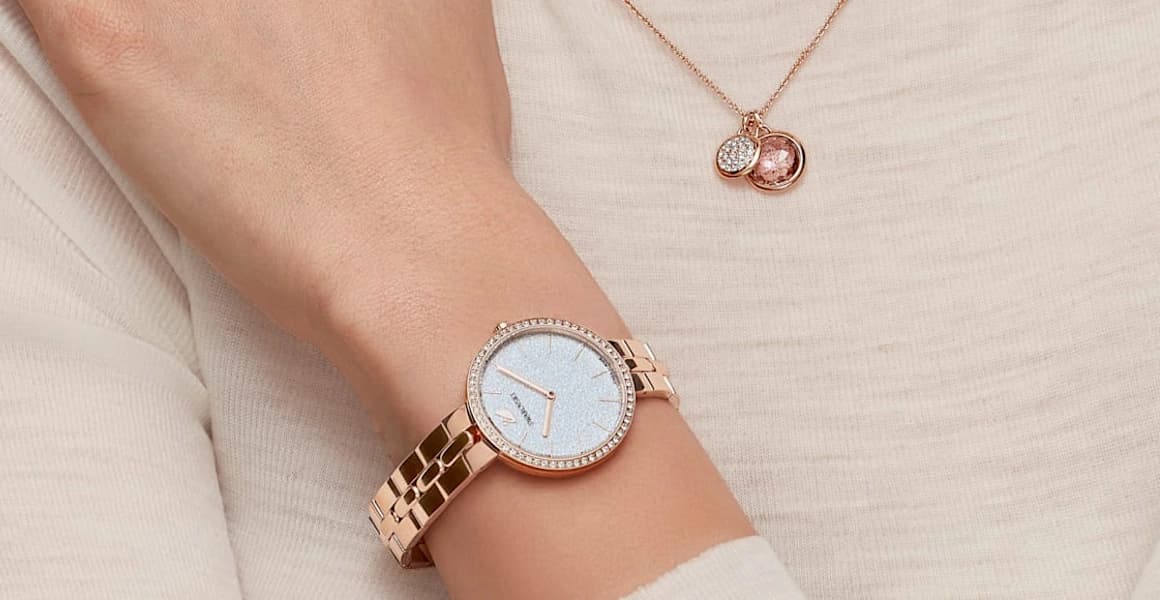
"Diamond dust". The phrase appears on dozens of Swarovski product sheets, and it sells. Yet it leads people to believe in something that does not exist. Here is what is actually on these dials, what you are paying at this price point, and the only technical argument the brand never highlights even though it is by far the strongest.
We have over three hundred Swarovski watches in stock, spread across ninety-two references. That is enough to observe patterns that isolated product sheets do not show. I went through our catalogue and sales data line by line, and enlarged the official visuals where detail matters. Some results surprised me.
"Diamond dust": what it really is
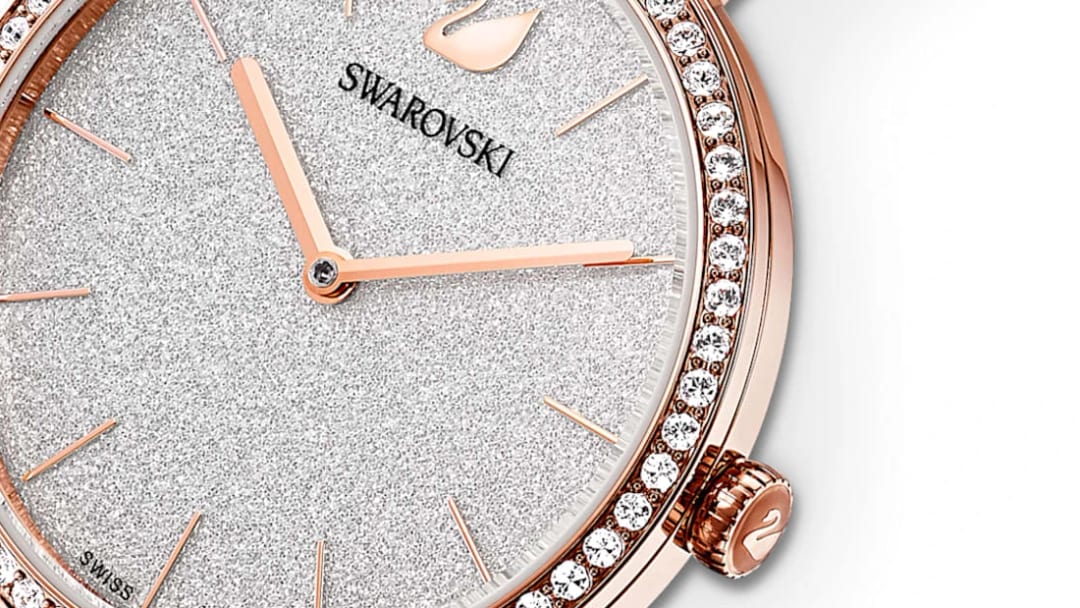
Look at this close-up. The dial is not set with stones. It is a continuous, granular surface, made up of micro-crystals applied in a layer. The sparkling effect comes from the multiplication of tiny facets, not from the presence of gems.
Compare it with the right edge of the image: there, on the bezel, you can clearly see individual faceted crystals set in the metal, each with its own edges. These are two different techniques, two different costs, and two different finishes. The same watch often bears both.
So, to be direct: there is no diamond in a Swarovski watch. "Diamond dust" is a commercial name that describes a visual effect, not a composition. It is not a lie in the strict sense, it is a marketing shortcut, but it is better to know it before you buy than to discover it afterwards.
Swarovski crystal, in practice
The house was founded in 1895 in Wattens, Austria, around a precise invention: a machine to cut crystal mechanically, where the work had previously been done by hand. Everything else stems from that. The Swarovski advantage was never the raw material, which is commonplace, but the reproducibility of the cut.
Technically, it is a glass to which lead oxide is added, historically around 32 per cent, which increases the refractive index and gives this coloured dispersion called fire. The brand has since developed lead-free formulations to meet environmental standards.
What you need to know for a purchase: a well-cut crystal shines more than a poorly cut diamond, to the naked eye and at conversation distance. The difference is visible under magnification, in hardness and in price. On a watch worn daily, the desired visual effect is achieved.
The argument Swarovski never highlights
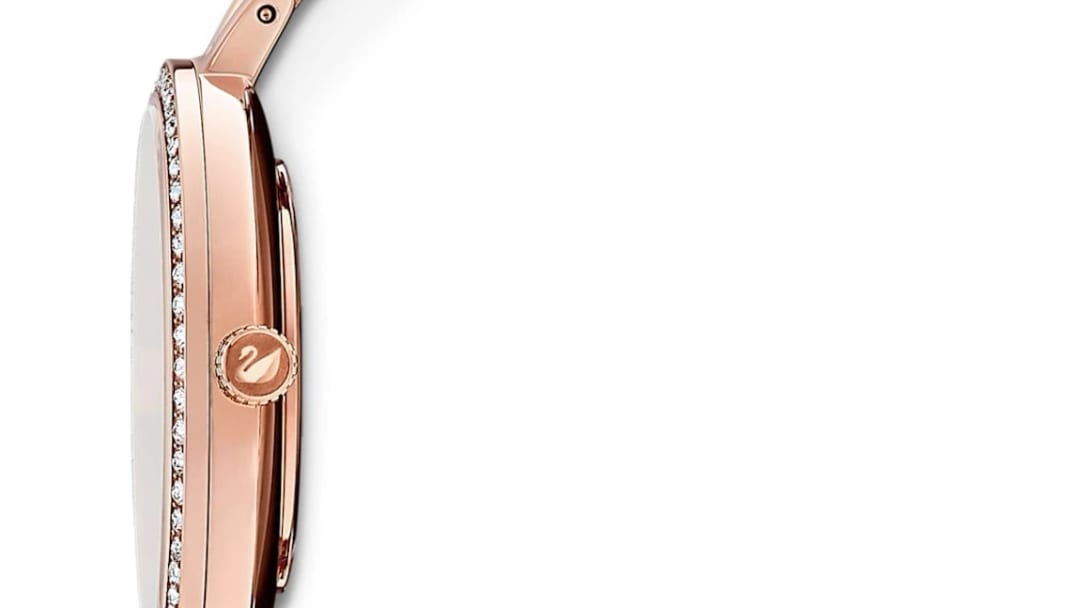
Here is the figure that surprised me most when going through our catalogue: of our ninety-two Swarovski watch references in stock, all are stamped Swiss Made. Ninety-two out of ninety-two.
This is not a decorative mention. The Swiss Made designation is legally regulated in Switzerland: since the strengthening of the ordinance in 2017, a watch can only bear it if at least 60 per cent of manufacturing costs are incurred in Switzerland, the movement is Swiss, and the casing and final inspection took place there. It is a real threshold, monitored, and it costs a lot to achieve.
To measure what this represents, I compared it with the rest of our catalogue, across all brands. Here are the brands with the most Swiss Made watches in our stock.
| Brand | Swiss Made references |
|---|---|
| Calvin Klein | 104 |
| Swarovski | 92 |
| Burberry | 88 |
| Salvatore Ferragamo | 23 |
| Versace | 11 |
| Gucci | 7 |
In other words, Swarovski ranks among the three brands with the most Swiss watches in our catalogue. This is counter-intuitive for a house that the public associates with costume jewellery and crystal figurines, and yet it is the strongest argument in favour of these watches.
What you are really paying for: our catalogue in figures
Let us move on to technical constants. I aggregated the characteristics of our ninety-two references in stock. The results are remarkably consistent, which greatly simplifies the buying decision.
| Characteristic | Actual distribution | What this means |
|---|---|---|
| Movement | Quartz: 92 out of 92 | No automatic watches. High precision, battery to be changed |
| Swiss Made | 92 out of 92 | Swiss movement, legal threshold of 60 per cent of costs |
| Crystal | Mineral: 59 · Sapphire: 7 | Sapphire remains in the minority, to be checked reference by reference |
| Water resistance | 3 ATM: 52 · 5 ATM: 39 | Splashes only for the majority |
| Strap | Leather: 51 · Steel: 41 | Distributed roughly equally |
| Warranty | 2 years on all | Industry standard |
Three practical lessons emerge from this table.
Quartz is systematic. If you are looking for a mechanical watch with automatic winding, Swarovski does not offer any in this range. This is not a flaw: on a jewellery watch worn intermittently, quartz is objectively the right choice, since it returns to the correct time after three weeks in a drawer. We detailed this trade-off in our comparison of automatic versus quartz.
Mineral crystal dominates. On the references where the information is provided, mineral far outweighs sapphire. Mineral sits around 5 to 6 on the Mohs scale, sapphire at 9: a key or a belt buckle can scratch the former, almost never the latter. On a watch with a clear, shiny dial, a scratch is visible. If this matters to you, check the sheet for the specific model before ordering, as both exist in the range.
Water resistance is low, and this is the main point to watch out for. I devote the next section to it, because it is by far the leading cause of disappointment with this type of watch.
3 ATM: what you will not be able to do
Fifty-two of our references display 3 ATM, thirty-nine display 5 ATM. These figures are often read as diving depths. They are not.
| Situation | 3 ATM | 5 ATM |
|---|---|---|
| Rain, splashes, hand washing | Yes | Yes |
| Shower | Risky | Occasional |
| Swimming, pool | No | No |
| Sauna, hammam | No | No |
| Diving | No | No |
The reason is twofold. First, the rating is measured in the laboratory, at static pressure, on a new watch: it says nothing about the state of the seals after months of wear, nor about a crown not pushed fully home, which is enough to let water in. An arm movement in the water, on the other hand, adds almost nothing: dynamic pressure is ½ρv², roughly 0.5 bar even at 10 m/s. Second, the heat of a shower expands the seals and soap attacks them, which degrades water resistance cumulatively and irreversibly.
On a watch with a crystal dial, water ingress has a particularly visible consequence: condensation deposits under the crystal and permanently dulls the sparkling surface. The damage is aesthetic as much as mechanical. If this happens to you, our article on condensation in a watch explains how to distinguish temporary condensation from a failed seal. To understand these ratings in detail, our 5 ATM guide and our general water resistance guide cover the subject from scratch.
Maintaining a watch with a crystal dial
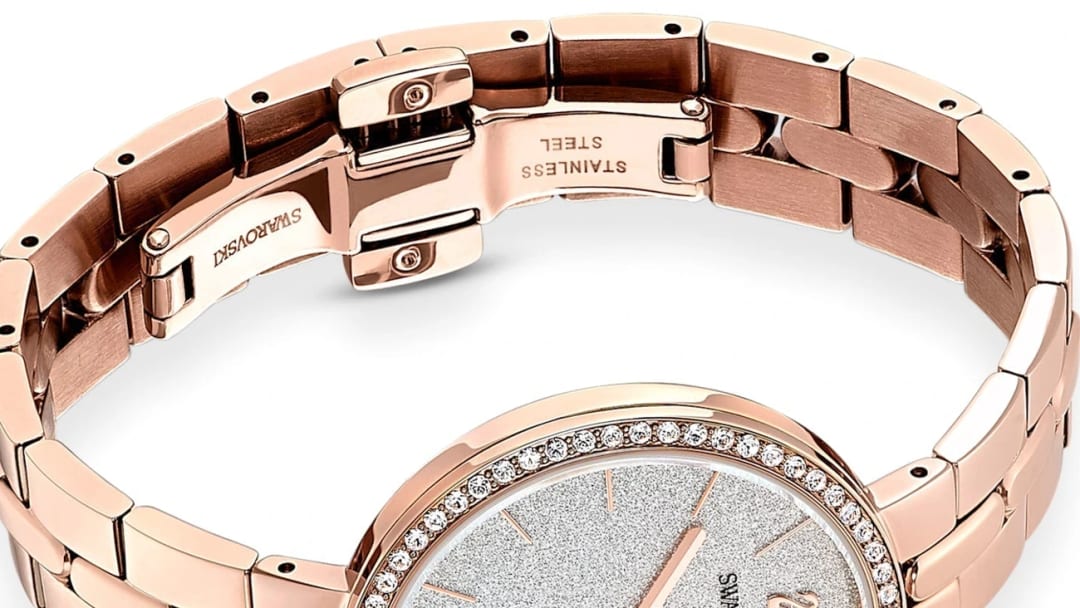
This is the most asked question about these watches, and it deserves more than a line in the manual. A sparkling dial loses its appeal as soon as it becomes dirty, and soiling is progressive, so barely noticeable day to day.
Cleaning. A dry microfibre cloth, in light circular motions, is sufficient in most cases. If a greasy film has built up, a microfibre cloth barely dampened with clear water, then immediate drying. Never use window cleaner, household alcohol or jewellery cleaner in a bath: these products attack the setting adhesives and can dull the plating.
The settings. In the macro photograph above, you can clearly see the gaps around each crystal. This is where powder, cream and perfume accumulate. A brush with very soft bristles, used dry, allows you to dislodge deposits. Never force it: a loose crystal cannot be reglued properly.
Cosmetics. This is the real killer of these watches, and nobody says it. Perfume, hairspray, sunscreen and hand sanitiser attack both the case plating and the adhesives. The rule is simple: put the watch on last, after perfume and cream, and remove it before removing your make-up.
The battery. All these watches being quartz, the battery runs out in two to three years. Have it replaced by a professional who will check the seal on reassembly: this is an opportunity to preserve what little water resistance is available, and the operation remains inexpensive.
Choosing your model: the three useful questions
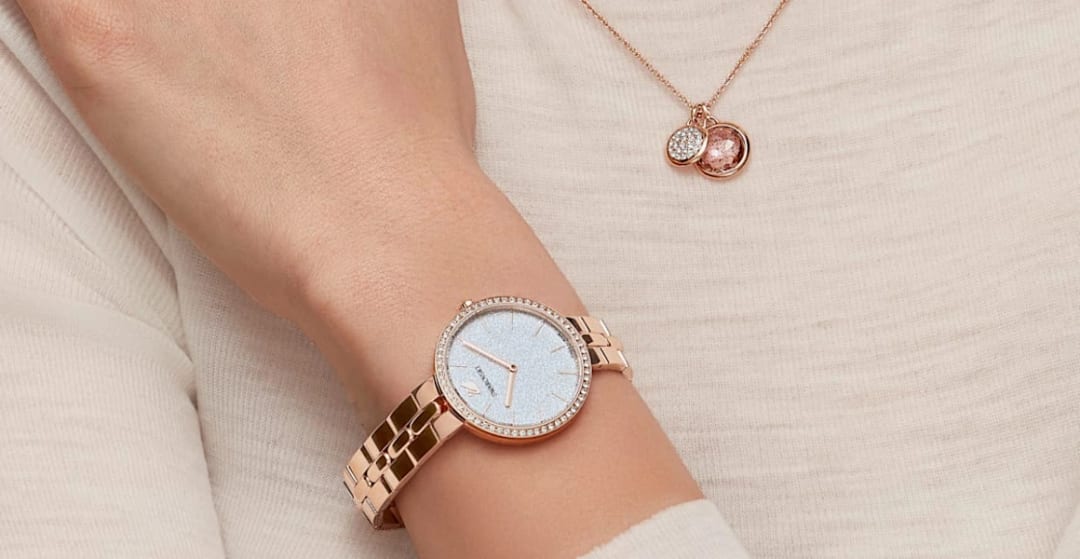
The range spans a core market segment, from accessible tier to accessible premium tier depending on finishes and bracelet type. Current prices appear on each product sheet. Here is how I guide the choice in store.
First question: full crystal dial or set bezel? The entirely paved dial, Cosmopolitan or Crystalline type, captures light constantly and is noticeable from a distance. The bezel set on a plain dial, Octea Lux type, is much more discreet and works better in a professional environment. This is a choice of register, not quality.
Second question: steel or leather? Our stock is shared almost equally. Steel, often rose gold on this range, reinforces the jewellery effect and cleans easily. Leather softens the overall look and wears better in summer on sensitive skin, but it ages and will need to be changed. Given that these watches fear water, leather adds no real constraint.
Third question: what diameter? These cases are mostly between thirty and thirty-eight millimetres, which suits most women's wrists. If you are unsure, our women's watch size guide gives the measurement method and correspondences.
The benchmark collections of the range
Swarovski names its lines, and these names often come up in searches. Here are the useful benchmarks to find your way, as they appear in our stock.
| Line | Refs in stock | Distinctive feature | For whom |
|---|---|---|---|
| Crystalline | 22 | Very sparkling variations, often leather strap or crystals on the bracelet | The evening and gift register |
| Octea Lux | 22 | Plain coloured dial, sparkle concentrated on the bezel | Most wearable at the office |
| Cosmopolitan | 7 | Dial entirely paved with micro-crystals, set bezel, slim round case | Maximum sparkle, assumed jewellery effect |
| Certa | 4 | Steel case, mixed silver and rose gold finishes | Those who want to nuance the gold |
A point that our sales reveal and which goes against the brand's narrative: models do not sell by collection effect, but individually. Over twelve months, our forty-three references sold are distributed very evenly, with no overwhelming best-seller. In other words, the buyer chooses a dial she likes, not a line. Do not let yourself be locked in by a collection name: compare dials side by side.
Who these watches suit, and who they do not suit
After selling several hundred of these pieces, the dividing line is quite clear.
They suit those looking for an accessory that stands out, who embrace the jewellery register, appreciate the idea of a Swiss movement under a decorative dial, and accept a watch that will not go in water. For a gift, they work very well: the object is immediately legible, the packaging is careful, and the name speaks to everyone.
They are not suitable for those who want a unique watch worn seven days a week without thinking about it, for those who swim or shower with their watch, for those seeking an investment, or for those who prefer discretion. In these four cases, a more classical watch with a better water resistance rating will be a better purchase, and our selection of women's water-resistant watches is a better starting point.
A word on value, because the question keeps coming up: these watches are not an investment. Crystal has no resale value, nor does quartz. They are bought to be worn and for the pleasure they provide, which is a perfectly sufficient reason, but one that must be stated.
To discover the full range, our Swarovski brand page and our selection of women's Swarovski watches bring together the available models. If your budget is the main criterion, our guide to women's watches with the best value for money broadens the search beyond the brand.
Frequently asked questions about Swarovski watches
Are Swarovski crystals real diamonds?
No. Swarovski crystal is lead glass cut with great precision, not a precious stone. Its hardness is around 6 to 7 on the Mohs scale compared to 10 for diamond. The mention of "diamond powder" that you see on some product sheets describes a visual effect, obtained by a layer of micro-crystals applied to the dial, and not the presence of diamonds.
Are Swarovski watches really Swiss?
Yes, and it is their strongest argument. All of our ninety-two references in stock bear the Swiss Made designation. This designation is governed by Swiss law: it requires a Swiss movement, at least 60% of manufacturing costs incurred in Switzerland, as well as casing and final inspection on site.
Can you shower or swim with a Swarovski watch?
Not for swimming. The majority of our references are rated for 3 ATM, the rest for 5 ATM, which covers splashes and rain but not immersion. Showering remains a risk at 3 ATM and should stay occasional at 5 ATM: heat expands the seals and soap degrades them. On a crystal dial, any seepage leaves condensation that permanently dulls the sparkling appearance.
How to clean a Swarovski watch without damaging it?
A dry microfibre cloth is usually sufficient, possibly barely dampened with clear water and dried immediately. For the gaps around set crystals, use a brush with very soft bristles dry. Absolutely avoid alcohol, window cleaners and jewellery cleaning baths, which attack the setting adhesives and plating. Always put the watch on after perfume and cream.
What movement powers Swarovski watches?
A quartz movement, across all of our ninety-two references. There is no automatic in this range. It is a coherent choice for a watch worn intermittently: it shows the correct time even after several weeks without being worn. The battery is replaced every two to three years, ideally by a professional who will check the seal.
Read next
More in this vein
Buying guides
200m Water Resistant Watch: The ideal companion for diving
Buying guides
The materials making a comeback in both watchmaking and creative jewellery
Buying guides
Maserati Sfida R8823140004: autopsy of an open heart NH70
Buying guides
Skeleton watch: the complete guide from a watchmaker (men's, women's, automatic)
Buying guides
Rolex-style watch: Submariner, Datejust and affordable homages
Buying guides
Rectangular watch: from the Cartier Tank to affordable alternatives
Buying guides
Snake watch: from Bulgari Serpenti to Just Cavalli, the complete guide
Buying guides