
Skeleton watch: the complete guide from a watchmaker (men's, women's, automatic)

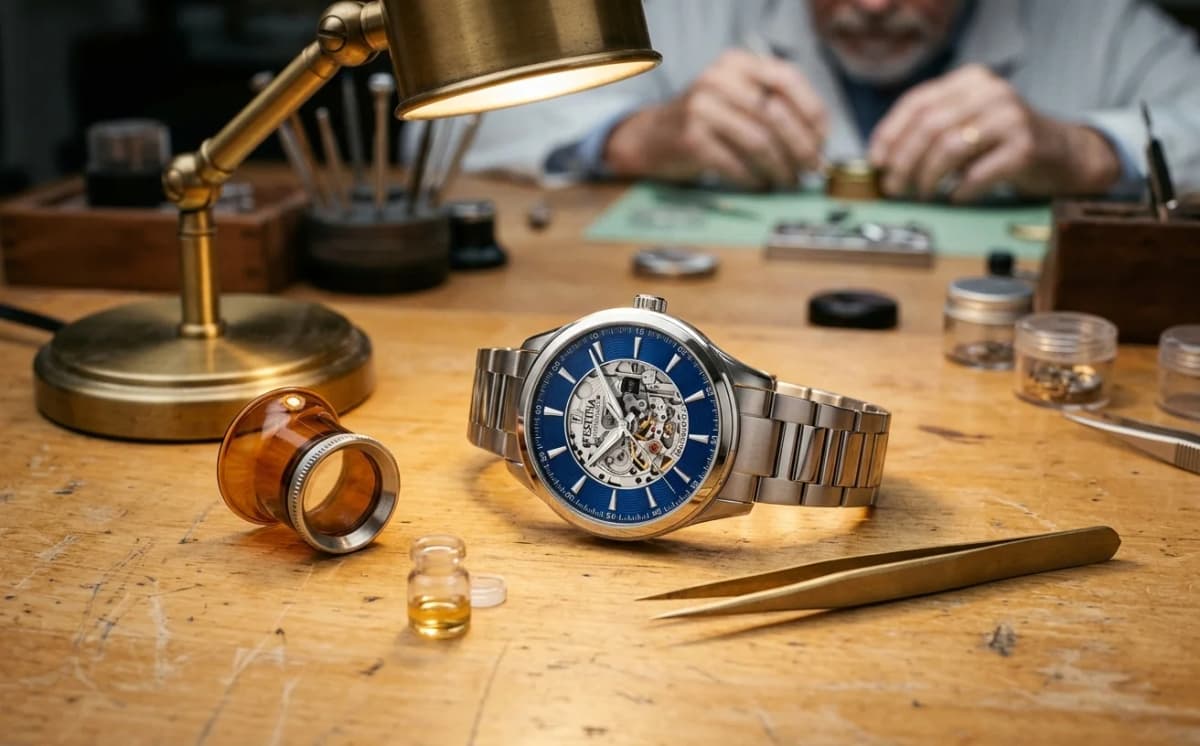
In twenty years at the bench, I've opened thousands of cases, and I can tell you what makes a skeleton watch unique: it's the only one that permanently shows what all watchmakers hide. Gears, balance wheel, mainspring: the naked mechanical spectacle, popularised by haute horlogerie and its six-figure skeletonised pieces, exists today in entirely serious affordable versions. But beware: beneath the word "skeleton" lurk three very different constructions, from the genuinely skeletonised movement to the simple open dial, and sellers happily maintain the confusion. Here is a watchmaker's guide to choosing a skeleton watch for men or women without being told tall tales.
Why the skeleton watch fascinates: the forbidden spectacle
Skeletonisation is an ancient art: from the 18th century, master watchmakers hollowed out plates and bridges to reveal the gears, transforming the instrument into theatre. Today, this language has become the signature of the very highest end: the skeletonised cases of Audemars Piguet, the suspended architectures of Hublot, and of course Richard Mille, whose tourbillon skeleton watches reach villa prices and dominate the imagination (searches for "watch that looks like Richard Mille" genuinely exist). What all of this world sells, fundamentally, is the same emotion: telling the time and seeing a living mechanism beat.
The good news that haute horlogerie won't shout from the rooftops: this emotion doesn't depend on price. A balance wheel oscillating at 3 Hz before your eyes produces the same small hypnotic miracle on a Festina automatic as on a collector's piece, and the 18,000 monthly searches combined around "skeleton watch" in France show that the public has understood this perfectly. The whole question is knowing exactly what you're being sold under that word, and that's where my profession becomes useful.
Skeleton, open heart, skeletonised dial: the 3 levels that sellers mix up
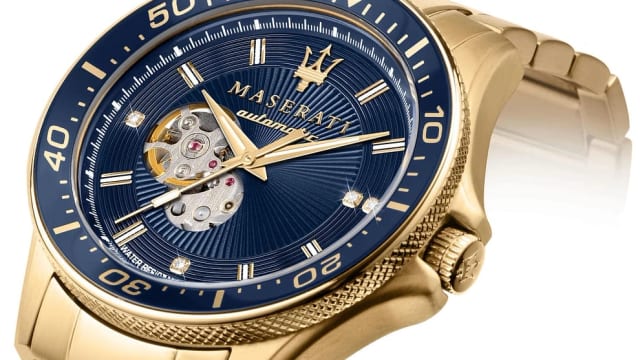
Here is the distinction I make at the bench, and which you won't find on any product sheet. Level 1, the full skeleton: the mechanical movement itself is skeletonised, bridges and plates hollowed out, visible from both sides. This is the true skeleton, the one from the historical term. Level 2, the open heart: a classic automatic movement whose dial is pierced with a window revealing the balance wheel, usually at 12 o'clock or 9 o'clock. The spectacle is real but partial. Our macro autopsy of a Maserati Sfida open heart shows this precisely: depending on the calibres, the opening sometimes reveals the jewels and gear bridges rather than the balance wheel itself. Level 3, the skeletonised dial on quartz: the dial is cut to show... a battery-powered movement, with its modest gear trains. The visual effect exists, the mechanical poetry much less so. None of these three levels is a con as long as it's sold for what it is: it's the blur maintained between them that is.
A true skeleton shows a movement with nothing left to hide. A skeletonised dial shows a movement with nothing to show. Both sell as "skeleton": learn to see the difference.
How to tell them apart in 10 seconds, workshop method: look for the balance wheel, that wheel oscillating rapidly back and forth. Visible and beating: you're at level 1 or 2, it's mechanical. No balance wheel, a seconds hand jumping sharply from second to second: quartz, level 3. Next, turn the watch over: a transparent caseback with a rotor (the semi-circular mass that pivots) confirms the automatic. This reading grid works for all brands, from the flea market to the luxury boutique. To go further on this debate, our guide automatic or quartz sets out the real terms of the choice.
Automatic skeleton watch: our two watchmaker references
Let's start with the pinnacle of our catalogue in this regard, the accessible level 1:
The Festina Skeleton Automatic F20536/3 is exactly what a watchmaker calls a skeleton: skeletonised automatic movement running through, visible front and back, blue dial ring to maintain minimum reading markers, sapphire crystal (extremely rare at this price tier, and a guarantee of scratch resistance), 43 mm in steel. Festina is a serious Spanish house that has been making affordable mechanics for decades, and this reference is the one I show when asked for "a true skeleton without breaking the bank". At this level of openness, readability requires a day of adjustment: it's the price of the spectacle, and you need to know it before buying.
The Maserati Epoca R8821118002 illustrates level 2, the well-executed open heart: anthracite sunburst dial pierced at the centre, automatic movement visible through the opening and the caseback, blue leather, and an unusual 10 ATM water resistance for a dressed mechanical watch (most skeletons cap out at 5 ATM). This is the compromise I recommend to anyone who wants the mechanical beat without sacrificing daily readability: the indices stay in place, the time reads at a glance, the spectacle is at the centre. The entire range is on our Maserati brand page, and our mechanical pieces on the men's automatic watch collection.

The committed quartz skeleton: visual effect without the mechanics
Level 3 deserves better than the disdain of purists, on one condition: own it. A skeletonised dial on quartz movement offers the industrial aesthetic of the skeleton (depth, visible layers, modernity) with the precision and peace of mind of quartz, on a tight budget. It's a perfectly legitimate style choice, and our best-seller of the kind proves it:
The Tommy Hilfiger Henry 1710479 plays the graphic skeleton: anthracite skeletonised dial, rose gold touches, assertive 44 mm, multi-function day-date. Let us be precise, as a watchmaker: it is a quartz with skeletonised dial, not a skeletonised movement, and its maker makes no claim otherwise. What you are buying is a very current wrist presence and maintenance reduced to a battery every two or three years. It is our best-selling skeleton by volume, precisely because it owns this positioning. In the same owned register, the Fossil skeleton watch (the FB-01 and Townsman with open dial, regularly in stock on our Fossil brand page) applies the same American recipe. The rest of the family is on the Tommy Hilfiger brand page.
Skeleton watch for women: the segment on the rise
For a long time, the skeleton was a male territory, and that is changing: "skeleton watch for women" now accounts for 1,000 monthly searches, a third of the men's volume. The dominant feminine interpretation passes through the skeletonised dial set with crystals: the visible mechanics treated as jewellery, crystals on the bezel, 36-37 mm formats.
The Guess Allara GW0604L3 is the best demonstration of this in our stock: rose gold skeletonised dial on anthracite background, octagonal bezel set with crystals, rose gold steel bracelet punctuated with set rows, 36 mm. The construction is a multi-function quartz with open dial (level 3, owned), and the wrist effect is that of a contemporary jewellery watch that stands out as much as a set bracelet. For women who prefer true visible mechanics, unisex open hearts in 40 mm remain an excellent option on a wider wrist, and our Emporio Armani page lines up several skeletonised Meccanico models that bridge the two worlds.

The workshop table: our skeletons in stock, level by level
| Model | Skeleton level | Movement | Diameter | Water resistance | For whom |
|---|---|---|---|---|---|
| Festina Skeleton F20536/3 | Level 1: full skeleton | Automatic | 43 mm | 5 ATM | The purist who wants the true through-view spectacle, sapphire crystal |
| Maserati Epoca R8821118002 | Level 2: open heart | Automatic | 42 mm | 10 ATM | The balance of visible mechanics, readability and daily use |
| Tommy Hilfiger Henry 1710479 | Level 3: skeletonised dial | Multi-function quartz | 44 mm | 5 ATM | Modern skeleton style without mechanical maintenance |
| Guess Allara GW0604L3 | Level 3: skeletonised dial set with crystals | Multi-function quartz | 36 mm | 3 ATM | The skeleton watch for women treated as jewellery |
Watchmaker reading of this table: the price roughly follows the level of mechanical skeletonisation, and that makes sense, hollowing out a movement is expensive, cutting a dial costs little. Be wary therefore of any "automatic skeleton" abnormally cheap on marketplaces: at this tier, the movement is often an undecorated Chinese mechanical with random reliability, or even a quartz in disguise. Our four references each play fair on what they are, with 2-year international warranty in all cases.
Choosing and living with a skeleton watch: workshop advice
Three truths of use that two decades of after-sales service have taught me. One: readability degrades with opening. On a full skeleton, reading the time at a glance takes a few days of habit; if you check your watch a hundred times a day in meetings, the open heart is more reasonable. Two: an automatic lives. Worn daily, it stays wound; left in a drawer for three days, it stops and resets to the correct time in thirty seconds. It is a ritual, not a chore, but know it. Three: the skeleton does not like shocks. A hollowed-out movement has, by construction, less material around its pivots: tennis, DIY and mountain biking are practised with another watch. For the rest, maintenance is that of any mechanical: a service every five to seven years at a watchmaker, and a simple soft cloth for the case.
Do
- Look for the beating balance wheel: it is the 10-second test to distinguish mechanical and quartz.
- Choose the open heart if you want mechanics AND daily readability.
- Favour sapphire crystal (Festina) if the watch will be worn every day.
- Own the skeletonised quartz as a style choice: it is the skeleton without constraint.
Avoid
- Paying a mechanical price for a skeletonised dial on quartz: check the word "automatic".
- Anonymous automatic skeletons at bargain prices on marketplaces: random reliability.
- Sport with a hollowed-out movement: less material = less shock resistance.
- Forgetting water resistance: most skeletons are at 3-5 ATM, never swimming.
And if mechanical aesthetics seduce you without the skeleton, two complementary reads: our guide to Rolex-style watches and affordable homages for sporting archetypes with transparent case back, and our rectangular watch guide for watchmaking geometry in its purest form. Three ways to love the mechanics of time.
67 skeletons in stock, from graphic quartz to full automatic
Festina, Maserati, Tommy Hilfiger, Guess, Emporio Armani: our skeleton watches are in real stock, with free delivery to mainland France, subject to our terms (3-5 working days) and 2-year international warranty. Outlet price in real time on each product page.
FAQ: your questions about skeleton watches
What is a true skeleton watch?
In the strict sense, it is a watch whose mechanical movement itself is skeletonised: bridges and plates hollowed out to reveal the gears, visible generally from both sides. By commercial extension, the word also covers open-heart dials (window on the balance wheel) and skeletonised dials on quartz. All three are legitimate; what matters is knowing which one you are buying, and the beating balance wheel test answers in ten seconds.
What is the best affordable automatic skeleton watch?
In our stock, the Festina Skeleton Automatic F20536/3 dominates the debate: full skeletonisation running through, sapphire crystal, 43 mm steel, serious mechanical brand. For easier daily wear, the Maserati Epoca with open heart offers visible beat with genuine readability and 10 ATM. Both showcase authentic mechanics, not a styling effect.
Men's skeleton watch: what size to choose?
Current men's skeletons come in 42 to 44 mm, and the dial opening visually amplifies the size: a 44 mm skeletonised looks larger than a 44 mm solid dial. From 17 to 20 cm wrist circumference, anything works; under 16 cm, aim for 40-42 mm maximum, and an open heart rather than full skeletonisation, whose visual complexity can overwhelm a slender wrist.
Do beautiful skeleton watches for women exist?
Yes, and the segment is progressing rapidly: the feminine interpretation mainly comes through the skeletonised dial set with crystals in 36-37 mm, like the Guess Allara rose gold in our stock, which is worn as a jewellery watch. Women who prefer authentic visible mechanics often choose a unisex 40 mm open heart worn oversized: it's a matter of style, not a rule.
Is a skeleton watch fragile?
More sensitive to shocks than a solid watch, yes: hollowing out a movement removes material around the pivots and bridges. In daily life (office, walking, driving), no concern; for tennis, percussion DIY or mountain biking, wear something else. On the water side, most skeletons display 3 to 5 ATM: splashes only, never swimming.
How to tell if a skeleton is automatic or quartz?
Look at the seconds hand and the balance wheel. A seconds hand that glides in rapid, fluid micro-steps plus a wheel that visibly oscillates: that's mechanical. A seconds hand that jumps with a sharp click every second, no visible beating component: that's quartz. Also check the "Automatic" mention on the dial and the presence of a rotor through the transparent caseback. The word "skeleton" alone guarantees nothing.
Why do luxury skeleton watches cost so much?
Because high-end skeletonisation is craftsman work: hollowing out a movement without compromising its rigidity, bevelling and decorating each remaining bridge, that represents dozens of hours of skilled labour. Pieces from Audemars Piguet, Hublot or Richard Mille add exotic materials and limited editions. The emotion of visible mechanics exists from the accessible tier onwards: it's the finishing that changes scale, not the principle.
What maintenance for an automatic skeleton watch?
The same as a standard automatic: a full service every five to seven years at a watchmaker's (cleaning, oiling, adjustment), regular soft cloth for the case, and avoid strong magnetic fields (speakers, laptop clasps). If the watch sits in a drawer, a few manual winds before wearing it is enough to restart it. There is no battery: you are the movement.
Read next
More in this vein
Buying guides
200m Water Resistant Watch: The ideal companion for diving
Buying guides
The materials making a comeback in both watchmaking and creative jewellery
Buying guides
Swarovski watch: crystal, Swiss Made, what you're really paying for
Buying guides
Maserati Sfida R8823140004: autopsy of an open heart NH70
Buying guides
Rolex-style watch: Submariner, Datejust and affordable homages
Buying guides
Rectangular watch: from the Cartier Tank to affordable alternatives
Buying guides
Snake watch: from Bulgari Serpenti to Just Cavalli, the complete guide
Buying guides