
Watch polishing: the complete guide by crystal and metal type

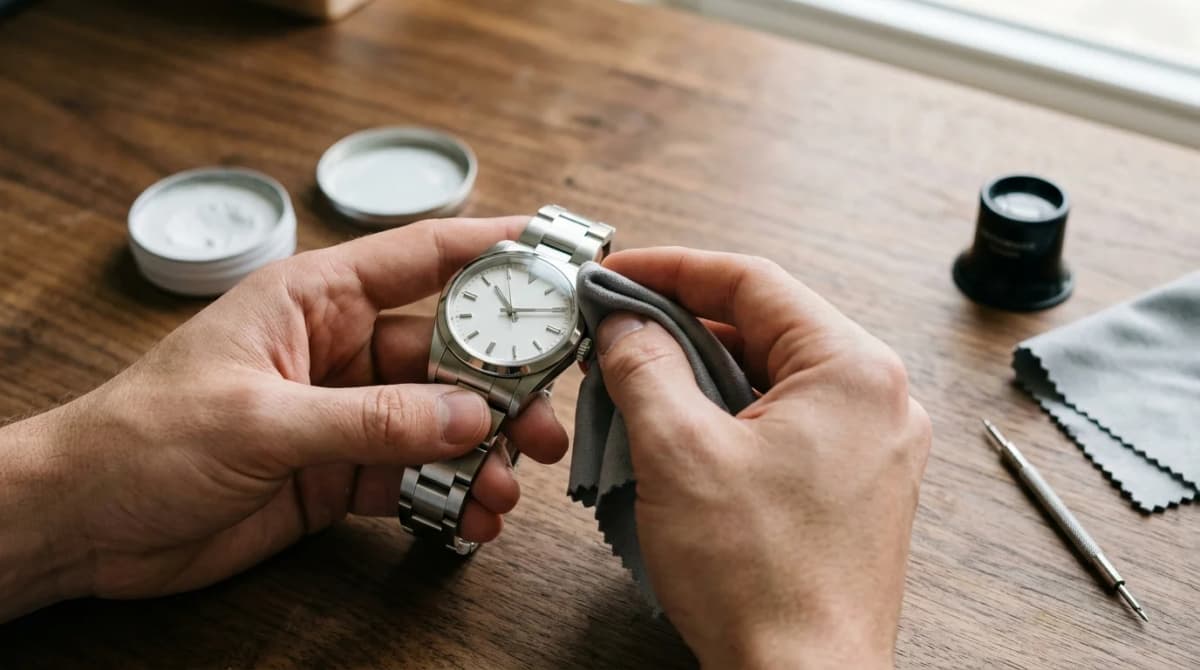
A scratch on the crystal, a mark on the strap, and the watch suddenly looks five years old. The reflex is to grab some polish paste and rub. Sometimes that's the right call, and sometimes it's the worst: on a sapphire crystal, you'll waste your time; on a gold-plated strap, you'll wear through the plating in a few passes. Before polishing anything, you need to know what you have on your wrist. This guide to watch polishing gives you the rule by material, with figures from our own catalogue, so you know how to remove a scratch from a watch without damaging it.
Polishing a watch: the first question is not "how", but "on what"
Most polishing guides start with the method. That's backwards. The technique is the same everywhere: a bit of paste, a cloth, circular motions. What changes everything is the material you're applying it to, because polish paste works by abrasion: it removes a tiny layer of material to flatten the edges of the scratch.
On solid material like steel, removing a few microns makes no difference. On a coating just a few microns thick, it means going through it. And on material harder than the abrasive, nothing simply happens.
To give you an idea of the real distribution, we counted the crystal types on the 3,277 watches currently in stock with us. The picture is clear.
| Crystal type | Share of catalogue | Polishable with paste? |
|---|---|---|
| Mineral | 90.5% | Yes, this is the standard case |
| Sapphire (all variants) | 5.3% | No, too hard |
| Scratch-resistant treated mineral | 1.9% | No, destroys the coating |
| Hardlex | 1.3% | With caution |
| Plexiglas / acrylic | 0.6% | Yes, and remarkably well |
Nine watches out of ten therefore have a mineral crystal, the one that polishes best. That's good news: if you don't know what you have, the odds are heavily in your favour. But the 5.3% sapphire are precisely the ones people labour over longest, thinking they're doing it wrong.
Polishing a mineral crystal on a watch: the simple case
Mineral crystal is tempered glass, with a hardness of around 5 to 6 on the Mohs scale. In practice, it scratches on contact with sand, suspended quartz dust, a set of keys in a pocket. It's the most common crystal on the affordable watch market, and it's also the one that accumulates the most micro-scratches over the months.
Good news: to remove a scratch from a mineral watch crystal, these micro-scratches can be recovered. A polish paste formulated for watchmaking contains an abrasive fine enough to flatten the edges of a surface scratch without gouging the crystal. The result isn't magic: the scratch doesn't disappear, its edges stop catching the light, and it becomes invisible to the naked eye.
The limit to know: the fingernail test

There's a simple and reliable test to know if a scratch will come out. Run your fingernail across the scratch perpendicularly, without pressing.
- The fingernail glides without catching: the scratch is superficial, it will come out with polishing.
- The fingernail catches: the scratch is deep. Polishing will reduce it at best, but won't remove it. Persisting will only create a hollow around it and distort the dial optically when viewed from an angle.
This test applies to all crystals, and it prevents the most common mistake: spending an hour rubbing a scratch that will never come out.
Scratch on a sapphire crystal: stop right now
This is the point on which almost all guides remain vague, and the one that wastes the most time.
Synthetic sapphire has a hardness of 9 on the Mohs scale, just behind diamond. The abrasives in watchmaking polish paste are well below that. Rubbing sapphire with polish paste is like trying to file steel with wood: the technique is correct, the tool has no grip.
If the scratch doesn't come out after several minutes of careful polishing, the question isn't your technique: it's probably sapphire.
This also explains a counter-intuitive observation. A watch with a sapphire crystal scratches very little, but when it does scratch, it's almost always permanent at home. Only a workshop with diamond paste and a polishing machine can refinish a sapphire, and the operation usually costs more than the crystal itself on an affordable watch.
How do you know if you have sapphire? Three clues. The model's technical sheet almost always mentions it, because it's a selling point. The crystal is colder to the touch of your lips than mineral. And a drop of water placed on it holds a more domed shape. In our survey, sapphire concerns only 5.3% of watches, but it becomes noticeably more common as you move up the price range.
The trap of scratch-resistant treated crystal
This is the trickiest case, because nothing distinguishes it to the eye from ordinary mineral crystal.
A mineral crystal with scratch-resistant coating has a hardened surface layer applied at the factory. This coating is a few microns thick. Polishing such a crystal works in the short term: the scratch fades. But the abrasion also removes the coating over the entire polished area. The crystal becomes bare mineral again, softer, which will scratch more easily than before, and this time there will be nothing left to remove.
In our catalogue, these treated crystals represent 1.9% of watches, or 63 models. That's not many, but if you're one of them, the information completely changes the decision. If in doubt about the mention "scratch-resistant treated" or "anti-scratch" in the technical sheet, don't polish.
Strap and case: the material decides, not the brand
The reasoning is identical for metal, with an even sharper dividing line.
Polishing a stainless steel watch strap: without worry

Stainless steel is a solid material. Removing a few microns from the surface changes nothing about its structure or its protection against corrosion, which is intrinsic to the metal and not applied on top. It is by far the most common material: 2,771 watches in our catalogue have a steel bracelet, compared to 856 in leather.
A useful note for steel: the direction of polishing matters. A brushed bracelet has intentional parallel striations. Polishing in circles on a brushed surface creates a shiny zone in the middle of a matt surface, more visible than the original scratch. On brushed steel, work in the direction of the striations. On mirror polish, circular movements are the right approach.
Gold plating, gold-plated, PVD: never polish
Gold plating is typically between 0.5 and 5 microns thick. A PVD coating is between 1 and 4 microns. A polishing paste, used normally, removes around one micron per insistent pass.
The calculation is straightforward: a few minutes of polishing is enough to go through the layer and expose the underlying brass or steel. The result is irreversible, and far more noticeable than the initial scratch, a pinkish or grey zone in the middle of a gold surface. Our catalogue contains 64 watches with plated metal bracelets (gold and rose gold), to which are added all the gold-plated cases, which are far more numerous.
On these finishes, the only reasonable intervention is cleaning: lukewarm water, mild soap, microfibre cloth. Scratches must be lived with, or treated by re-plating at a workshop.
Ceramic: neither polishable nor repairable
Watchmaking ceramic is very hard and barely scratches. However, it is brittle: a sharp impact shatters it rather than marking it. A ceramic chip cannot be polished, it must be replaced. We have 28 examples in our catalogue, with a median price significantly higher than the rest.
The method, once the material is identified

If you have made it this far and your watch has a mineral crystal or a steel bracelet, the technique itself is straightforward.
- Clean first. A grain of sand left on the crystal will turn your cloth into a scratching tool. Lukewarm water, mild soap, complete drying.
- Protect what should not be polished. A piece of masking tape on the gold bezel, on the dial if the crystal is removed, on adjacent brushed areas.
- Little paste. The equivalent of a pinhead is enough for a watch crystal. Too much product clogs the cloth and disperses the abrasive.
- Work in short sequences. Thirty seconds, then wipe and look at the result in the light. Polishing is irreversible: three controlled passes are better than one that is too long.
- Finish with a clean cloth. A second microfibre cloth, without paste, to remove residue and reveal the actual result.
What polishing will not fix: removing a scratch has its limits
Three situations where polishing is the wrong tool, and where insisting makes things worse.
A scratch that catches the fingernail. Attempting to repair this watch scratch is futile: it is too deep. Reducing it would require removing enough material around it to create a visible optical deformation. On a mineral crystal, replacement often costs less than one might imagine.
A scratched dial. The dial is under the crystal. If the scratch is on the dial, no external polishing will reach it, and opening the watch to access it is a workshop job, with a water resistance risk as a consequence.
A crystal that has become cloudy or pitted. This is not a scratch but corrosion or an old infiltration. Polishing will only thin the crystal.
Maintain rather than repair
The best way to deal with a scratch is not to create one. A few habits that really make a difference, and which cost zero pounds.
Remove the watch before DIY and indoor sports: the majority of deep scratches come from contact with metal or concrete, not from daily wear. Never place a watch face-down on a hard surface. Store it separately from other watches and jewellery, which scratch each other mutually in a drawer. And if your watch is water-resistant, a rinse with fresh water after exposure to salt or chlorine prevents far more damage than polishing can repair, we detail this point in our guide to women's water-resistant watches and its men's equivalent.
For mechanical watches, maintenance goes beyond the surface: servicing, seals, lubrication. This is the subject of our complete guide to maintaining an automatic watch.
Finally, if your steel bracelet is loose on the wrist and rubs against surfaces, adjusting it also solves part of the scratching problem. For fabric bracelets, see our method for adjusting a Milanese mesh bracelet.
The equipment: what is useful, what is not
Polishing a watch at home does not require workshop tools. Three things are enough to cover almost all cases.
A watchmaking polishing paste, formulated for precious metals and mineral crystals, this is the heart of the matter, and the grain size makes all the difference compared to an overly aggressive car paste. Two microfibre cloths, one for applying, one for finishing: reusing the cloth loaded with paste for finishing brings the abrasive back onto the surface. And masking tape to protect areas not to be touched.
What you do not need: a rotary polisher, which heats the crystal and deforms edges far faster than the hand; toothpaste, whose grain size is irregular and which scratches as much as it polishes; and any car paste, designed for varnish, not for mineral crystal.
For more technical interventions, case opening, crystal replacement, re-seating a screw-down caseback, the equipment changes category. Our professional watch press falls into that use, not simple polishing.
In summary: the rule in one sentence
Before removing scratches from a watch, identify the material. Mineral crystal and solid steel: go ahead. Sapphire, treated crystal, gold plating, PVD, ceramic: refrain. This single distinction avoids the overwhelming majority of irreversible damage we see coming through after-sales service, and it can be determined at a glance from your watch's technical specifications.
Read next
More in this vein
Maintenance
Watch polishing paste: what it really removes

Brands
Burberry Men's Watch Size Guide: How to Find the Perfect Size

Brands
Burberry Elegance Men's Watch: British Refinement for Special Occasions
Buying guides
200m Water Resistant Watch: The ideal companion for diving

Brands
Emporio Armani Gold Men's Watch: The Brilliance of Italian Luxury
Care & maintenance
Crystals and rhinestones falling from a watch: why, and how to protect them
Buying guides
The materials making a comeback in both watchmaking and creative jewellery
Buying guides