

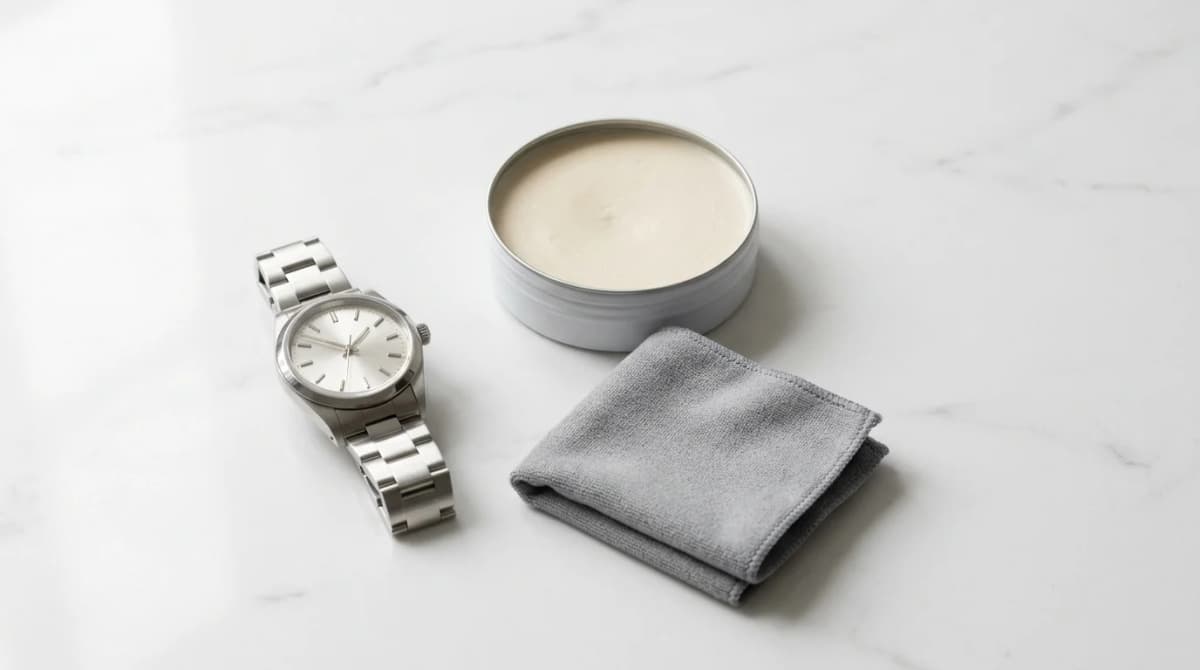
A watch polishing paste costs less than ten euros and promises to make scratches disappear. The promise is true, but partial: it works for certain scratches, on certain materials, and not on others. Rather than repeat the manufacturer's claims, here is what a watchmaking polishing paste actually does to remove a scratch from a watch, what it will never do, and how to decide in thirty seconds whether it is the right tool for your watch.
How a watch polishing paste works
There is a persistent misunderstanding about polishing pastes: many people imagine a product that fills the scratch, like a filler. That is not how it works.
A scratch is a groove cut into the material. Its edges are irregular and angular, and it is these ridges that catch the light and make the mark visible. A polishing paste contains micro-abrasives in suspension: by rubbing, they very slightly plane the surface around the groove, round its edges and render it optically invisible.
The consequence is important to understand: you remove material, you do not add any. This is why polishing is irreversible, and why the precautions that follow are not merely commercial caution.
A polishing paste does not repair a scratch. It removes material around it until the scratch ceases to be visible.
Polishing a watch crystal: what it works on
We counted the types of crystal on the 3,277 watches in our catalogue whose technical sheet documents this point. The result frames the real use of a polishing paste well.
| Material | Share of catalogue | Result after polishing |
|---|---|---|
| Mineral crystal | 90.5% | Micro-scratches erased |
| Plexiglas / acrylic | 0.6% | Excellent, soft material |
| Stainless steel (bracelet) | 2,771 watches | Effective, solid material |
| Sapphire crystal | 5.3% | No effect |
| Mineral treated scratch-resistant | 1.9% | Destroys the coating |
| Gold plating / PVD | 64 bracelets + cases | Pierces the plating |
In other words: in nine cases out of ten, a polishing paste is the right tool for your watch crystal. This is why this product makes sense in a drawer. But the exceptions matter, because they are irreversible.
The case of plexiglas, often overlooked
Watches with plexiglas or acrylic crystal, common on vintage re-editions, are those where polishing gives the most spectacular results. The material is soft: a scratch that clearly catches the fingernail can disappear completely, which never happens on mineral crystal. They represent only 0.6% of our catalogue, but if you own one, polishing paste is your best ally.
What it does not work on, and why that matters
Sapphire crystal. Its hardness reaches 9 on the Mohs scale, compared to 5 to 6 for mineral. The abrasives in a watchmaking paste are well below that. You can rub for ten minutes: nothing will happen. This is not a product defect, it is materials physics. If your watch has a sapphire crystal and it is scratched, only a workshop equipped with diamond paste can help.
Scratch-resistant treated crystals. The coating is a hardened superficial layer of a few microns. Polishing removes it along with the scratch. The crystal will appear repaired at first, then scratch much more easily than before, with no possibility of trying again. There are 63 in our catalogue, and nothing distinguishes them visually from ordinary mineral, only the technical sheet says so.
Plated finishes. Gold plating is 0.5 to 5 microns thick, a PVD coating 1 to 4 microns. A few minutes of vigorous polishing is enough to pierce the layer and expose the base metal. The result, a pinkish or grey zone on a gold surface, is far more visible than the original scratch and can only be corrected by re-plating.
The Gasmann 75 ml paste: what it is

The Gasmann polishing paste we distribute is a watchmaking formulation, designed for precious metals, cases and mineral crystals. This is the essential difference from an automotive paste or universal polish: the particle size. An abrasive designed for car paint is too coarse for a watch crystal and will leave a haze of micro-scratches in place of the original scratch.
The 75 ml container seems modest, but actual use is very economical. To polish a watch crystal, the useful dose is equivalent to a pinhead. A tube comfortably covers several years of domestic maintenance on several watches, and also works for silver or steel jewellery.
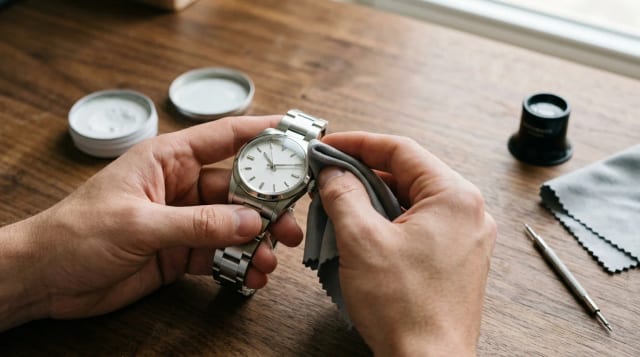
It is used by hand with a microfibre cloth, or with a polishing pad mounted on a machine for workshops. For domestic use, the hand is quite sufficient, and it is safer: a rotary polisher heats the surface and rounds the case edges much faster than one anticipates.
The method in five steps
- Clean first. A grain of sand left on the crystal turns the cloth into a scratching tool. Warm water, mild soap, complete drying.
- Mask what must not be touched. Masking tape on the gold bezel, on adjacent brushed surfaces, on anything that is plated.
- Use very little. A pinhead. Too much product clogs the cloth and disperses the abrasive without polishing further.
- Work in thirty-second sequences. Wipe and look at the light between each pass. Since polishing is irreversible, three controlled passes are better than one long one.
- Finish with a second clean cloth, without paste, to remove residue and judge the actual result.
To polish a steel watch bracelet, one additional point: respect the finish. On brushed, work in the direction of the grain, never in circles, a shiny zone in the middle of brushed is more visible than the scratch. On mirror polish, circles are the right approach.
What not to use instead
Three substitutes circulate online, and they cause more damage than they repair.
Toothpaste comes up in every forum. Its particle size is irregular and uncontrolled: it polishes in one spot and scratches elsewhere, with uneven results depending on the brand and batch. Bicarbonate of soda is far too aggressive for a watch crystal. And automotive polishes are formulated for polyurethane varnish, a material bearing no relation to mineral crystal or brushed steel.
Watch polishing paste is nothing magical, but its particle size is calibrated for these specific materials. That is all that is asked of it.
When paste is not the solution
Let us be honest about the limitations, because buying the wrong product is a waste of time for everyone.
Attempting to repair a watch scratch has its limits. If your crystal is cracked, do not polish: the pressure spreads the crack and residue seeps into the case. If the scratch is on the dial, it is beneath the crystal and out of reach. If the crystal has become cloudy or pitted, it is corrosion, not a scratch. And if your watch has a sapphire crystal, no domestic paste will make any difference to it.
In these four cases, crystal replacement at a workshop is the real answer, and it often costs less than you might imagine on an accessible-range watch.
Watch polishing: going further
We have detailed the complete logic, material by material, in our watch polishing guide by crystal and metal type: it is the starting point if you do not yet know what you have on your wrist.
For thorough maintenance of a mechanical watch, servicing, seals, lubrication, see our automatic watch maintenance guide. And if your bracelet is loose and rubs against surfaces, adjusting it properly reduces accidental scratches at source: our method for a Milanese mesh bracelet covers the case of woven bracelets.
Read next
More in this vein
Maintenance
Watch polishing: the complete guide by crystal and metal type

Brands
Burberry Men's Watch Size Guide: How to Find the Perfect Size

Brands
Burberry Elegance Men's Watch: British Refinement for Special Occasions
Buying guides
200m Water Resistant Watch: The ideal companion for diving

Brands
Emporio Armani Gold Men's Watch: The Brilliance of Italian Luxury
Care & maintenance
Crystals and rhinestones falling from a watch: why, and how to protect them
Buying guides
The materials making a comeback in both watchmaking and creative jewellery
Buying guides