
Watch Water Resistance Ratings: ATM, Bar, Metres (Complete Guide)

A customer brought me a Fossil watch a few months ago. The dial was clouded, the movement waterlogged, the watch fit only for complete restoration. When I asked what had happened, his answer was direct: "I took it on holiday, I went scuba diving, it was marked 5 ATM so I thought it was fine." Five ATM. Fifty metres theoretical in the laboratory. Used at fifteen metres real depth in the sea, with sudden movements, a wetsuit squeezing the strap, a crown loosened by accident. Result: total water ingress, movement to be replaced, restoration cost close to the watch's value. This confusion between the engraved rating and a usable diving depth, I encounter it at least twice a month in my workshop. The aim of this article is simple: to give you the physical and practical basics so you never again get confused about what an ATM rating means, a figure in bars or a metre indication engraved on the back of your watch.
Diagnosis in 5 seconds

ATM, bar, metres: what does the rating engraved on my watch really mean
When you turn your watch over and read "Water Resistant 10 ATM", "WR 100 m" or simply "30 bar" on the case back, you are reading a test pressure indication, not permission to dive to that depth. This is the first misunderstanding to clear up, and it is fundamental.
The three units you will encounter on commercial watches are always the same:
- ATM: technical atmosphere. Unit of pressure corresponding to atmospheric pressure at sea level, approximately 101,325 pascals. It is the most common unit on European and Japanese watches.
- Bar: unit of the international system, very close to ATM in common uses. 1 bar = 100,000 pascals. In watchmaking practice, 1 ATM = 1 bar, and the two terms are used interchangeably on dials and case backs.
- Metres (m): the most intuitive conversion for the general public. It is estimated that a column of water 10 metres high exerts a pressure of approximately 1 bar (or 1 ATM) on a surface. So 10 ATM = 10 bars = 100 metres theoretical static pressure in the laboratory.
These three units express exactly the same physical reality with different representations. The manufacturer freely chooses which one to engrave. A watch "Water Resistant 5 ATM", a watch "WR 5 bar" and a watch "water resistant 50 m" have undergone the same pressure resistance test. They offer the same level of real protection.
What varies between brands is sometimes the rigour of the test protocol. This is where ISO standards come in, which we will return to in detail in the dedicated section. For now, remember that the displayed rating is a test value, not a usage depth.
To go further on the visible effects of failing water resistance, particularly misting under the crystal, our complete guide to watch misting and condensation details the physics of moisture ingress.
The exact conversion table ATM ↔ bar ↔ metres

The conversion between ATM, bar and metres is one of the simplest in watch metrology. There is no complicated correction factor to memorise for everyday use. Here is the exact table:
| Displayed rating | Test pressure (bar) | Theoretical depth | Recommended real use |
|---|---|---|---|
| 3 ATM / 3 bar / 30 m | 3 bars | 30 metres (lab) | Resistance to splashes, rain, quick hand washing |
| 5 ATM / 5 bar / 50 m | 5 bars | 50 metres (lab) | Occasional shower, very brief and exceptional surface swimming |
| 10 ATM / 10 bar / 100 m | 10 bars | 100 metres (lab) | Pool, sea, light snorkelling, surface water sports |
| 20 ATM / 20 bar / 200 m | 20 bars | 200 metres (lab) | Recreational diving (if ISO 6425 certified), intense water sports |
| 30 ATM / 30 bar / 300 m | 30 bars | 300 metres (lab) | Technical diving, light professional diving |
| 50 ATM / 50 bar / 500 m | 50 bars | 500 metres (lab) | Saturation diving, extreme professional use |
A few important clarifications on this table:
- The values "theoretical depth" are equivalents of static pressure, tested in the laboratory at constant temperature, on a new watch. They never represent an authorised diving depth in real conditions.
- The indication "2.5 ATM" or "25 m" exists on certain fashion watches. It corresponds to an even more basic resistance than 3 ATM: light splashes only, not even sustained rain.
- For the query "2 5 atm in bar" that I see regularly in the workshop: 2.5 ATM = 2.5 bars = 25 metres theoretical. Minimal protection, equivalent to a "water resistant" watch without a high numerical index.
The conversion "10 ATM in metres" is one of the most searched for: 10 ATM = 10 bars = 100 metres of static pressure in the laboratory. But at 100 metres real depth in scuba diving, this watch will not hold up. The reason is explained in detail in the section on the myth of depth.
Why these units are different (and misleading for users)
Why did manufacturers not choose a single universal unit? The answer is both historical and commercial.
ATM (atmosphere) is the oldest physical unit in watchmaking. Swiss and French testing laboratories used this reference from the 1960s onwards, when water resistance became a marketing criterion. The bar became established in parallel with the generalisation of the international metric system. The two units coexist because they are numerically almost identical (1 ATM = 1.01325 bars, negligible difference for watchmaking) and because no one thought it useful to eliminate one.
The indication in metres, on the other hand, is clearly a marketing decision. "Water Resistant 100 m" is more meaningful to the consumer than "10 ATM" or "10 bar". The figure is larger, the mental image is stronger. But it is also the most dangerous indication, because it creates an illusion of achievable depth.
When someone reads "50 m" on their watch, their brain instantly translates: "I can dive to 50 metres". That is wrong. It is a pressure equivalent to 50 metres of static water column, applied in the laboratory to a new watch, under perfect conditions. Not a real diving depth.
This confusion is so widespread that the ISO 22810 standard, which governs water resistance for watches not intended for professional diving, has required since 2010 that manufacturers do not indicate "water resistant" without mention of a minimum numerical index. But it does not require changing the presentation in metres, which remains legally authorised even when it is misleading.
In summary: the unit does not change the actual protection. But it changes the way you interpret that protection. That is why this article exists.
Definitive table ATM ↔ bar ↔ m ↔ real use
| Index | Equivalents | Hand washing / Rain | Shower 🚿 | Bath 🧖 | Swimming pool 🏊 | Sea / Beach 🌊 | Snorkelling 🐚 | Diving 🤿 |
|---|---|---|---|---|---|---|---|---|
| 3 ATM 3 bar / 30 m |
Basic Water Resistant | ✓ | ⚠ (risk) | ✕ | ✕ | ✕ | ✕ | ✕ |
| 5 ATM 5 bar / 50 m |
Water Resistant 5 ATM | ✓ | ✓ (occasional) | ⚠ (risk) | ✕ | ✕ | ✕ | ✕ |
| 10 ATM 10 bar / 100 m |
Water Resistant 10 ATM | ✓ | ✓ | ✓ | ✓ | ✓ | ✓ (light) | ✕ |
| 20 ATM 20 bar / 200 m |
Diver's Watch (if ISO 6425) | ✓ | ✓ | ✓ | ✓ | ✓ | ✓ | ✓ (leisure < 40m) |
| 30 ATM+ 30 bar / 300 m+ |
Technical / Professional Diving | ✓ | ✓ | ✓ | ✓ | ✓ | ✓ | ✓ (technical) |
Legend: ✓ = authorised without reservation / ⚠ = possible but at your own risk, increased monitoring advised / ✕ = forbidden, risk of infiltration and irreversible damage.
A few remarks on frequent cases in the workshop:
- A classic Daniel Wellington watch generally displays 3 ATM. It is a fashion watch, not a sports watch. Hand washing is tolerated, the shower is a bad idea, the swimming pool is excluded.
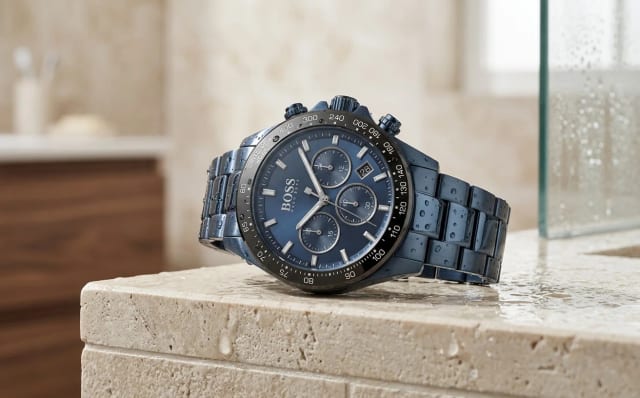
- A Hugo Boss watch in the sports range often displays 5 ATM. The shower is tolerated, not regular swimming pool use.
- Seiko and Citizen watches in their sports ranges frequently reach 10 ATM, sometimes 20 ATM for the Prospex and Promaster series. These watches are designed for the sea and swimming pool.
For women looking for a watch suited to their water use, our guide to water-resistant watches for women presents the best options by index. For men, our guide to water-resistant watches for men covers the same ground.
The myth of depth: static vs dynamic pressure
This is the heart of the problem, and it is what I explain to every customer who leaves with a freshly serviced watch: in real life, your watch is no longer in the conditions of the test, and it is not the water pressure that makes the difference.
Here is what "static pressure" means in the context of water resistance tests: the watch is placed in a water tank or subjected to controlled air pressure. The pressure is increased gradually, held for a defined time (usually a few minutes), then released. The watch is stationary. The water is at room temperature. There is no shock, no sudden movement, no thermal gradient.
In real life, here is what really changes compared with the test:
- The dive itself adds almost nothing. Contrary to a very widespread belief, the dynamic pressure of entering the water is ½ρv², roughly 0.5 bar at 10 m/s, far below the test pressures. A breaststroke or front crawl movement adds even less.
- The watch is no longer new. Chlorine, salt, sun cream, soap, temperature cycles and permanent compression age the seals year after year.
- If you remove the watch from water heated by the sun and plunge it into cool water, the thermal shock expands and then contracts the rubber seals, creating progressive micro-cracks.
- If the crown is slightly unscrewed (even by a quarter turn), the water resistance index becomes zero. The crown is the systematic weak point that I check first during any inspection.
- A cracked crystal, or a case back reopened (battery change) without a new water resistance test, lets water in whatever the engraved rating.
The direct consequence of all this: the rating is not something you correct with a coefficient. It describes a new watch, tested in ideal conditions. What protects your watch is using it as the rating allows (table above), a crown pushed back in or screwed fully down, and checked seals. And for scuba diving, even at 10 metres, you need a 20 ATM watch bearing the Diver's marking (ISO 6425).
It is not a question of depth. A certified diving watch has undergone tests that a town watch never goes through: overpressure beyond the rating, shocks, condensation, thermal shock. It is this design, not a margin calculated on the engraved figure, that makes it fit for diving.
From 3 ATM to 30 ATM+: what each threshold changes in practice
When I say that the difference between a 5 ATM and a 10 ATM is not just a number, I am thinking of the concrete differences I see every day on my workbench.
3 ATM (30 m): minimum protection
A 3 ATM watch is designed to resist splashes and rain. Water resistance seals are present (around the crystal, crown and case back), but they are sized to the minimum. The push crown is generally not screwed down. The case back is often clipped rather than screwed. This is the case with most entry-level fashion watches, including some Daniel Wellington models and dressed quartz watches. Hand washing: yes. Shower: risky. Swimming: no.
5 ATM (50 m): shower, but not the pool
At 5 ATM, the seals are more robust, the crown may be screwed (not systematically), the case back is often screwed. This is the standard for the versatile urban watch. Brands like Hugo Boss or Fossil watches at 5 ATM fall into this category. Occasional showers are tolerated. Regular pool use wears seals prematurely. Our dedicated article explains everything you can actually do with a 5 ATM watch.
10 ATM (100 m): the real swimming threshold
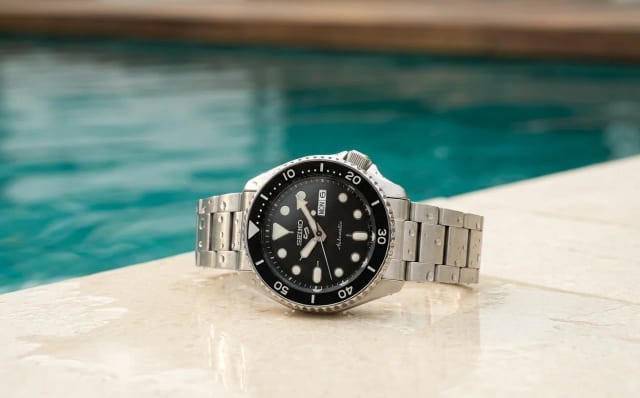
At 10 ATM, the screwed crown is generally the rule (or the crown is protected by a specific locking system). The case back is screwed with defined torques. The crystal is shock-resistant (mineral or sapphire). The seals are fluoroelastomer or superior quality silicone. This is the territory of Seiko 5 Sports and entry-level Citizen Promaster. Pool, sea, light snorkelling: yes. Scuba diving: no. To detail everything, our article on 10 ATM is your reference.
20 ATM / 200 m: the real leisure diving watch
This is the minimum threshold for a watch to be legitimately called a "diving watch", provided it is ISO 6425 certified. At this level, the case is designed with particular attention to pressure resistance: screwed case back with double O-ring seal, bevelled sapphire crystal, unidirectional ratcheted bezel, double-locking screwed crown. Leisure diving to 30-40 metres is practicable. Our guide to water-resistant 200 m watches for diving lists the models I recommend in this category.
30 ATM and beyond: technical diving
Beyond 20 ATM, you enter the realm of technical and professional diving. 300 m, 500 m or 1000 m watches (such as certain Seiko Marinemaster or Citizen Promaster Marine) are instruments designed for extreme uses. Their cases are often thicker, heavier, with double or even triple-stage crown locking systems. For the vast majority of leisure divers, a 200 m watch certified ISO 6425 is more than sufficient.
Why 5 ATM ≠ 50 m of diving (the most common confusion)
The confusion "5 ATM = 50 m of diving" is the most frequent and most dangerous that I encounter. It results from the literal reading of the metre indication combined with forgetting what the test really measures: a new, stationary watch in water at constant temperature.
The watchmakers' rule is simple: scuba diving calls for a 20 ATM watch bearing the Diver's marking (ISO 6425 standard), whatever the planned depth. A 5 ATM or 10 ATM watch without that marking is not a diving watch, even for a few metres. And before every immersion, the crown must be screwed fully down.
To understand exactly what you can and cannot do with a 5 ATM in everyday life, with concrete tested examples, our article 5 ATM: everything you need to know about showers, pools and swimming answers all your practical questions.
ISO 22810 and ISO 6425 standards: when they change everything

Two standards coexist in world watchmaking for watch water resistance. Knowing them radically changes the way you interpret an engraved rating.
ISO 22810: the standard for water-resistant watches
Published in its current version in 2010, ISO 22810 governs so-called "water-resistant" watches for non-professional use. It defines the minimum test protocols for ratings from 3 ATM to 200 m. It notably requires:
- A static pressure resistance test (duration and pressure defined according to the rating).
- A condensation test (controlled thermal shock).
- A verification of water vapour resistance.
But ISO 22810 does not prohibit mentioning "200 m" on a watch that is absolutely not designed for actual diving at 200 metres. It governs the tests, not the commercial use of the figures. This is important to understand.
ISO 6425: the real standard for divers
This is a fundamentally different standard. It imposes much stricter constraints:
- Pressure resistance test at 125% of the stated rating (a 200 m watch is tested at 250 m).
- Mechanical shock resistance test.
- Magnetic field resistance test.
- Condensation resistance test with thermal shock from 40°C to 5°C.
- Legibility guaranteed up to 25 cm distance in darkness (luminescent hands and indices).
- Unidirectional bezel mandatory with first minute marking.
- "DIVER'S WATCH XXXm" or "DIVER'S XXXm" indication mandatory.
A watch certified ISO 6425 is a genuine diving watch, tested for real conditions. It can legitimately be worn for recreational diving to the stated depths, provided the crown is screwed fully down and the seals are checked regularly.
In practice: if your watch does not display "Diver's" or "ISO 6425" on the dial or case back, it is not certified for diving, regardless of the depth in metres displayed. A watch "Water Resistant 200 m" without ISO 6425 certification is not a diving watch.
For diving watches proper, our selection of best water-resistant 200 m watches includes only models certified or close to ISO 6425 requirements.
Decoding your watch: where to find the rating and how to read it

In the workshop, when a customer asks me what the water resistance of their watch is, here is the order in which I search for the information:
1. The case back
This is the reference location. Turn your watch over and read the engraved inscriptions. You will generally find the brand, the model reference, the serial number, the case material and, normally, the water resistance rating. It can take the following forms:
- "Water Resistant 5 ATM" or "WR 5 ATM"
- "Water Resistant 10 bar"
- "Water Resistant 100 m" or "WR 100 m / 330 ft"
- "Diver's 200 m ISO 6425" (diving certification)
- Simply "Water Resistant" with no figure: minimal protection against accidental splashes, no reliable figure.
2. The dial
On sports watches and diving watches, the rating is often repeated on the dial, generally at 6 o'clock or under the hands. "200 m" or "Diver's 300 m" engraved on the dial is commercial information. It must be confirmed by the case back to have technical value.
3. The bezel
Some vintage diving watches indicated water resistance on the bezel. This is rare on contemporary watches, but it still exists on a few higher-end Seiko or Citizen models.
If you cannot find a rating
The complete absence of a water resistance rating on a watch does not mean it is water-resistant. It means the manufacturer guarantees nothing. Avoid any contact with water, even hand washing. This is the case with some fashion watches, vintage watches whose case back has been replaced, or counterfeits.
For questions related to case maintenance and seals, our automatic watch maintenance guide covers the periodic revision of water-resistant seals, equally valid for quartz watches.
How to check if the engraved rating is still valid after a few years
This is the question I wish the customer with the drowned Fossil had asked me before their holiday. The rating engraved on the case back is a value at the moment of manufacture. It does not remain valid forever.
Why water resistance degrades over time
Water-resistant seals are wear parts. Manufactured from nitrile rubber, fluoroelastomer (Viton) or silicone depending on the watch's range, they are subject to continuous stresses:
- Oxidation: oxygen in the air slowly degrades elastomeric polymers.
- Thermal cycles: each transition from hot to cold (and vice versa) compresses and releases the seal, creating progressive micro-deformations.
- Chemical agents: chlorine from swimming pools, sea salt, sunscreen, soap. These substances chemically attack elastomers and make them porous or crumbly.
- Permanent compression: a seal that ensures water resistance is constantly compressed. This permanent compression causes irreversible plastic deformation that reduces its effectiveness.
How often to have water resistance serviced
The rule I apply in my workshop and that I recommend to my customers:
- Every 2 years: preventive water resistance service for any watch regularly exposed to water (daily showers, weekly swimming).
- Every year: service recommended for an actively used diving watch.
- Before any sea trip or water holidays: systematic water resistance test, regardless of the watch's age.
- Immediately: if the crown has been removed (battery replacement, time adjustment), water resistance must be retested before any water exposure.
How a water resistance test is carried out at a watchmaker's
There are two main methods: the compressed air test (compressed air pressure is applied to the watch and resistance is measured) and the water pressure test (more representative but less common in the workshop). A full test takes 10 to 20 minutes and allows you to know if the watch still holds the water resistance stated on its case back. If not, I replace the seals (crown, crystal, case back) and retest.
If you have any doubt about your watch's water resistance, do not hesitate to contact us via our customer service for advice or guidance on the appropriate service. Our watches for sale on Montres Outlet are offered with a 2-year manufacturer's warranty, but that warranty does not cover water resistance: it covers movement failures. Hence the importance of keeping to the use the rating allows and of always pushing the crown back in, or screwing it fully down.
For everything relating to fogging under the crystal (the first visible sign of failing water resistance), our pillar article on fogging and condensation explains how to distinguish normal condensation from actual water ingress.
Before any contact with water: the watchmaker's Do/Don't block
To do before water
- Check that the crown is fully pushed in and screwed down (if screw-down crown) before any contact with water.
- Confirm the ATM rating of your watch matches your intended use (table above).
- Have the water resistance tested by a watchmaker if the watch has not been serviced for more than 2 years.
- Rinse the watch with fresh water after each swim in the sea or chlorinated pool.
- Allow the watch to air dry before refitting a leather or fabric strap.
- Check for the absence of cracks or deep scratches on the crystal before diving (potential water entry point).
- Remove your watch before applying sunscreen (chemical agents degrade the seals).
Absolutely avoid
- Adjusting the date or time underwater or just before entering the water (pulling the crown eliminates all water resistance).
- Changing the battery of a quartz watch and diving back into the water without prior water resistance testing.
- Wearing a 3 ATM or 5 ATM watch in a pool, even "just for a few minutes".
- Trusting the metre rating as an authorised diving depth.
- Ignoring condensation under the crystal: it is a sign of water ingress, the watch must be opened immediately.
- Exposing a watch to hot bath or hot tub water with a rating below 10 ATM (heat expands the seals, and the return to cold creates a thermal shock). The sauna and steam room, for their part, are ruled out whatever the rating.
- Wearing the same watch for diving and water skiing without checking the rating and the crown: a fall at full speed is above all a mechanical shock for the watch, and a crown not fully screwed down is enough to flood it.
These rules apply to all watches, regardless of price. I have seen watches worth several thousand euros drowned by an open crown, and budget watches survive 10 years in the pool because their owner instinctively applied these reflexes.
For broader maintenance advice, our maintenance advice section brings together all our practical guides on watch lifespan and maintenance.
Your rating, your use: practical guides to go further
The physical basics and conversion tables are now clear. But the real question often remains practical: "with my 5 ATM watch, can I do the washing up?" or "will my 10 ATM hold up during a surfing session?".
These questions deserve precise answers, case by case. That is the purpose of our satellite articles:

Understand the exact use of your rating
According to your rating, our detailed guides explain what you can really do, with tested use examples and recommendations for accessible brands.
If you are looking for a watch with the rating suited to your use, our buying guides by profile point you directly to the models available at Montres Outlet:
- Complete guide to water-resistant watches for women: selection by ATM rating and by style.
- Complete guide to water-resistant watches for men: from urban 5 ATM to 20 ATM leisure diving.
- Water-resistant watches 200 m for diving: our selection certified ISO 6425 or compatible with leisure diving.
All our watches come with free delivery to mainland France, subject to our terms (3 to 5 days delivery), with returns possible within 14 days and 2-year manufacturer's warranty. For any personalised advice on the water resistance of a model, our team is available via the contact page. Customer reviews are available on Temovio.
FAQ: your questions about ATM, bar and metre ratings
Our Montres Outlet selection
To help you move from advice to purchase, here are the 1 watches we are particularly highlighting on this subject, all in stock at Montres Outlet and suited to the profiles described in this article.
What does 5 ATM mean on my watch?
5 ATM means your watch has been tested in the laboratory at a pressure equivalent to 5 atmospheres, or 5 bars, or approximately 50 metres of static water column. It is not an authorised diving depth. In real use, a 5 ATM watch resists occasional showers and everyday activities involving water (washing up with shallow water, rain, splashes). It is not designed for regular pool use, prolonged swimming or the sea. To understand all the practical uses of a 5 ATM, consult our dedicated guide.
5 ATM, how many bars is that?
5 ATM corresponds exactly to 5 bars in watchmaking use. The physical difference between 1 ATM (101,325 pascals) and 1 bar (100,000 pascals) is about 1.3%, which is completely negligible in the context of water resistance testing. The two units are used interchangeably by manufacturers. You can therefore consider that 5 ATM = 5 bars = 50 metres of static pressure in the laboratory. To convert quickly: multiply the ATM rating by 10 to get the equivalent in metres of static pressure. 5 ATM × 10 = 50 metres (test value, not diving).
10 ATM in metres, how much exactly?
10 ATM corresponds to 10 bars and 100 metres of static pressure in the laboratory. It is the most common rating for versatile sports watches (pool, sea, snorkelling). The formula is simple: 1 ATM = 10 metres of static pressure. So 10 ATM × 10 = 100 metres. Caution: these 100 metres are a test value, not a real diving depth. In practice, a 10 ATM watch is suited to the pool, sea swimming and light snorkelling, but not to scuba diving. Discover all the practical uses in our complete article on 10 ATM.
Why does my 50 m rating not mean 50 metres of diving?
The "50 m" indication on your watch is a static test pressure, not an authorised diving depth. The test is carried out in the laboratory: the watch is stationary, pressure is applied slowly, conditions are perfectly controlled. Contrary to a widespread belief, arm movements or entering the water add almost nothing: the dynamic pressure is ½ρv², roughly 0.5 bar at 10 m/s, far below the test pressures. What lets water in is a crown pulled out or not fully screwed down, ageing seals (chlorine, salt, sun cream, soap, temperature cycles), a thermal shock, a cracked crystal or a case back reopened without a new test. For scuba diving, even at 10 metres, you need a 20 ATM watch bearing the Diver's marking (ISO 6425).
How do I know if my watch is still water-resistant after 5 years?
After 5 years without servicing, you cannot know if your watch is still water-resistant without having it tested. Rubber or fluoroelastomer seals degrade due to oxidation, thermal cycles and chemical agents (chlorine, sunscreen, salt). A 10 ATM watch can lose part of its water resistance after a few years of intensive use without maintenance. The only reliable way to know is a compressed air test at a watchmaker's, which takes 10 to 20 minutes. I recommend this test every 2 years for watches regularly exposed to water, and systematically before aquatic holidays. If in doubt, contact our customer service.
What is the difference between "water resistant" and an ATM rating?
"Water Resistant" without a figure is the most basic mention, it indicates minimal resistance to accidental splashes with no guaranteed pressure rating. It is not even the equivalent of 3 ATM: it is symbolic protection. As soon as a figure accompanies the mention ("Water Resistant 3 ATM", "WR 100 m"), the manufacturer commits to a test pressure verifiable according to ISO 22810 standard protocols. The mention "water resistant" alone without a figure should not encourage you to expose the watch to anything other than light accidental rain. Daniel Wellington watches, for example, display 3 ATM on their common models, which is already a minimal guaranteed rating.
What does ISO 22810 vs ISO 6425 mean?
ISO 22810 is the international standard governing water-resistant watches for non-professional daily use. It defines test protocols for ratings from 3 ATM to 200 m (water resistant). ISO 6425 is the standard specific to diving watches. It imposes far more severe tests: resistance to 125% of the stated rating, resistance to mechanical shocks, magnetic fields, thermal shock, legibility in darkness and mandatory unidirectional bezel. A watch certified ISO 6425 bears the mention "Diver's Watch" or "Diver's". Without this mention, even a "200 m" watch is not certified for actual diving. This is a fundamental distinction for any diver.
3 ATM, 5 ATM, 10 ATM: what is the real use of each?
3 ATM (30 m): resistance to splashes and rain. Hand washing tolerated with care. Not the shower, not the swimming pool. This is the standard for fashion watches like some Daniel Wellington models. 5 ATM (50 m): occasional shower tolerated, very brief bathing in calm water at a pinch, but not regular swimming pool or sea. This is the territory of versatile urban watches like some Hugo Boss or Fossil models. 10 ATM (100 m): swimming pool, sea, light snorkelling, surface water sports. This is the true threshold for an aquatic sports watch, represented by entry-level Seiko 5 Sports and Citizen Promaster models. For diving, you need a minimum of 20 ATM with ISO 6425 certification.
Does the engraved rating remain valid for life or does it decrease over time?
The engraved rating is valid at the time of manufacture. It does not remain valid for life. Water-resistant seals are wear parts subject to oxidation, thermal cycles and chemical agents. Depending on the intensity of use and exposure conditions, actual water resistance can degrade significantly in 2 to 5 years. This is why I systematically recommend a water-resistance test every 2 years for watches exposed to water. After battery replacement (for a quartz watch) or after opening the case back for any intervention, water resistance must be retested before any water exposure. The engraved rating describes the new watch, not the watch after 5 years of use without maintenance.
This guide is part of our complete water-resistance guide (ATM/bar/metres + infographic) which centralises all standards and uses.
What minimum water resistance for the sea on holiday?
For a seaside holiday with regular bathing, the minimum I recommend is 10 ATM. At this level, you can swim, dive from the shore, practise light snorkelling and expose yourself to waves without risk under normal conditions. However, check that the seals are in good condition: if the watch is more than 2 years old or has been opened (battery change, service), have its water resistance tested at a watchmaker's before you leave. Rinse it in fresh water after every swim in the sea, and keep the crown screwed down, or pushed fully home, before going into the water.
Read next
More in this vein
Care & maintenance
How to Change a Watch Battery: a Watchmaker's Method, and the Step Almost Everyone Forgets
Care & maintenance
Crystals and rhinestones falling from a watch: why, and how to protect them
Care & maintenance
Casio Water Resist: is your vintage watch water resistant? (A158, A168, LA670)
Care & maintenance
Dust on a watch dial: how to remove it easily
Care & maintenance
10 ATM on a watch: everything you need to know (swimming pool, sea, snorkelling)
Care & maintenance
5 ATM on a watch: everything you need to know (shower, swimming pool, swimming)
Care & maintenance