
How to Clean a Watch and its Strap Without Damaging It: Steel, Leather, Silicone, Mesh, and the Moves to Avoid

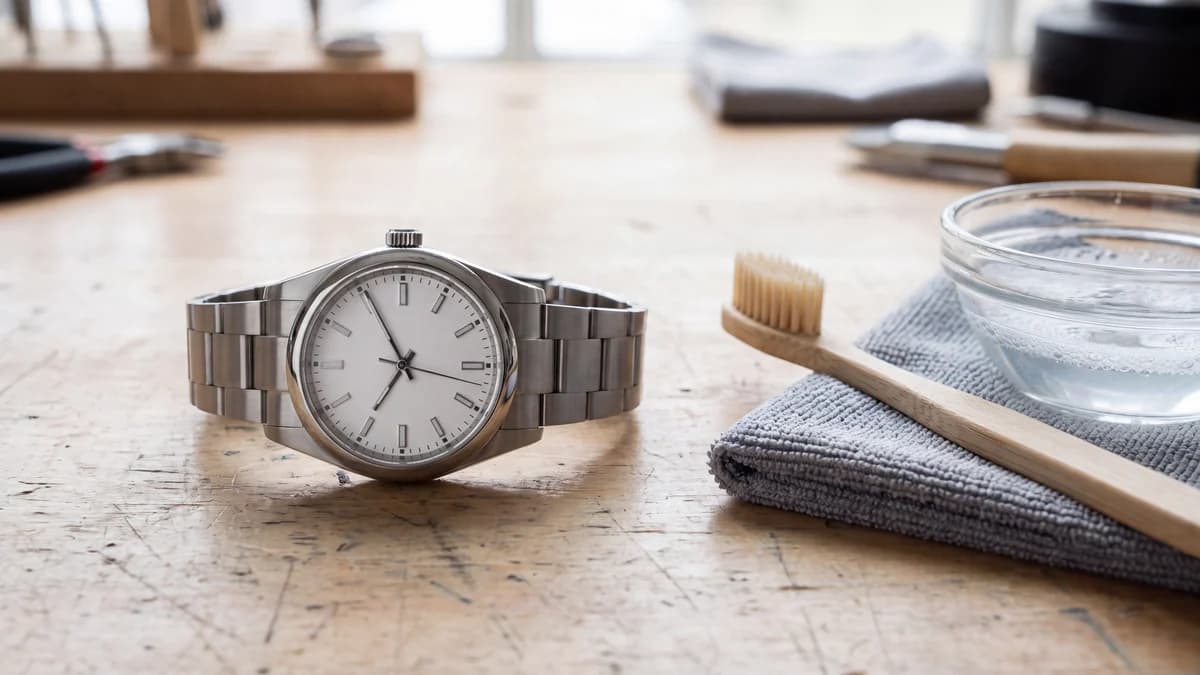
Cleaning a watch looks like the simplest part of looking after it. Yet it is the job that lets water into more cases, and dulls more gold-tone finishes, than any other. The reason is always the same: people clean according to the material they see (steel, leather) instead of first reading what is engraved on the back, the water resistance rating, and the position of the crown. This guide gives a safe watch cleaning method, material by material, and the short list of moves that can ruin a watch in two minutes.

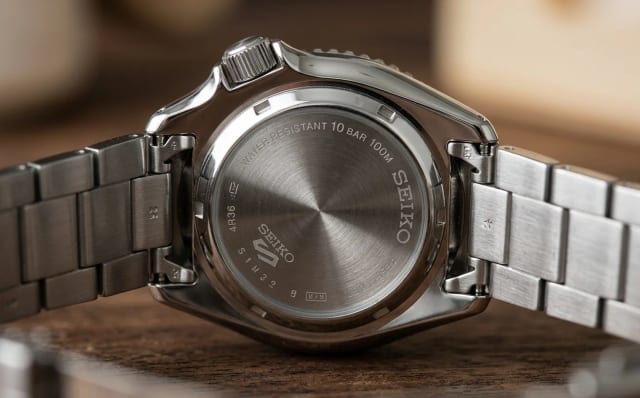
Before you clean a watch: two things to read on the back
"How to clean a watch" does not have one answer, it has three, and the case back picks which one. The water resistance rating decides whether the watch head can touch water, and the crown decides whether that water stays outside. A crown pulled out by a single click, even for a second, opens a direct path to the movement: it is the first cause of water ingress we see after a clean. Our water resistance film shows why an ATM rating is a test pressure, not a promise against the tap.
This affects far more watches than people think. In our own stock, in October 2026, 28% of the watches with a stated water resistance are rated 3 ATM or less: they handle a splash, not a rinse. And the figure does not depend on the strap: among our steel bracelet watches, more than one in four (26%) is rated 3 ATM or less. A metal bracelet tells you nothing about what the watch can take.
Can your watch go under water to be cleaned?
One last check before you start: the condition of the gaskets. A watch that has not been serviced for years, or whose battery was changed without a check, may no longer have the water resistance engraved on its back. Our guide on how to change a watch battery explains why every opening of the case back puts the rating back in question.
What to clean a watch with: the kit, and what to leave out
What should you clean a watch with? Very little, and certainly not what is under the kitchen sink. A bottled watch strap cleaner is not necessary: a drop of mild soap (liquid Marseille-type soap, additive-free washing-up liquid) in a bowl of lukewarm water does the same job on steel and silicone.
| Product or tool | Verdict | Why |
|---|---|---|
| Microfibre cloth | Yes, everywhere | Removes fingerprints and skin oil without scratching the crystal or the metal |
| Soft-bristle toothbrush | Yes: steel, silicone, mesh | Reaches inside the links and the grooves of the bezel |
| Lukewarm water and mild soap | Yes, depending on the water resistance | Dissolves sweat without attacking the gaskets |
| Wooden toothpick | Yes, gently | Lifts grime lodged between the links or around the lugs |
| Alcohol, hand sanitiser | Not on leather, with care elsewhere | Dries out and cracks leather; can dull some crystal coatings |
| Toothpaste, baking soda, scouring cream | No | Abrasive: they scratch a mineral crystal and strip a gold-tone finish |
| Vinegar, bleach, household cleaners | No | They attack gaskets, plating and adhesives |
| Hot water, hair dryer, radiator | Never | Gaskets warp in the heat and the water resistance does not come back |
The crystal deserves its own line. A dry microfibre cloth is almost always enough. In our stock, 93% of watches have a mineral crystal, and only 5% a sapphire one: mineral glass, much softer, scratches at the first abrasive grain. If a scratch is already there, our guide on polishing by crystal and metal type explains what can and cannot be fixed, and our article on polishing paste details what it really removes.
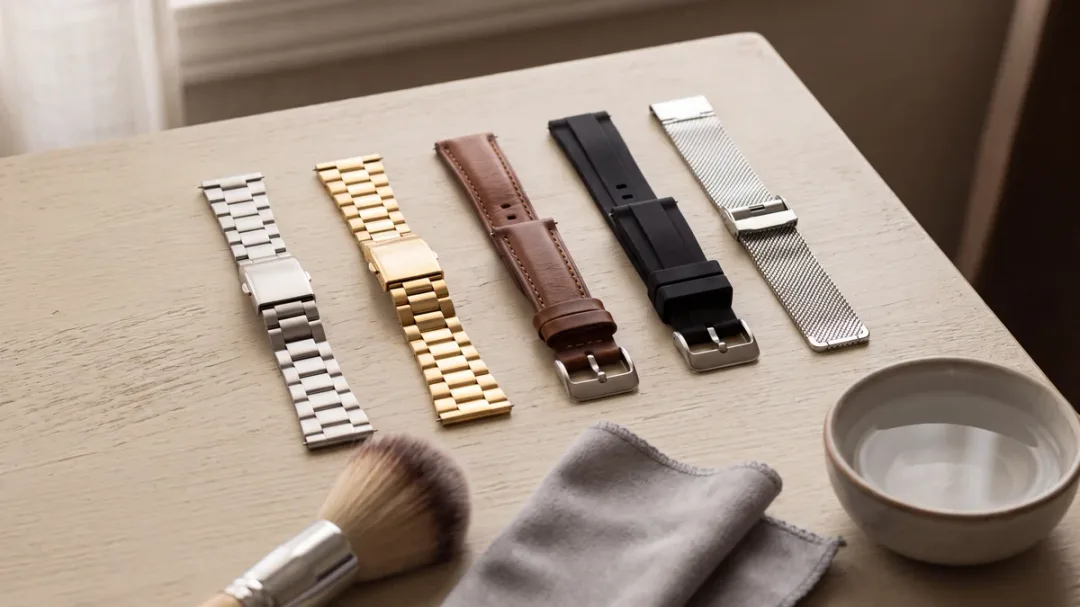
How to clean a stainless steel watch and its metal bracelet
Steel is the most common case: stainless steel makes up nearly two bracelets in three in our stock (2,820 watches out of 4,296 with a stated strap material, in October 2026). How to clean a stainless steel watch depends, once again, on its water resistance: the bracelet accepts almost anything, but it is attached to a case that may not accept water.
How do you clean a steel watch rated only 3 ATM? By splitting the job. The case is cleaned with a barely damp microfibre cloth, crown pushed in. The bracelet is removed (see below) and cleaned separately. On a watch rated 10 ATM or more, with a screw-down crown, the whole watch can be cleaned in lukewarm soapy water.
How to clean a steel watch bracelet, step by step
- Push or screw the crown fully in, check the water resistance rating.
- If the watch is rated 3 ATM or less, remove the bracelet with its spring bars (or ask a watchmaker).
- Dip the soft brush in lukewarm soapy water and brush between the links, in both directions.
- Run a wooden toothpick through the gaps between the links and under the clasp.
- Rinse in lukewarm water, never hot.
- Dry straight away with the cloth, then leave to air dry, clasp open.
Avoid
- Soaking the whole watch "to loosen the dirt".
- Using a wire brush or a scouring sponge.
- Rubbing a gold-tone or rose gold bracelet with toothpaste or baking soda.
- Putting the watch back on with water still trapped in the links.
Gold-tone and rose gold bracelets need even more care. These colours almost always come from plating or a PVD coating, a layer a few microns thick on top of the steel. In our stock, more than a thousand watches have a gold or rose gold coloured bracelet (563 and 517 in October 2026). How do you clean a gold-tone bracelet without dulling it? Lukewarm water, mild soap, a soft brush, and that is all: any abrasive, even a "gentle" one, wears the coloured layer and reveals the steel underneath, first on the edges of the links, where friction is strongest.
How to clean a leather watch strap
The rule for a leather strap fits in one sentence: leather is cleaned, not washed. Water swells it, heat shrinks it, and the two together make it crack, especially at the fold near the buckle. How to clean a leather watch strap without damaging it? A barely damp microfibre cloth on the outer face, a leather soap (glycerine soap or saddle soap) in a very small amount if a stain resists, then dry it flat, in the open air, away from any heat source.
The trap is believing that a water resistant watch makes its leather strap water resistant too. In our stock, one leather strap watch in ten is rated 10 ATM or more: the case can go to the pool, the strap cannot. If you swim with it, keep a silicone or steel strap for the summer, and the leather for the rest of the year.
A bad smell from a leather strap comes from sweat absorbed by the lining. You do not mask it with perfume (the alcohol dries the leather), you deal with the cause: take the watch off at night so the leather can breathe, never store it still damp in a closed box, and alternate two straps if you wear the same watch every day. A leather strap worn daily in summer is replaced more often than one worn in winter; it is a wear part, like the sole of a shoe.
How to clean a silicone, plastic or fabric watch band
Silicone is the easiest material. To clean a silicone watch band, lukewarm soapy water and a soft brush are enough, whether the band is removed or not (as long as the watch is rated at least 5 ATM, crown pushed in). How do you clean a white silicone band that has yellowed? Yellowing comes from skin oil and UV: regular cleaning slows it down, but a colour that has already set will not disappear completely. With the band removed, a paste of baking soda and water can lighten the surface of the silicone; keep this for the band alone, never near the case or the crystal.
A plastic band is cleaned like silicone, in lukewarm soapy water, without solvents (acetone and some degreasers make it dull or brittle). A fabric band, NATO style, is removed and washed by hand in lukewarm soapy water, then dried flat. Fabric holds moisture: never put a watch back on with a textile strap that is still wet, or you will get odour and skin irritation.
How to clean a mesh watch strap
Milanese mesh is the most delicate of the metal straps, for a simple reason: water and grime settle between hundreds of tiny links, and do not come out on their own. To clean a mesh watch strap, brush it in lukewarm soapy water with a soft brush, along the mesh and then across it, rinse in lukewarm water, then pat it dry in a towel for a long time and leave it to dry flat, clasp open. If your mesh slips or adjusts badly after cleaning, our guide on adjusting a Milanese mesh strap shows the right method, through the clasp and not the mesh.
The moves that ruin a watch in two minutes
These are well-meant moves. They all come from wanting to do things properly, and they all appear among the causes of damage a watchmaker sees.
The right habits
- Crown pushed in or screwed down before any contact with water.
- Lukewarm water, always.
- A rinse in fresh water after the sea or the pool (salt and chlorine attack gaskets).
- Dry with a cloth, then in the open air.
- A water resistance test at a watchmaker every two years for a watch that goes in the water.
The forbidden moves
- Cleaning the watch with the crown pulled out, even by one click.
- Putting it under hot water, then cold water.
- Drying it with a hair dryer or on a radiator.
- Putting the watch head in an ultrasonic bath.
- Rubbing the crystal or a gold-tone finish with an abrasive.
- Opening the case back "to clean the inside".
The hair dryer deserves a closer look. It blows at over ninety degrees, while gaskets start to warp at seventy: a watch dried this way can lose its water resistance for good, with nothing visible. It is also the first reflex to avoid when mist appears under the crystal, as our guide on misting in a watch explains. Going from hot water to cold has the same effect, more slowly: the gaskets expand and then contract, and water takes its chance.
Ultrasonic baths sold for jewellery raise another problem. The vibrations can loosen small parts, push water around the gaskets and lift plating that is already weakened. A solid steel bracelet, removed from the watch, can go in safely; the watch head, never, and even less a watch that is not water resistant. Watchmakers do use ultrasonic cleaning, but on dismantled parts, with suitable baths, before reassembling the watch with new gaskets.
Any doubt about your watch's water resistance after cleaning?
Mist under the crystal, a droplet, a hand that slows down: our after-sales form directs your request in a few questions, from simple advice to a water resistance test.
How to clean the inside of a watch, and the dial
You do not clean the inside of a watch yourself. Opening the case back to clean it means letting in the very dust you wanted to remove, pinching a gasket when closing it, and losing the water resistance. Dust visible on the dial, under the crystal, cannot be removed from the outside: our guide on dust on a watch dial explains where it comes from and who can remove it properly. Cleaning a watch dial is a watchmaker's job, done with the watch open, in a workshop, with new gaskets when it is closed.
In an automatic watch it is the same, only more delicate: the movement is lubricated, and an internal clean is called a service, roughly every five years depending on the manufacturer. Our guide on automatic watch maintenance details the steps.
The right rhythm: how often to clean your watch
| How often | What to do | For which watches |
|---|---|---|
| Every evening | A wipe with a dry microfibre cloth on the case and crystal | All |
| Every week | Soft brush and lukewarm soapy water on a metal or silicone strap | Depending on the water resistance (see above) |
| Every month | Bracelet removed, links fully cleaned; leather soap on a leather strap | Straps worn every day |
| After the sea or the pool | Rinse in lukewarm fresh water, crown screwed down, dry | Watches rated 10 ATM and above |
| Every two years | Water resistance test at a watchmaker | Watches that go in the water |
For a watch you wear in the water, our guide on what 10 ATM really allows explains why rinsing after the sea matters as much as the rating itself. And keep in mind that water damage is not covered by the warranty: careful cleaning remains the best insurance.

Cleaning your watch, then, starts with reading its back: the water resistance rating and the crown tell you what the watch head accepts, the strap material tells you the rest. With a soft brush, lukewarm water and a microfibre cloth, you cover almost every case; the only real dangers are heat, abrasives and a crown left pulled out.
Frequently asked questions
Can I put my watch under the tap to clean it?
Only if it is rated at least 5 ATM, with the crown pushed in or screwed down, and in lukewarm water. Below 5 ATM, the watch head is cleaned with a barely damp microfibre cloth, and a metal bracelet is cleaned removed. In our stock, 28% of watches are rated 3 ATM or less: always check the rating engraved on the back.
What should I use to clean a stainless steel watch?
A soft toothbrush, lukewarm water with a few drops of mild soap, a wooden toothpick for the gaps and a microfibre cloth to dry. No toothpaste or baking soda, especially on gold-tone or rose gold steel, whose colour is only a thin layer.
How do I clean a leather watch strap?
With a barely damp cloth, a little leather soap if a stain resists, then dry it flat in the open air. Never alcohol or hand sanitiser, never a hair dryer. Against odours, take the watch off at night and alternate two straps.
Can I clean a watch in an ultrasonic cleaner?
A removed solid steel bracelet, yes. The watch head, no: the vibrations can loosen parts, push water around the gaskets and lift plating. Watchmakers use ultrasonic cleaning on dismantled parts, before reassembling the watch with new gaskets.
How do I clean the inside of a watch?
You do not do it yourself. Opening the case back lets dust in and compromises water resistance. Dust or mist under the crystal is a job for a watchmaker; for an automatic watch, internal cleaning is part of the service, roughly every five years depending on the manufacturer.
Read next
More in this vein
Care & maintenance
Watch anatomy: the name of every part, and what it tells you about your watch
Care & maintenance
How to set the time and date on a watch without breaking anything: the crown, the date, digital watches
Care & maintenance
How to Change a Watch Battery: a Watchmaker's Method, and the Step Almost Everyone Forgets
Care & maintenance
Crystals and rhinestones falling from a watch: why, and how to protect them
Care & maintenance
Casio Water Resist: is your vintage watch water resistant? (A158, A168, LA670)
Care & maintenance
Dust on a watch dial: how to remove it easily
Care & maintenance
Watch Water Resistance Ratings: ATM, Bar, Metres (Complete Guide)
Care & maintenance