
Watch anatomy: the name of every part, and what it tells you about your watch

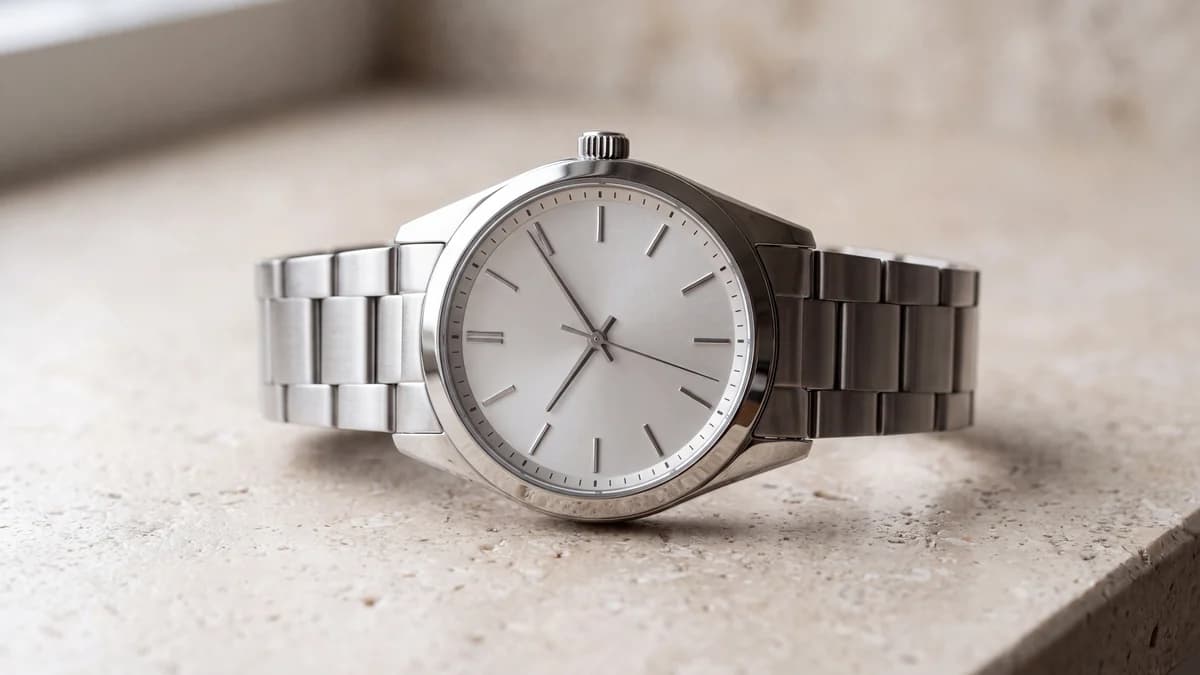
You wear it every day and glance at it dozens of times, yet do you know what each part of your watch is called? Dial, crown, bezel, lugs, case back, jewels: these words appear on every product page, and each one hides a useful piece of information. A bezel that only turns one way, a sapphire crystal, three letters engraved on the back: every part tells you what the watch can do, and what it can't. This guide to watch anatomy goes through the parts of a watch one by one, with what they really mean and what we see across the 3,923 watches in our stock.
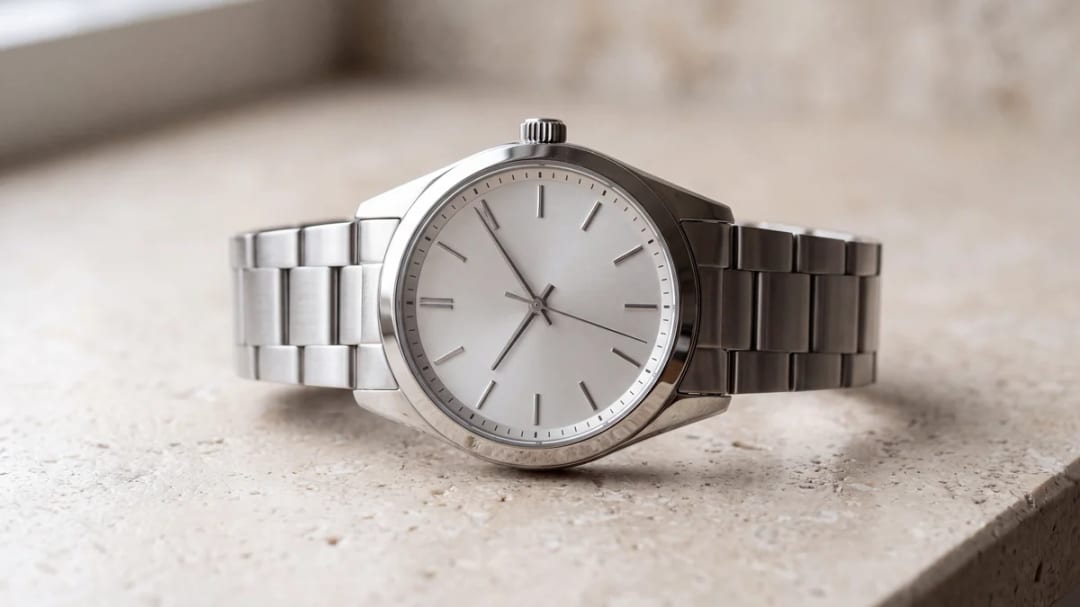
The parts of a watch at a glance
Before going into detail, let's set out some basic watch terminology: watch parts fall into three groups. You read a watch from the outside in. The case is the shell: it carries the bezel, the crown, the lugs and the case back. Under the crystal, the dial and its hands show the time. And hidden inside, the movement (the engine of the watch, also called the calibre) drives everything. The table below lists the watch parts names you'll find on almost every model, with what each one tells you.
| Part | Where it is | What it does | What it tells you |
|---|---|---|---|
| Dial | Under the crystal | Shows the time | Its finish (sunray, mother-of-pearl, skeleton) sets the style; its inscriptions sometimes give water resistance and origin |
| Indices | Around the dial | Mark the hours | Luminous or not: readable in the dark, or not |
| Hands | Centre of the dial | Hours, minutes, seconds | A seconds hand that glides gives away a mechanical movement |
| Date window | Usually at 3 o'clock | Shows the day of the month | It comes with a setting rule (see below) |
| Crystal | Over the dial | Protects the dial | Mineral, sapphire or acrylic: how well it resists scratches |
| Bezel | Around the crystal | Frames the dial, sometimes measures time | Fixed, rotating, unidirectional: the intended use |
| Crown | On the side, at 3 o'clock | Sets time and date, winds | Screw-down or not: part of the water resistance |
| Lugs | At the four corners of the case | Hold the strap | Their spacing gives strap width and fit on the wrist |
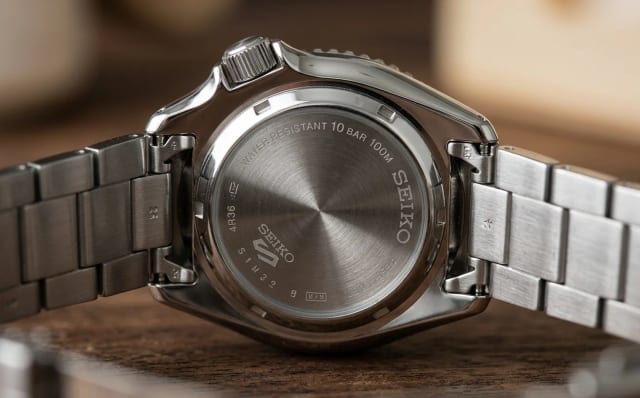
| Case back | On the back | Closes the case | Real water resistance, material, movement origin |
| Movement | Inside | Drives the hands | Quartz or automatic: battery or wrist |
| Jewels | Inside a mechanical movement | Act as bearings | A movement built to last, not a decoration |
| Strap and clasp | Either side | Keep the watch on your wrist | Tang buckle or deployant clasp: comfort and security |
The dial: the face of the watch
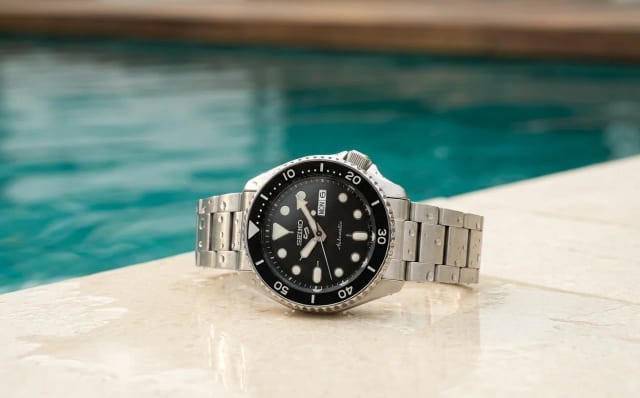
The watch dial is the plate that carries the time markers. It's the part you look at, and the one that sets the style most: a sunray dial reflects light in rays from the centre, a mother-of-pearl dial shifts colour with the angle, a skeleton dial shows the movement through cut-outs (our skeleton watch guide covers the variations). In our stock, 91% of dials are round; rectangular, square and tonneau shapes share the rest.
The dial also speaks through its inscriptions. At the bottom, below the centre, you often read the water resistance ("Water Resistant 50 m", "WR 100") or the origin ("Swiss Made"). These are useful, but only a reminder: for water resistance, the case back is what counts, as we explain below.
Indices and hands
The watch indices are the hour markers. On our watches, baton indices clearly dominate: 56% of the dials listed, against about 14% mixing batons and numerals, 8% Roman numerals and 6% Arabic numerals. When indices and hands are coated with a luminous material (the best known is Super Luminova), the watch can be read in the dark: the material stores daylight and gives it back for several hours, with no radioactivity at all.
Most watches have three watch hands: the hour hand, the shortest; the minute hand; and the seconds hand, the thin one. Watch the seconds hand, because it says a lot. On a quartz watch it jumps once a second. On an automatic it moves in six to eight tiny steps a second, so fast it seems to glide. Our film How an automatic watch works shows the difference.
The date window
The date window is the small opening that shows the date, usually at 3 o'clock. In our stock, 71% of the watches listed have one. It comes with a rule few people know: on an automatic watch, and on many analogue quartz watches, you don't change the date between 9 pm and 3 am, because that's exactly when the mechanism is moving it on. Forcing it then can damage the teeth of the date disc. The right order: set the time outside that window first, then the date.
The crystal: mineral, sapphire or acrylic
The watch crystal protects the dial and takes the knocks and rubbing of daily life. There are three main families, which differ mostly in hardness.
| Crystal | Scratch resistance | What to know | Share of our stock |
|---|---|---|---|
| Mineral | Good | Toughened glass, the standard; scratches against hard objects, can be replaced | 93% |
| Sapphire | Very high (9 on the Mohs scale, diamond being 10) | Almost scratch-proof, but more brittle under a sharp knock | 5% |
| Hardened mineral | Good to very good | Treated mineral glass, sold under a trade name by some Japanese makers | 1% |
| Acrylic | Low | Light, scratches quickly but polishes out easily | 0.5% |
The figure often surprises people: in our stock, a sapphire crystal watch is only about one in twenty. So it's no small detail: when a product page lists a sapphire crystal, it's a real durability argument. And if your mineral crystal is scratched, our guide to polishing by crystal and metal type explains what can and can't be saved.
The bezel: from simple ring to measuring tool
The watch bezel is the ring around the crystal. On most watches it's purely decorative: in our stock, 97% of the bezels listed are fixed. But some bezels are real tools, and their shape tells you the intended use.
- Unidirectional rotating bezel (ratcheted): graduated from 0 to 60, it only turns anticlockwise. It's the dive watch bezel. Why one way only? If you knock it by mistake underwater, it can only show a longer dive time than reality, never a shorter one: the error is always on the safe side.
- Bidirectional rotating bezel: turns both ways, to count time or track a second time zone.
- Tachymeter bezel: marked with a speed scale, it works with a chronograph to work out an average speed over a known distance.
- Fluted bezel: cut with fine grooves. Originally the flutes were used to screw the bezel onto the case; they've become a decorative pattern that catches the light.
A unidirectional bezel alone doesn't make a dive watch. The word "Diver's", water resistance of at least 20 ATM and a screw down crown go together; our guide to water resistance ratings in ATM, bar and metres explains what each one covers.

The crown: the button that controls everything
The watch crown is the small grooved button, usually at 3 o'clock. It controls the watch through positions you reach by pulling it out notch by notch:
- Pushed in: on a mechanical watch you turn it to wind the mainspring; on a quartz watch it does nothing.
- First notch: on a watch with a date, you set the date.
- Second notch: you set the time (on many watches the seconds hand stops so you can set it to the second).
Some crowns screw down: you have to unscrew them before you can pull them out. That isn't a pointless extra step, it's part of the water resistance. Leave the crown pulled out or not fully screwed down and water will find its way in, whatever rating is engraved on the back: it's the mistake that ruins more water-resistant watches than any other, as our film on water resistance and ATM ratings shows.
One word causes a lot of confusion: winder. In watchmaking, the crown's winding mechanism is what winds a watch. But in everyday language, a watch winder is also the motorised box that turns an automatic watch you aren't wearing. The two have nothing in common; for the box, our automatic watch winder guide explains when it's worth having.
Lugs: lug width and lug to lug are two different measurements
Watch lugs are the four small arms of the case that hold the strap. Between two lugs sits a spring bar, which the strap hooks onto. Lugs give two very different measurements, and this is where many buyers go wrong.
- Lug width is the gap between the two lugs, left to right. It gives you the strap width. In our stock, the most common values are 22 mm (26% of the watches listed) and 20 mm (21%), then 18 mm. Before buying a replacement strap, this is the number you need.
- Lug to lug is measured top to bottom, from the tip of one lug to the other. It decides whether the watch fits your wrist: seen from above, the lugs shouldn't overhang the flat part of your wrist. Our watch size guide explains how to compare it with your wrist.
The case back: the watch's ID card
Turn your watch over: the watch case back is the most honest part of a watch. It closes the case, protects the movement and carries engravings that often say more than the dial. You'll usually find:
- Water resistance ("Water Resistant 5 ATM", "WR 100 m"). This is the one that counts, not the dial. And a reminder: 5 ATM isn't a diving depth, it's a test pressure (our guide to 5 ATM: shower, pool and swimming gives the real scale of uses, and answers the common question of what water resistant watch meaning really is).
- The material of the case ("Stainless Steel", true of 96% of the cases listed in our stock).
- The origin: "Swiss Made", "Japan Movt"…
- The model reference and a serial number, useful for any after-sales request.
The back itself tells you how the watch opens: snap-on, screw-down or held by screws. That's valuable the day the battery needs changing, as our guide on how to change a watch battery explains. Some automatic watches also have a display case back in glass or sapphire that shows the movement and the rotor at work.
Swiss Made, Japan Movt, WR: what these markings really mean
A Swiss Made watch isn't just a slogan: in Switzerland, an ordinance has governed the label since 1971, revised in 2017. To carry it, a watch must in particular have a Swiss movement, be cased up and inspected in Switzerland, and at least 60% of its manufacturing cost must be incurred there. In our stock, 8% of watches carry the marking.
Japan Movt means the movement is Japanese: it refers to where the engine comes from, not where the watch is assembled, which may be elsewhere. That's no flaw: Japanese quartz and automatic movements power a large share of the watches on the market and are known for reliability. WR, finally, stands for "Water Resistant", followed by a pressure or a depth equivalent.
Reading a watch properly
- Read the water resistance on the back, on the case back.
- Note the lug width before buying a strap.
- Compare the lug to lug length with the width of your wrist.
- Spot a screw-down crown and screw it fully home before water.
- Keep the reference and serial number for after-sales.
Common mistakes
- Taking "50 m" as a diving depth.
- Confusing lug width with lug to lug length.
- Thinking a watch with lots of jewels is necessarily better.
- Changing the date between 9 pm and 3 am.
- Choosing a rotating bezel for a use that doesn't need one.
The movement and its jewels: what's inside
The watch movement is its engine, and there are two main families. Quartz runs on a battery and a crystal vibrating 32,768 times a second; an automatic winds itself through the movements of your wrist, which spin a rotor. In our stock, 96% of watches are quartz and 4% automatic. Our guide to automatic vs quartz compares the two in detail.
Watch jewels belong to mechanical movements (a quartz movement has few or none). So what are jewels in a watch? Not decorative stones: they are synthetic rubies, a corundum made in a laboratory, used as bearings for the wheel axles. Their hardness reduces wear and friction. A simple hand-wound mechanical movement classically has 17 jewels, an automatic 21 or more (24 or 26 depending on the calibre). More jewels doesn't mean a better watch: beyond the points that actually need them, extra jewels add nothing to how it runs.
What three details reveal in 5 seconds
Strap and clasp: tang buckle or deployant
The strap fixes onto the spring bars between the lugs and closes in two main ways. The tang buckle is the classic watch buckle, like a belt: a pin goes through a hole in the strap. The deployant clasp unfolds in two or three blades: the watch can't fall when you open it, and the leather doesn't always bend in the same place, which spares the strap. In our stock, 54% of the watches listed have a deployant clasp and 34% a tang buckle; clip and jewellery-style clasps make up the rest.
On a steel bracelet, you adjust the length by removing or adding links, held by small pins; on a Milanese mesh, the clasp slides and adjusts to the millimetre, as our guide to adjusting a Milanese mesh strap explains. Above all, remember this: a good fit leaves room for one finger, no more, no less.

You know the parts; now choose the right size
Diameter, lug to lug, thickness, strap width: our guide turns these measurements into a safe choice for your wrist.
Thickness, the measurement people forget
Thickness isn't one of the parts of a watch, but it's a case measurement that changes everything when you wear it. In our stock the most common value is 12 mm, and just over half the watches listed (54%) are 10 mm or less. Under 10 mm, a watch slides under a shirt cuff; above 12 mm, it catches more easily. A slim quartz can go down to about 6 mm, while an automatic with a date often exceeds 10 mm: the movement sets the minimum thickness.
Knowing the anatomy of a watch is mostly about reading a product page without mistakes: where to look for the water resistance, which number to note for a strap, which part gives the movement away. Next time you turn a watch over, its case back will already have told you almost everything.
Frequently asked questions
What are the main parts of a watch?
The case (with its bezel, crown, lugs and case back), the dial with its indices and hands, the crystal that protects it, the movement inside, and the strap with its clasp. On a watch with a date, add the date window, usually at 3 o'clock.
What is the crown on a watch for?
It sets the time and date as you pull it out notch by notch, and winds the mainspring of a mechanical watch when pushed in. If it screws down, unscrew it before pulling it out and screw it fully home afterwards: it's part of the water resistance.
What is lug width on a watch?
It's the gap between the two lugs in millimetres, which matches the strap width (often 20 or 22 mm). Don't confuse it with lug to lug length, measured top to bottom, which decides whether the watch fits your wrist.
What are the jewels in a watch for?
They are synthetic rubies used as bearings for the axles of a mechanical movement, to reduce wear and friction. A typical automatic has twenty or so. More jewels don't mean a better watch: only the ones that actually work are useful.
Where do I read a watch's real water resistance?
On the back, on the case back: that engraving is what counts, not the dial inscription. And the rating is a test pressure, not a depth: 5 ATM suits the occasional shower, 10 ATM swimming.
Read next
More in this vein
Care & maintenance
How to set the time and date on a watch without breaking anything: the crown, the date, digital watches
Care & maintenance
How to Clean a Watch and its Strap Without Damaging It: Steel, Leather, Silicone, Mesh, and the Moves to Avoid
Care & maintenance
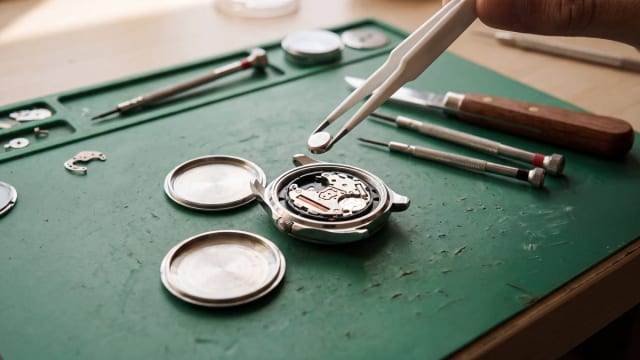
How to Change a Watch Battery: a Watchmaker's Method, and the Step Almost Everyone Forgets
Care & maintenance
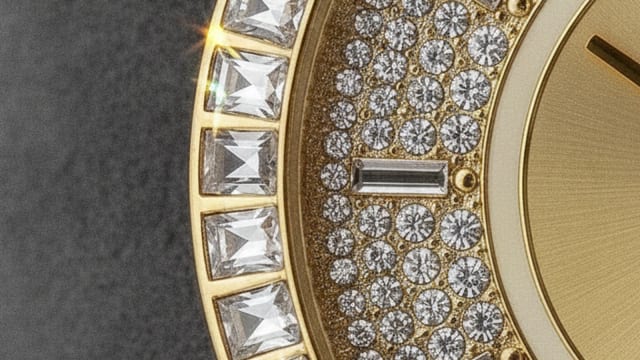
Crystals and rhinestones falling from a watch: why, and how to protect them
Care & maintenance
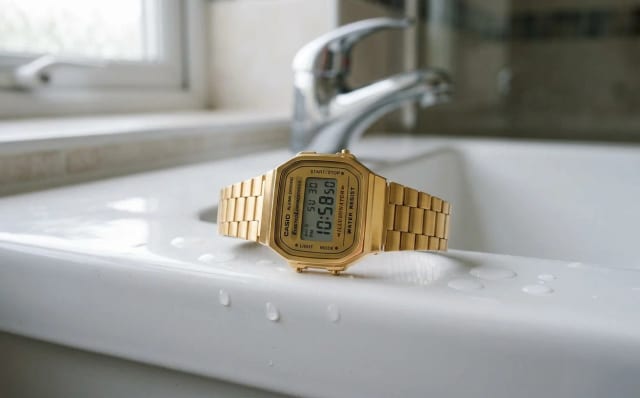
Casio Water Resist: is your vintage watch water resistant? (A158, A168, LA670)
Care & maintenance
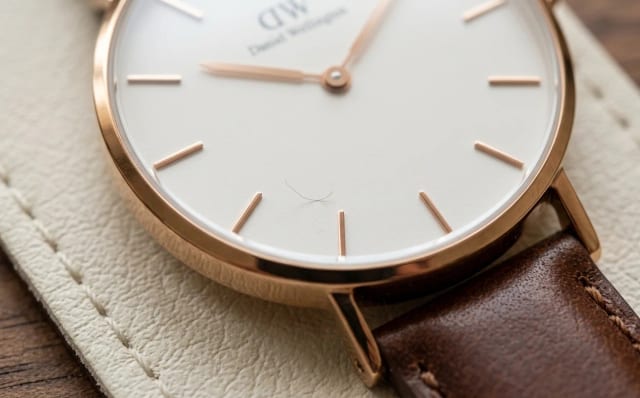
Dust on a watch dial: how to remove it easily
Care & maintenance
Watch Water Resistance Ratings: ATM, Bar, Metres (Complete Guide)
Care & maintenance