
Why do dials show IIII instead of IV? The video guide
The video guide · 2:03
Chapters
Transcript
Take a close look at this dial. At four o'clock, there is no I followed by a V, but four I's in a row. A mistake? A mistake that isn't one. The Romans themselves often wrote four this way. On their inscriptions, both forms sit side by side, sometimes in the same text. In Europe, four I's in a row even remain the usual form until around the seventeenth century. It appears on the oldest clock dials known. The one in Wells Cathedral, in England, dates from the late fourteenth century, and its four is already written as four I's. The habit is so strong that in London, Parliament describes the Great Clock of Big Ben as an exception: it shows an I followed by a V, "rather than the usual four on other clocks". Why keep it? No text ever made it compulsory. The most widespread hypothesis is balance: opposite, at eight o'clock, the eight is written with four signs. The two wide numerals answer each other. Another hypothesis: legibility. An I followed by a V looks a lot like the six, especially at the bottom of the dial, where numerals are often written upside down. As for the French king who supposedly refused this four, it is a legend, with no proof at all. So this dial is no mistake: it follows a tradition more than six centuries old. Discover a whole selection of watches at Montres Outlet.
More video guides
 ▶ 2:25
Why do quartz watches run at 32,768 Hz? The video guide
 ▶ 2:16
Quartz or automatic? The video guide
 ▶ 2:26
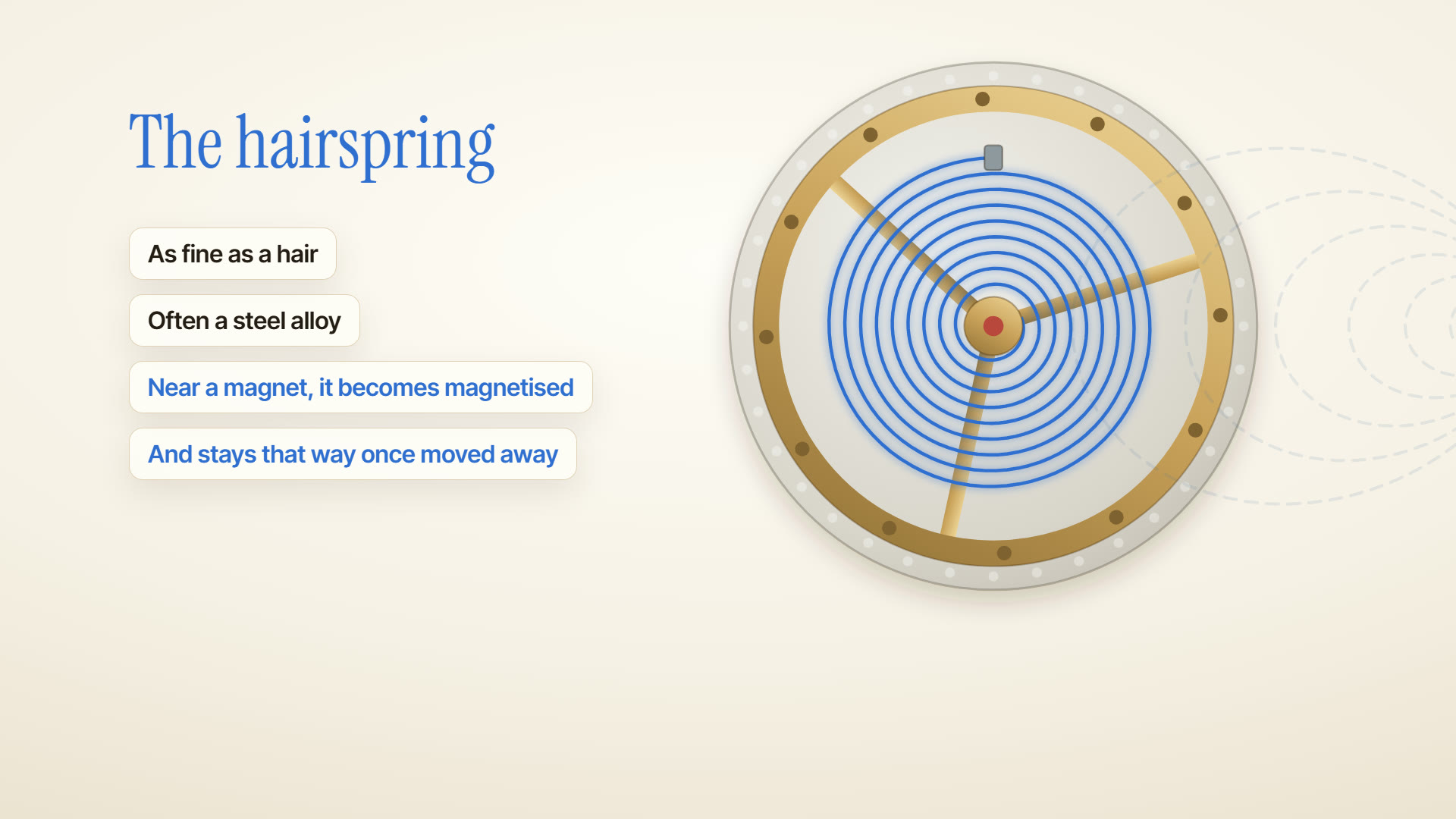
Why does a magnet make your watch run fast? The video guide
 ▶ 2:25
What are the jewels in a watch for? The video guide
 ▶ 2:11
Is sapphire crystal unbreakable? The video guide
 ▶ 2:17