
Affordable Men's Watch: Complete Guide to the Best Offers 2026

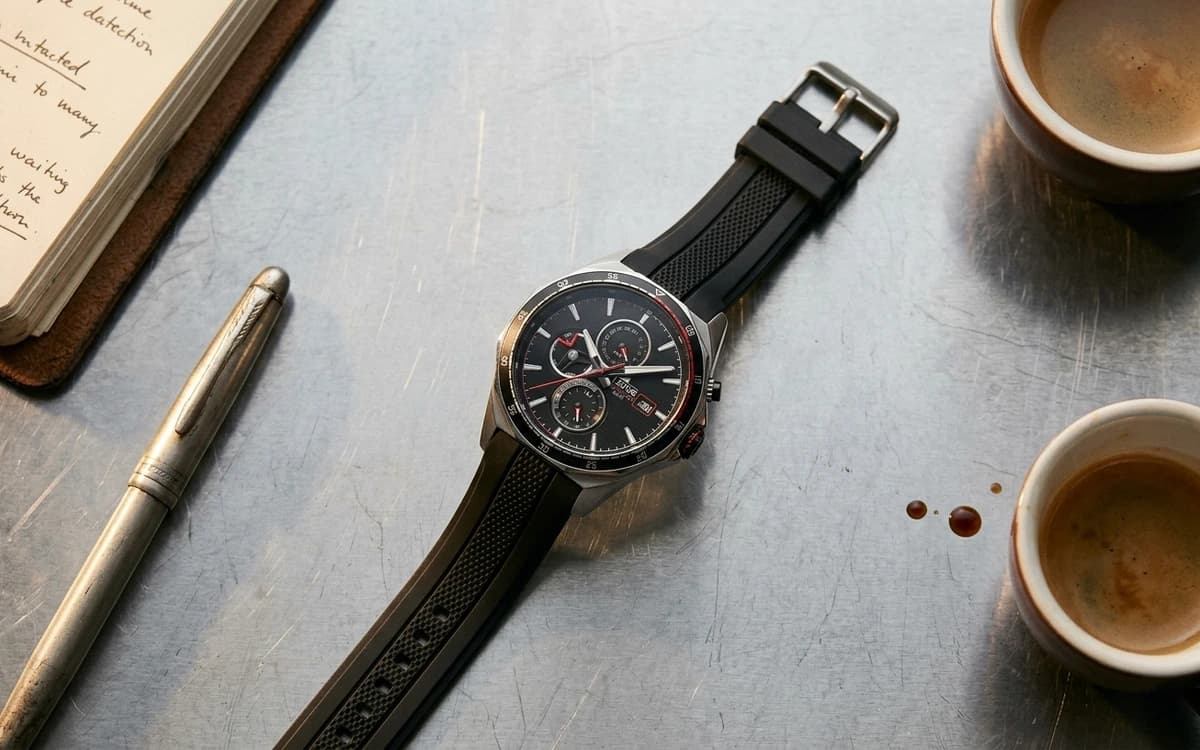
A reasonably priced men's watch can last ten years, maintain impeccable accuracy and display finishes worthy of a premium shelf. The secret: knowing which criteria to look at, which brands truly deserve your trust, and where to buy without taking risks. This guide dismantles received ideas and gives you the concrete tools to choose wisely.
Diagnosis in 5 seconds

Updated 2 May 2026 · 14 min read · By Nicolas Bernard, Field Tester
Why the affordable watch market has changed profoundly
For a long time, the affordable segment was associated with gadget watches: zinc alloy cases, straps that fray within three months, anonymous movements of unknown origin. That time is over. Three phenomena have transformed this market since the early 2010s.
First phenomenon: the democratisation of Japanese movements. Miyota (a Citizen subsidiary) and Seiko manufacturers produce quartz movements in industrial volumes. These blanks are sold to fashion brands at costs that allow a reliable motor to be integrated into a low-priced watch. The accuracy of these calibres is between +/- 15 and +/- 20 seconds per month, which is entirely acceptable for daily use.
Second phenomenon: the upgrade of budget materials. 316L steel has become the minimum standard on cases, even at low prices. Reinforced mineral crystal (Hardlex type at Seiko, K1 at other suppliers) has replaced fragile organic glass. These materials, initially reserved for higher segments, are now accessible at all production levels.
Third phenomenon: the outlet circuit. Major brands plan their volumes according to seasonality, new launches and retail uncertainties. Unsold items and end-of-line pieces arrive in the outlet circuit with significant reductions, with no compromise on quality or warranty. In our current stock at Montres Outlet, over 60% of references are new pieces from exactly this mechanism.
Direct consequence: on a reasonable budget, a well finished, accurate and durable watch is now accessible, provided you know what to look for. Contrary to what many buyers think, this budget does not condemn you to major compromises, it simply requires more careful reading of the technical specifications. This guide gives you the tools for that.
Accessible brands to know and their real positioning
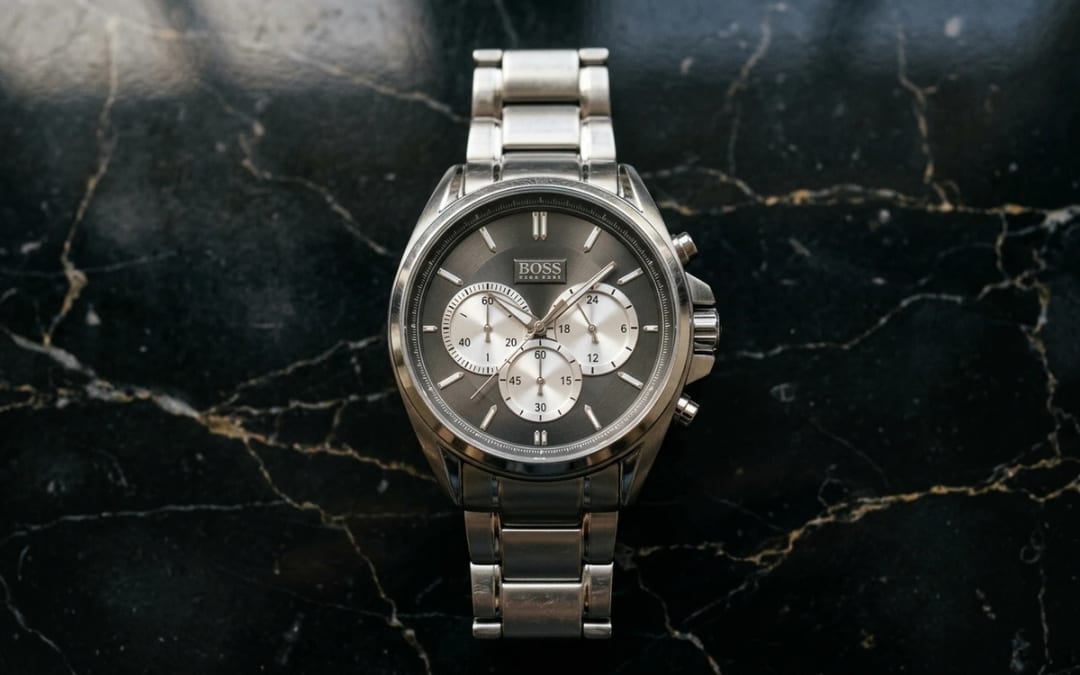
Here is a factual overview of the brands most present in this segment, with their real positioning and their specific strengths, based on the references we handle regularly.
Tommy Hilfiger: American sport-preppy, everyday versatility
Tommy Hilfiger relies on a recognisable visual vocabulary: tricolour flags, blue or white dials, two-tone straps. The models are equipped with Japanese quartz movements (Miyota in the majority of cases) integrated into 316L steel cases. The diameter generally ranges between 44 and 46 mm, which corresponds to current preferences for a standard male wrist.
The brand's strength in this segment: versatility. A Tommy Hilfiger works just as well with jeans as with business casual attire. Leather or steel mesh straps are correctly finished at this price level. The outlet range sits in the mid-range bracket depending on models and periods.
To learn more: consult our complete Tommy Hilfiger men's guide or browse directly the Tommy Hilfiger collection.
Daniel Wellington: Scandinavian minimalism, interchangeable straps
Daniel Wellington has built its entire identity on sobriety: dials without numbered indices, fine bezels, NATO or leather straps in neutral colours. The positioning is deliberate: a fashion accessory watch, to wear with everything, to personalise easily thanks to interchangeable straps.
The movement used is Japanese. Water resistance is generally limited to 3 ATM, which corresponds to splash resistance but not swimming. This is not a flaw: the brand's lifestyle positioning implies it. The outlet range sits in the entry-level bracket. It is one of the most accessible entry points for a brand with strong brand awareness.
Emporio Armani: Italian design, office use and formal occasions
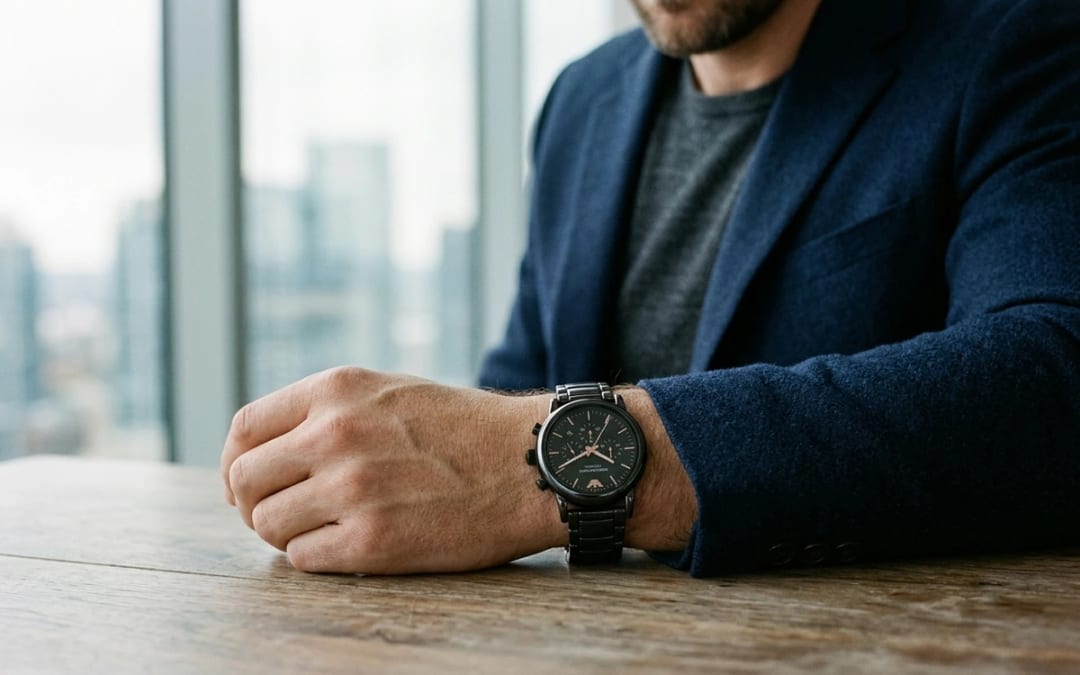
Emporio Armani is the more accessible line of the Armani group. The design is distinctive: black or anthracite dials, cases with geometric shapes, carefully polished finishes. It is a watch that dresses up rather than sports. The movements are Japanese. The materials include stainless steel and mineral crystal.
The outlet price positioning sits in the mid-range bracket. This is the most relevant bracket if you are looking for a watch for the office, a professional meeting or a formal occasion without wanting to invest in a higher segment. Find our detailed analysis in the Emporio Armani men's guide.
Hugo Boss: contemporary sophistication, assured sport-chic
Hugo Boss occupies the upper end of the accessible bracket in this guide. Boss watches are characterised by contemporary designs with attention to detail: well-integrated crowns, worked case backs, bracelets with deployment clasps on mid-range models. The movements are Japanese or Swiss depending on the ranges.
The outlet argument is particularly strong here: a Hugo Boss in outlet often corresponds to a model sold at a clearly higher public price in standard retail. The value for money becomes excellent. See our Hugo Boss men's guide for details by range.
Casio: technical robustness, reliability without compromise
Casio plays in a different stylistic league but deserves to be mentioned for its unique value proposition: technically flawless watches at some of the lowest prices on the market. Casio's simplest models are assembled with standardised components but industrially tested. G-Shock offers levels of shock and water resistance unmatched at these prices. If your priority is pure durability rather than fashion style, Casio is a serious reference.
Comparative table: representative selection 2026
| Brand | Dominant style | Movement | Case materials | Outlet bracket | Ideal use |
|---|---|---|---|---|---|
| Tommy Hilfiger | Sport-preppy, colourful | Japanese quartz (Miyota) | 316L steel, mineral crystal | Middle of the selection | Daily wear, casual, first purchase |
| Daniel Wellington | Minimalist, timeless | Japanese quartz | Stainless steel, mineral crystal | Most accessible | Lifestyle, interchangeable straps |
| Emporio Armani | Elegant, urban | Japanese quartz | Stainless steel, mineral crystal | Middle of the selection | Office, formal occasions |
| Hugo Boss | Sport-chic, contemporary | Japanese or Swiss quartz | 316L steel, reinforced mineral crystal | Top of the selection | Professional, versatile premium |
| Casio | Technical, robust | Proprietary Casio quartz | Resin/steel depending on range | Most accessible | Sport, field, maximum durability |
The quality criteria that make the difference in the mid-range
Buying an affordable watch without a precise reading grid is like choosing a car without looking under the bonnet. Here are the five technical criteria to apply before any purchase in this price range.
The movement: Japanese quartz as absolute reference
The movement is the most important component. At these budgets, quartz movements dominate and this is a very good thing for two reasons: precision and minimal maintenance.
The two reference manufacturers at this price level are Miyota (Citizen group) and Seiko. Their calibres are industrially tested, documented and available in spare parts worldwide. A battery to change every two to three years, occasional strap cleaning: maintenance boils down to that. If you wish to explore the difference between quartz and automatic in detail, our automatic vs quartz comparison covers the subject exhaustively.
What to avoid: movements with no identified brand on the product sheet. A serious seller always indicates the calibre or at least the movement manufacturer. The absence of information on this point is a warning sign.
Dial finishes: the details that betray quality
On a well-built watch, even in the entry-level bracket, the dial finishes are sharp. Here is what you should check, ideally on high-definition photos or in store:
- The indices (batons or numerals): aligned, with no ink overflow or misalignment.
- The brand logo: sharp, centred, with no blur.
- The hands: uniformly coloured, with no visible scratches when new.
- The overall dial symmetry: no element should appear misaligned.
These details are a direct indicator of the level of quality control in the factory. A brand that monitors its finishes also protects its other components.
Materials: 316L steel, reinforced mineral crystal, solid strap
Case: 316L stainless steel is the standard to demand in this range. It resists corrosion, is hypoallergenic and withstands daily impacts without deforming. Zinc or zamak alloys, present on a significant portion of budget cases I have dismantled, oxidise, deform and sometimes cause allergic reactions. The product sheet must explicitly mention "stainless steel" or "stainless steel 316L": if it is not written, assume it is not 316L.
Crystal: Mineral crystal is the standard in this range. It resists impacts well but scratches more easily than sapphire. Some manufacturers offer reinforced mineral crystal (Hardlex at Seiko, K1 at others) which offers better scratch resistance for a marginal additional cost. Sapphire crystal is rare at these prices but it exists at a few technical brands.
Strap: For leather straps, check the quality of the stitching and the flexibility of the material: low-grade leather cracks in less than six months. For steel bracelets, the links must fit together with no perceptible play. Counter-intuitively, a simple Milanese mesh bracelet often holds up better over time than a synthetic leather strap: metal, after all, does not deform.
Water resistance: understanding ATM levels
Water resistance is often misunderstood. Here are the useful levels in this price segment:
- 3 ATM (30 m): resists splashes and rain. No swimming, no shower.
- 5 ATM (50 m): wearing under the shower possible, no bathing or swimming.
- 10 ATM (100 m): swimming and snorkelling without problem.
Most affordable fashion watches are at 3 or 5 ATM. This is sufficient for normal daily use. If you are looking for a truly water-resistant watch for regular aquatic activities, our complete guide to water-resistant men's watches will guide you towards suitable models.
Authenticity: the golden rule for this segment
The segment of "affordable branded watches" is unfortunately a priority target for counterfeiters. Brands such as Tommy Hilfiger, Emporio Armani and Hugo Boss are among the most copied. The only effective protection: buy only from an authorised retailer.
An authorised retailer delivers each watch with its original box, a manual, a warranty card and, depending on the brand, a certificate of authenticity. At Montres Outlet, the absence of even one of these elements on a model sold as new is grounds for rejecting the product upon receipt: it is non-negotiable.
Also be wary of prices that seem too far removed from market reality: a Hugo Boss at an unrealistically low price on an anonymous marketplace is almost certainly a counterfeit. The outlet circuit generates genuine reductions of 30 to 50%, not 80 or 90%.
To prioritise
- Buy from a retailer officially authorised by the brand
- Check for Miyota or Seiko movement in the product sheet
- Require 316L steel case and mineral crystal as a minimum
- Request the 2-year warranty before any purchase
- Customer reviews are available on Temovio.
- Check minimum 3 ATM water resistance for daily use
To avoid
- Buy on a marketplace without verifying authorised retailer status
- Rely on a discount of more than 70% without serious explanation
- Buy a watch delivered without brand box or warranty card
- Choose a "metal" case without specification of the alloy used
- Ignore the complete absence of movement information
- Confuse "low price" and "good value for money": the two are not synonymous
Which watch for which use: guide your choice by lifestyle

Technical criteria mastered? The question becomes stylistic and functional. Here is how to guide your choice based on the intended primary use.
For the office and formal occasions
Priorities: clean dial, polished finishes, leather strap or steel mesh, reasonable diameter (40-44 mm maximum under a shirt cuff). The most suitable brands in this range: Emporio Armani for Italian design, Hugo Boss for contemporary sobriety, Daniel Wellington for absolute minimalism.
Contrary to what many imagine, a watch loaded with complications does not impress in a formal context: it gets in the way. I have seen chronographs with cluttered dials turned away at the entrance to business meetings, where a simple three-hand watch passed without comment. Legibility and discretion remain the two criteria that make or break an office watch.
For everyday and casual wear
This is the natural playground of Tommy Hilfiger and Daniel Wellington. Versatility takes priority: a watch that works with jeans and casual suits without a hitch. Interchangeable straps (with Daniel Wellington in particular) are a real advantage: you can change the look of your watch according to your outfits without buying a new model.
For this use, 3 ATM water resistance is sufficient. Standard mineral crystal is suitable. Priority goes to design and dial legibility in varying light conditions.
For sport and outdoor activities
Classic fashion brands are not designed for intensive sport. If your use includes regular water activities, trail running or contact sports, turn to Casio (G-Shock for maximum resistance) or models specifically positioned for sport with minimum 10 ATM water resistance. Our guide to men's water-resistant watches details this segment.
Classic vs sports watches: quick decision table
| Criterion | Classic watch | Sports watch |
|---|---|---|
| Typical diameter | 38 to 42 mm | 44 to 48 mm |
| Strap | Leather, fine steel mesh | Silicone, robust steel mesh |
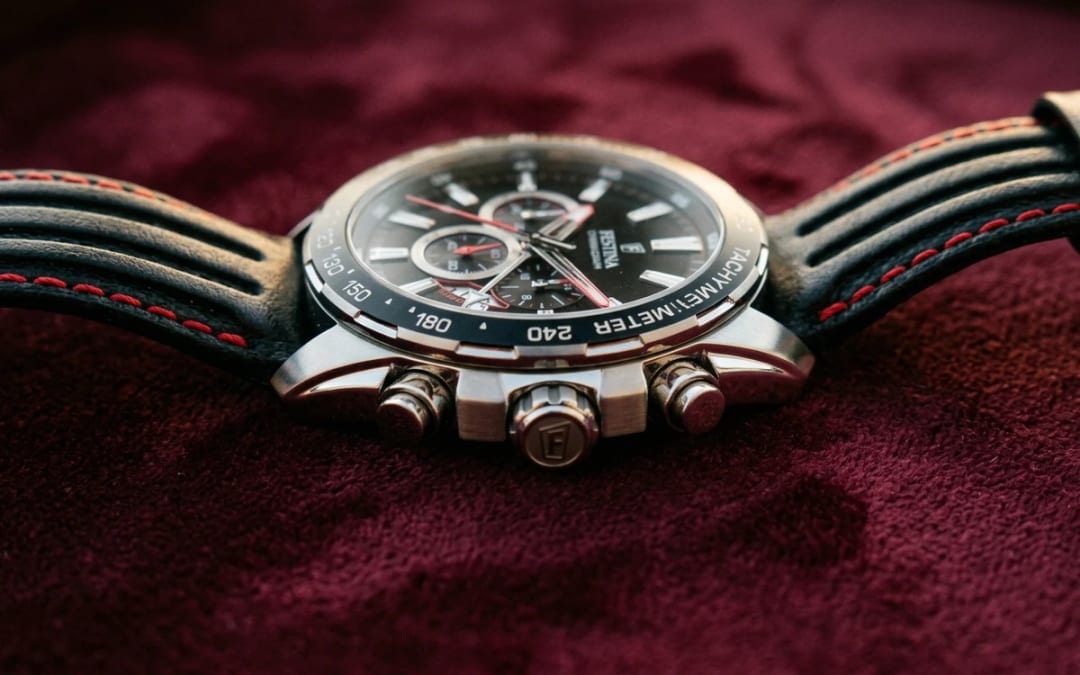
| Dial | Clean, few complications | Chronograph, tachymetre possible |
| Water resistance | 3 ATM generally | 5 to 10 ATM recommended |
| Primary use | Office, evening, casual | Sport, outdoor, active daily wear |
| Suitable brands (outlet) | Daniel Wellington, Emporio Armani | Tommy Hilfiger Sport, Hugo Boss Sport, Casio |
Understanding the outlet circuit: how price reduction really works
The most common confusion among buyers discovering the outlet circuit: confusing "outlet" with "clearance of defective products". That is not the reality.
Here is how this circuit actually works in fashion watchmaking:
End of collection. Major brands regularly refresh their ranges, and models from previous seasons leave the classic distribution network. The watch is strictly identical to the one sold in store a few months earlier: same quality, same packaging, same warranty. I compared side by side "outlet" and "retail" boxes of the same Tissot PR 516 model: impossible to tell the difference.
Seasonal overstock. Retail retailers order in volume and do not always sell their complete stock. This overstock, perfectly new and never worn, ends up in the outlet circuit at a reduced price. Contrary to what many imagine, it is not a quality issue but simply a matter of commercial logistics.
Is the warranty maintained? Yes. As long as the watch is new, the 2-year warranty applies from the date of purchase by the end consumer. Buying an outlet watch from an authorised retailer like Montres Outlet triggers the warranty from your purchase, not from the manufacturing date. This is the standard rule in the industry.
Typical reductions in this circuit are between 30 and 50% compared to the recommended retail price. Higher discounts appear occasionally during sales or Black Friday. Levels of 70 to 80% exist, but I observe them almost exclusively on references removed from the catalogue more than three years ago: be wary of announcements displaying this type of discount on recent models.
When and how to buy to get the best price
The first advantage of the outlet circuit, and I repeat it to every customer who waits for January to buy: reduced prices are permanent. At Montres Outlet, approximately 65% of sales take place outside promotional periods. Seasonality is mainly a consumer habit, not an outlet market reality.
Classic promotional periods
Winter and summer sales generate cumulative discounts that can reach 40 to 50% on models already cleared. Black Friday remains the most active period: fashion brands discount aggressively, and on certain references I track all year, I have seen significant price differences within 48 hours.
Private sales: the best value-for-opportunity ratio
Private sales reserved for newsletter subscribers are, in my experience, the most underestimated lever: early access to new arrivals, unpublished discounts, and models in limited quantities before going online. Registration is free, and on short runs, it often makes the difference between finding the right strap size or missing out.
Price comparison: method and precautions
Comparing prices between several sites is good practice, provided you ensure that the sites being compared are all authorised resellers. A lower price on an unidentified marketplace does not reflect a better deal but often a risk of authenticity. The reference price to retain is the manufacturer's suggested retail price (MSRP), available on each brand's official website. A reduction of 30 to 50% on this reference price from an authorised reseller is a verifiable good deal.
Maintenance and lifespan: what you can reasonably expect
The question of the lifespan of an affordable watch comes up repeatedly. On the hundreds of references that have come into after-sales service at Montres Outlet, here is what field experience reveals concretely in this segment.
The quartz movement: longevity and minimal maintenance
A Miyota or Seiko calibre used correctly generally lasts between 10 and 15 years without major servicing. The only regular maintenance operation is battery replacement, generally every 2 to 3 years depending on the calibre and active functions (backlighting, chronograph). This operation is inexpensive at a watchmaker. It does not require completely dismantling the watch.
If your watch loses time or stops for no reason, change the battery before suspecting a mechanical problem. On the returns I process, a flat battery is by far the most frequent cause of the malfunction: it is the first step, not the last.
The strap: often the first point of wear
The strap is the component that wears out fastest, regardless of the watch's price. A leather strap shows signs of fatigue after 1 to 3 years depending on the intensity of wear and conditions (perspiration, humidity). A steel bracelet lasts much longer but can deform if the links are of poor quality.
Good news: straps are replaceable without breaking the bank. A decent replacement leather strap sits in the entry level range, often less than 20% of the watch's price. Replacing the strap rather than the entire watch remains, after 3 to 4 years of wear, the most cost-effective decision.
The crystal: preventing scratches
Mineral crystal resists impacts well but scratches much faster than sapphire, when in contact with granite, concrete or metal. If micro-scratches are already present, a watchmaker generally replaces it at a modest cost on this segment, often cheaper than a new strap. For anything involving moisture and water resistance, our article on misting in a watch details causes and solutions.
For complete maintenance of an automatic watch or any collection model, our watch maintenance guide covers all steps, from case cleaning to movement adjustment.
The most common mistakes to avoid on a first purchase
Ten years of handling watches from entry level to upper range allow me to identify the same mistakes, whether for a first purchase or a gift. They do not change from one year to the next.
Mistake no. 1: relying solely on the dial photograph. The dial is often well finished even on mediocre models. It is the secondary finishes that reveal the reality: a case back that is too light, a clasp that creaks when opening, strap stitching that frays within the first few months. That is where I look first.
Mistake no. 2: not checking the diameter on your own wrist. A 46 mm model on a 17 cm wrist circumference looks disproportionate. Measure your wrist before ordering. For a wrist up to 18 cm, 40 to 44 mm is generally the most balanced range.
Mistake no. 3: buying a chronograph without using it. On watches I disassemble in the workshop, budget chronographs multiply weak points: pushers, column wheel, sub-dial hands. If you do not use the chrono function daily, a simple dial like that of the Casio MTP-V001 is not only more legible but mechanically more reliable.
Mistake no. 4: neglecting the weight of the watch. I have held hundreds of cases: a genuine 316L weighs around 60-80g bracelet included, against 30-35g for a budget alloy labelled "stainless steel". If a watch feels abnormally light in your hand, it is rarely a good sign.
Mistake no. 5: confusing seller warranty with the 2-year warranty. Contrary to what most buyers think, a seller's commercial warranty does not cover manufacturing defects according to the brand's standards. Only the 2-year warranty card, physically included in the box, offers you this recourse. Check this point before finalising your order.

Find your watch
All the watches presented in this guide are in stock, brand new, with a 2-year warranty and free delivery to mainland France, subject to our terms.
Frequently asked questions
What is the best affordable men's watch brand in 2026?
Can an affordable men's watch last a long time?
How do you choose a quality men's watch on a tight budget?
What is the difference between a quartz watch and an affordable mechanical watch?
Where can you find the best deals on men's watches?
How long should you keep a men's watch before changing it?
Does a discounted men's watch lose quality?
What is the most reliable men's watch in the entry level to mid-range segment?
Read next
More in this vein
Buying guides
200m Water Resistant Watch: The ideal companion for diving
Buying guides
The materials making a comeback in both watchmaking and creative jewellery
Buying guides
Swarovski watch: crystal, Swiss Made, what you're really paying for
Buying guides
Maserati Sfida R8823140004: autopsy of an open heart NH70
Buying guides
Skeleton watch: the complete guide from a watchmaker (men's, women's, automatic)
Buying guides
Rolex-style watch: Submariner, Datejust and affordable homages
Buying guides
Rectangular watch: from the Cartier Tank to affordable alternatives
Buying guides