
Why do all watches show 10:10? Symmetry, legibility and the smile hypothesis

Open a catalogue, an online shop or a watch advert: the time shown is almost always the same, 10:10, ten past ten. It is neither a coincidence nor a stopped watch. This guide sets out the three reasons usually given for the choice and what two psychology studies really say about it. It adds a calculation you can check for yourself: the perfectly symmetrical V does not fall at 10:10, but at 10:09:14.
10:10, the time in watch adverts since the 1950s
The best-documented history comes down to two markers. In the 1920s and 1930s, 8:20 was almost universal in watch adverts. Since the 1950s, 10:10 has dominated. These markers come from the introduction to a study published in 2017 in the journal Frontiers in Psychology, which itself draws on a 2008 article and an archive of old adverts. The authors do not date the switch to the year, and neither will we.
Elsewhere you will read more precise dates, with the name of the brand said to have started the trend, or the exact setting some maker supposedly follows. We do not repeat them: these claims come from blogs, no period source confirms them, and they change from one site to the next. The same caution applies to the legends that tie 10:10 to a historical event: none has been proven.
Reason one: a symmetrical V that frames the logo
On many dials, the brand name is printed just below 12. At 10:10, the hour hand points just past 10 and the minute hand at 2: together they draw a V that opens upwards, framing the logo instead of cutting across it. Three specialist sources give this reason first and agree on it: Gear Patrol, Crown & Caliber and Le Calibre.
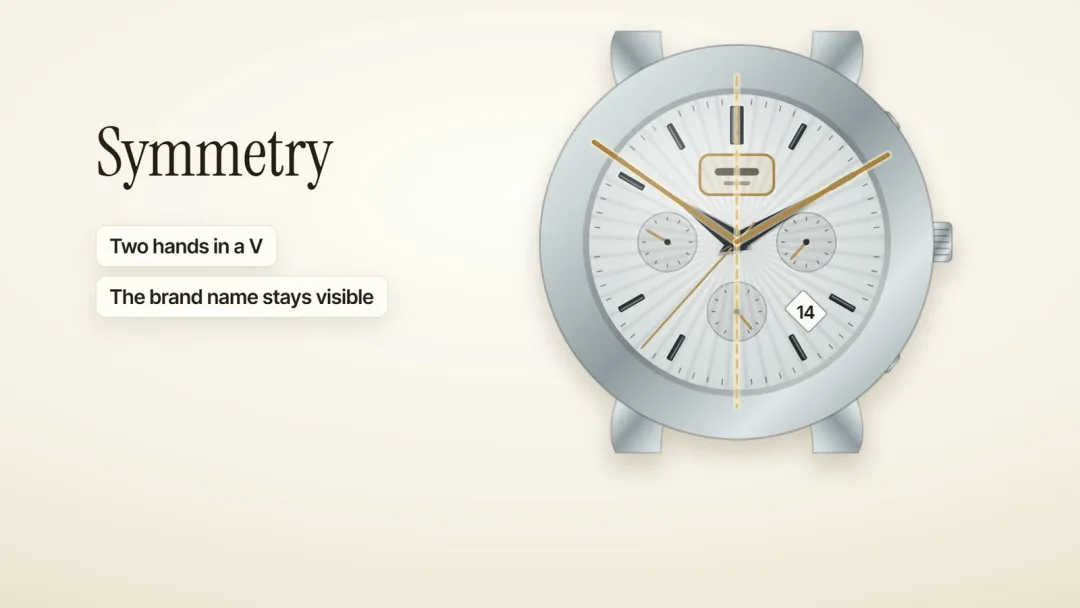
The V also sits on either side of the 12-6 axis, one hand to the left, one to the right, at almost the same distance. That is what sets 10:10 apart from 8:20: 8:20 forms the same V, but pointing downwards. It frames the 6, leaves the top of the dial empty, and so does not frame a logo printed below 12.
Reason two: nothing is hidden
An advert has to show the whole product. Yet a hand covers whatever it passes over: a date window, a chronograph subdial, a marker. At 10:10, the hour hand is at 305° and the minute hand at 60°: both stay above the 9-3 line. A date window at 3 o'clock, a subdial at 6 or 9 o'clock: the hands pass at least 30° away from these positions.
The other times that come up in this debate do less well. At 8:20, the minute hand sits on the 4 o'clock marker, and both hands drop into the lower half of the dial. At 11:30, the minute hand cuts the dial down to the 6, while the hour hand, 15° to the left of 12, brushes the logo area.
10:08, 10:09: why watches are not set at exactly 10:10
Look closely at a watch photo: the time is often 10:08 or 10:09, not 10:10. Gear Patrol gave the reason in January 2023: at exactly 10:10, the minute hand lands on the 2 o'clock marker and hides it. Setting it back a minute or two clears the marker.

The calculation confirms this and puts numbers on it. The 2 o'clock marker is at 60°. At 10:09, the minute hand is at 54°, 6° short of the marker. At 10:08, it is at 48°, 12° short. Setting the hands back has a less obvious side effect: it also changes the symmetry of the V, because the hour hand does not stand still.
The calculation: the perfect V falls at 10:09:14
It is easy to forget: the hour hand does not stay on the 10 for the whole hour. It moves 0.5° per minute, while the minute hand moves 6° per minute. At 10:10, it has therefore travelled 5° beyond the 10 and sits at 305°, 55° to the left of 12, while the minute hand is 60° to the right. The V at 10:10 is 5° out of symmetry.
| Time | Hour hand (left of 12) | Minute hand (right of 12) | Symmetry gap | Margin before the 2 o'clock marker | Opening of the V |
|---|---|---|---|---|---|
| 10:08 | 56° | 48° | 8° | 12° | 104° |
| 10:09 | 55.5° | 54° | 1.5° | 6° | 109.5° |
| 10:09:14 | 55.4° | 55.4° | 0° | 4.6° | 111° |
| 10:10 | 55° | 60° | 5° | 0° (on the marker) | 115° |
Two readings stand out. 10:09 is almost perfect: only 1.5° out, and the 2 o'clock marker stays clear. 10:08 clears the marker better, but it is less symmetrical than 10:10 (8° out against 5°). The calculation therefore suggests that watches are set back to 10:08 for legibility, not for symmetry. A rule worth keeping: every minute away from 10:09:14 adds 6.5° of asymmetry, the minute hand's 6° plus the hour hand's half-degree.
The calculation has a curious sequel: perfect symmetry comes round 13 times per turn of the dial, every 55 min 23 s (twelve hours divided by thirteen), counting noon, when the hands overlap. Six of these positions form a V that opens upwards. At 11:04:37 the V is very narrow (55°); at 9:13:51 it is almost flat (166°). Only 10:09:14 and its mirror image, 1:50:46, give a V opened to 111° above the centre.
10:10, 8:20, 11:30, 13:50: what we know about each time
| Time | Shape of the hands | What is clear or hidden | What the studies say |
|---|---|---|---|
| 10:10 | V opening upwards (115°), exact symmetry at 10:09:14 | Logo below 12 framed, lower half clear; the minute hand covers the 2 o'clock marker | 2017: more pleasure than 8:20 and 11:30, seen as a smile |
| 8:20 | Inverted V, opening downwards (130°), exact symmetry at 8:18:28 | Top of the dial clear, hands in the lower half; the minute hand covers the 4 o'clock marker | 2017: seen as a sad face. The usual time in adverts of the 1920s and 1930s |
| 11:30 | Almost a straight line (165°) | The minute hand passes over the 6, the hour hand brushes the logo area | 2017: less pleasure than 10:10 |
| 13:50 | Same V as 10:10, mirrored (115°), exact symmetry at 13:50:46 | Logo framed; the minute hand covers the 10 o'clock marker | 2015: tested alongside other times, no effect of the time on how the watches were rated |
One thing stands out from the table: 13:50, ten to two, has the same geometry as 10:10, with the short hand on the right instead of the left. If only symmetry and legibility mattered, the two times would be equal. That is what makes the 2015 study, below, interesting.
Reason three, more surprising: the smile
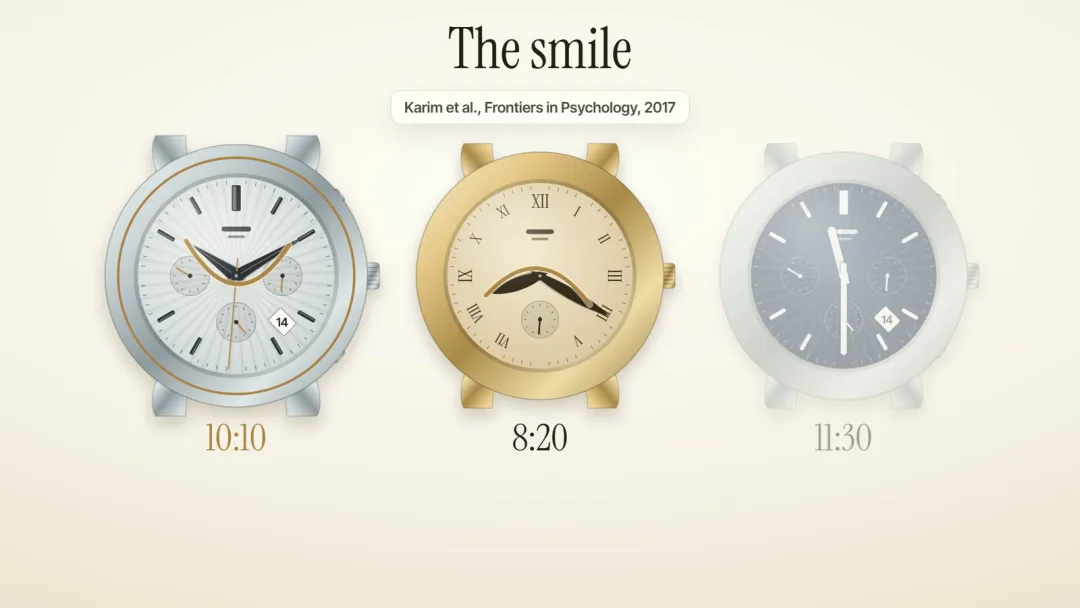
This third explanation, for its part, has been put to an experiment. In 2017, four researchers (Karim, Lutzenkirchen, Khedr and Khalil) published a study in Frontiers in Psychology entitled "Why Is 10 Past 10 the Default Setting for Clocks and Watches in Advertisements? A Psychological Experiment". They photographed watches set at three different times: 10:10, 8:20 and 11:30.
First experiment, 46 participants (20 men, 26 women): they rated the pleasure each photo gave them on a scale illustrated with small figures, from a smiling face to a frowning one (the SAM scale, for Self-Assessment Manikin). The watches at 10:10 gave more pleasure than those at 8:20 and 11:30. Second experiment, 23 participants (11 men, 12 women): they said how far each setting resembled a facial expression. 10:10 was seen as a smile, 8:20 as a sad face.
What the 2017 study does not prove
Add to these limits the size of the samples: 46 and then 23 people is not much to draw a general conclusion from. Another, earlier study found nothing at all. In 2015, Furnham, King and Kolzeev published an experiment on the time shown on watches in the journal Psychology (vol. 6, no. 14): no effect of the time on how the watches were rated.
Be careful not to make it say more than it does: it tested neither 10:10 nor 8:20, but 13:50, 9:00, 19:20, 8:10 and 10:25. So it does not directly contradict the 2017 study. Among those times, though, is 13:50, which forms the same V as 10:10, and it did no better than the others. The smile remains a hypothesis; symmetry and legibility, on the other hand, can be checked on any dial.
Setting your watch to 10:10 for a photo
To photograph your watch the way a catalogue does, there is no need to aim for the second: 10:09 gives an almost symmetrical V and leaves the 2 o'clock marker visible. Most of the steps below are explained in detail in our guide on how to set the time and date on a watch without breaking it.
- Correct the date first, if needed, with the hands outside the 9 pm to 3 am window, when the date mechanism is engaged.
- Pull the crown out to the time position: the second position on a watch with a date, the first on a watch without one.
- Bring the hands to 10:09, finishing forwards. If you overshoot, go back a little further and come forwards again: this takes up the play in the gears.
- Check the reference points: the tip of the minute hand just short of the 2 o'clock marker, the hour hand just past the 10, each the same distance from its marker.
- Take the photo straight away: every minute adds 6.5° of asymmetry. On most quartz watches and many automatics, the seconds hand stops while the crown is pulled out to the time position, which freezes the hands while you take the shot.
- Push the crown back in, screw it down fully if it is a screw-down crown, then set the watch to the correct time.
A watch at 10:10 in a photo is not wrong
In a photo, the time on the watch has been chosen for the picture. It puts the logo in the centre, keeps the date and subdials visible, and follows a habit that goes back to the 1950s. To put a name to each element this setting leaves on show (markers, date window, subdials), our guide to watch anatomy goes through them one by one.
Dials worth a closer look
Chronographs with subdials, watches with a date window: it is on these busy dials that the 10:10 setting shows its full value.
Frequently asked questions
Why do watches show 10:10 in adverts?
Three reasons are given. The hands form a symmetrical V that frames the logo, often printed below 12. They leave the date, subdials and markers visible. And a 2017 study suggests that the V looks like a smile. The first two can be checked on any dial; the third remains a hypothesis.
Since when have watches been photographed at 10:10?
Since the 1950s, according to the introduction to the study published in 2017 in Frontiers in Psychology. In the 1920s and 1930s, adverts almost always showed 8:20, a downward-pointing V that the volunteers in that study associated with a sad face.
Why are watches often set at 10:08 or 10:09?
At exactly 10:10, the minute hand lands on the 2 o'clock marker and hides it; setting it back a minute or two clears it. The calculation also shows that the perfectly symmetrical V falls at 10:09:14: 10:09 is very close (1.5° out), 10:08 less so (8°).
Does the 2017 study prove that 10:10 looks like a smile?
No. It rests on two small experiments (46 and 23 participants) and only three settings, with a rating scale made of faces, and its authors do not rule out a simple familiarity effect. A 2015 study, which tested other times including 13:50 (the same V), found no effect of the time shown.
Is a watch showing 10:10 in a photo stopped?
No, the time was set on purpose for the photo. To recreate the setting at home, aim for 10:09 rather than 10:10 and always finish by moving the hands forwards.
Read next
More in this vein
Care & maintenance
Grey market watches: why a genuine watch can differ from the one you saw in a shop

Care & maintenance
Watch anatomy: the name of every part, and what it tells you about your watch

Care & maintenance
How to set the time and date on a watch without breaking anything: the crown, the date, digital watches

Care & maintenance
How to Clean a Watch and its Strap Without Damaging It: Steel, Leather, Silicone, Mesh, and the Moves to Avoid

Care & maintenance
How to Change a Watch Battery: a Watchmaker's Method, and the Step Almost Everyone Forgets
Care & maintenance
Crystals and rhinestones falling from a watch: why, and how to protect them

Care & maintenance
Watch polishing paste: what it really removes

Care & maintenance