

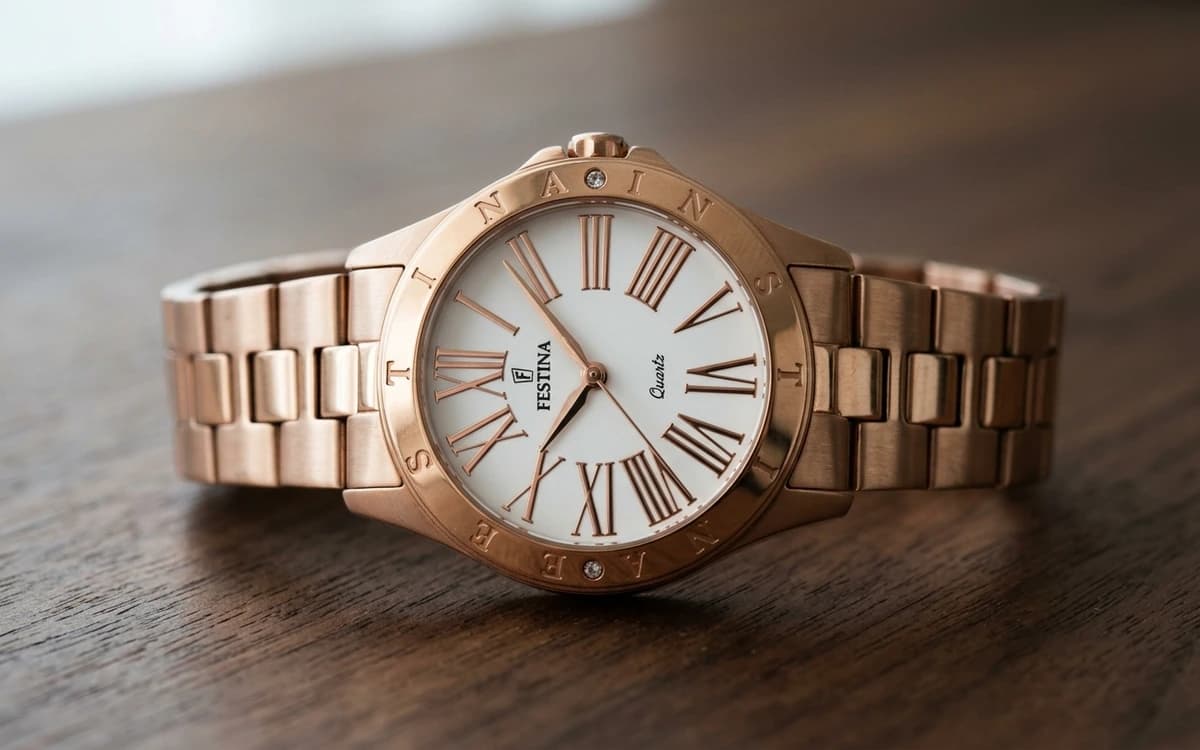
A women's watch in the entry-level range can last ten years. Another in the accessible upper range can disappoint you in eighteen months. The price of a watch does not follow a linear logic: it reflects a precise balance between movement, materials, brand image and technical complexity. This guide deciphers each factor to help you choose with full knowledge, whatever your budget.
Updated 2 May 2026 · 17 min read · By Camille Lefèvre, Watch Journalist
Diagnosis in 5 seconds

Women's watch price ranges in 2026
| Range | Typical movement | Crystal | Common water resistance | Brand examples |
|---|---|---|---|---|
| Entry-level | Japanese or Chinese quartz | Standard mineral | 3-5 ATM | Casio, Timex, Guess |
| Mid-range | High-end Swiss or Japanese quartz | Reinforced mineral or sapphire | 5-10 ATM | Michael Kors, Emporio Armani, Hugo Boss, Fossil |
| Upper mid-range | Japanese automatic or precise Swiss quartz | Anti-reflective sapphire | 10 ATM | Tissot, Frederique Constant, certain Seiko Presage |
| Premium and luxury | Swiss automatic (ETA, Sellita, manufacture) | Double anti-reflective sapphire | 10-30 ATM depending on model | Longines, Baume & Mercier, Omega |
Entry-level
In this bracket, the watch is above all a fashion accessory. The quartz movement is reliable and precise (±15 seconds per month), but mass-produced. The case is often chrome-plated alloy or light steel, with a standard mineral crystal (hardness 5 on the Mohs scale: it scratches, but is easily replaced). Water resistance at 3 ATM covers splashes and rain, not showers.
What you pay for here: design and logo. What you get in return: a contemporary look at a low price, minimal maintenance (battery change every 2-3 years), a wide variety of colours and shapes. Synthetic leather or silicone straps are functional but show signs of wear after 18-24 months of daily use.
Mid-range
This is the most popular balance zone. The quartz movement improves in quality: Ronda calibres (Swiss) or top-quality Seiko (Japanese), sometimes with chronograph or date display with magnifying lens. The case is solid 316L stainless steel, an industrial standard recognised for its corrosion resistance and hypoallergenic properties.
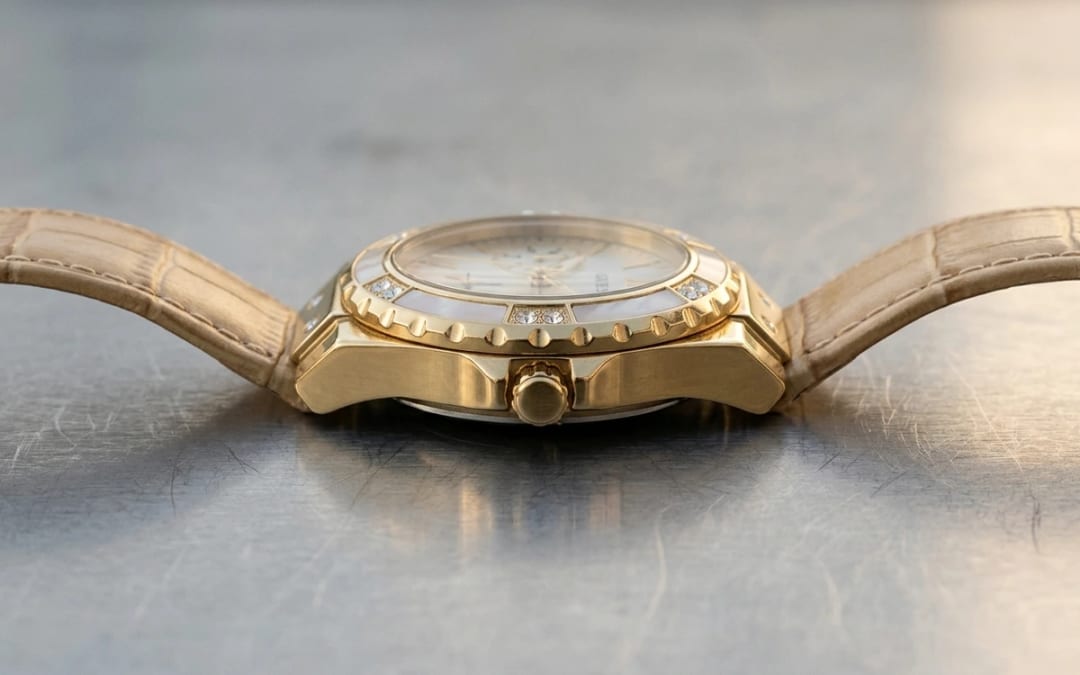
The crystal moves to reinforced mineral (Krysterna type) or synthetic sapphire on the best-positioned models. Water resistance reaches 10 ATM, which allows showers and occasional swimming. PVD finishes (yellow gold, rose gold, black) are more durable than standard plating. Genuine leather or steel straps with safety fold-over clasp provide real daily comfort.
Brands like Michael Kors, Emporio Armani or Hugo Boss occupy this segment: they sell a recognisable style and correct assembly quality. The brand premium represents part of the price, but the materials and finishes justify the gap with the cheapest models.
Accessible upper range
This tier marks a clear qualitative leap, particularly on the movement. An automatic movement becomes realistic: Miyota 8N calibres (Japanese) or Seiko NH, or even a basic Swiss Sellita SW200 depending on the brand. The mechanics become visible through a transparent sapphire caseback on many models. Sapphire crystal with anti-reflective treatment is almost systematic.
Finishes improve noticeably: finer polishing, mother-of-pearl dials of high quality or with sunburst effect, applied indices with facets. On the pieces I handled at the salon, the difference is felt immediately to the touch, not just to the eye. Full-grain leather straps or solid steel bracelets with triple-security fold-over clasp reinforce this impression every time you fasten your watch in the morning.
An important point to factor into your calculation: an automatic movement requires a complete overhaul every 5 to 7 years, at a significant cost that depends on the complexity of the calibre. This is not an optional expense if you want to maintain the precision and longevity of the movement. Consult our guide to maintaining automatic watches to plan this budget.
Premium and luxury
Beyond that tier, you enter the realm of fine watchmaking. Automatic movements are Swiss with advanced design: ETA 2892, Sellita SW300, or proprietary manufacture calibres, often decorated by hand (perlage, anglage, blued screws). Precision is certified, sometimes to COSC standard (±4 seconds per day maximum).
Materials reach another level: inlays of certified diamonds, straps in exotic leather (alligator, ostrich, lizard), cases in solid gold or titanium on sport-luxury models. Advanced horological complications make their appearance: moon phase, GMT (second time zone), power reserve, annual calendar.
This is a passion purchase as much as a practical one. Resale value is better than in lower ranges, but it remains strictly dependent on three factors: the brand, condition of preservation and completeness of the file (box, papers, certificates). Contrary to what many think, a watch without box or papers can lose 30 to 40% of its value on resale. A piece in this range can be passed down, provided you ensure its maintenance every five to eight years.
The four factors that explain price differences

The brand: a premium that is partially justified
The brand incorporates several elements into its price: heritage and reputation, investments in research and development, distribution and marketing costs, after-sales service, and the social value associated with the name. For fashion brands (Tommy Hilfiger, Diesel, Guess), the premium is mainly on visual identity and trend. For established watchmaking brands (Tissot, Citizen, Seiko), it reflects more accumulated technical expertise.
Price ranges observed at Montres Outlet for the most popular brands:
- Tommy Hilfiger: Affordable to mid-priced. American casual chic style, reliable quartz movements, correct finishes.
- Michael Kors: Mid-range. Urban glamour, highly identifiable designs, good assembly quality for the segment.
- Emporio Armani: Same middle segment. Italian minimalism, careful finishes, refined dials.
- Tissot: A notch above the fashion brands. Swiss watchmaking brand with genuine technical heritage, certified movements, sapphire crystal almost systematic.
The movement: quartz or automatic, two different philosophies
The movement is the most determining technical component in price formation. It also conditions your daily experience and your maintenance constraints. To go further on this subject, consult our complete automatic vs quartz comparison.
Quartz: reliability and accessibility
A quartz crystal vibrates 32,768 times per second under the effect of an electric current: this regularity produces a precision of ±15 seconds per month on average, which is remarkable for a very low manufacturing cost. The quartz movement is robust, thin (6-8 mm case thickness), and requires only a battery change every 2 to 3 years. A quality Japanese quartz calibre (Miyota, Seiko) costs just a few euros per unit in series production.
Automatic: complexity and maintenance
An automatic movement comprises several hundred mechanical parts assembled by hand or semi-automatically. The oscillating rotor winds the barrel spring thanks to wrist movements: no battery required. Precision is ±10 to 30 seconds per day depending on calibre quality, significantly lower than quartz. The case is thicker (9-12 mm minimum). The manufacturing cost of a basic Japanese automatic calibre is already five to ten times higher than that of a comparable quartz.
Concrete price difference: The same case climbs a price tier in its automatic version compared with its quartz version. This gap reflects mechanical complexity, not better precision - on the contrary, a quartz drifts 15 sec/month where a basic automatic can show 20 sec/day.
To prioritise
- Quartz if you seek maximum precision without maintenance constraint
- Automatic if you appreciate the artisanal aspect and wear your watch every day
- Check the calibre name (Miyota, Ronda, ETA, Sellita): it is a reliable quality indicator independent of the brand
- Compare the 2-year warranty: 2 years minimum, standard at Montres Outlet
To avoid
- Buying an automatic if you do not wear your watch daily: it will stop and require regular winding
- Neglecting the cost of overhauling an automatic in your total budget
- Confusing "Swiss Made" and high quality: some of the simplest Swiss movements are less robust than premium Japanese calibres
- Ignoring the country of origin of the calibre: Japan (Miyota, Seiko) and Switzerland (ETA, Ronda, Sellita) are the two reliable market references
Materials: each upgrade has a measurable cost
Materials influence aesthetics, durability and comfort. Here is what each choice implies concretely in price and performance, with gaps that can range from single to triple on models that are nonetheless very visually similar:
- Stainless steel 316L: Industry standard. Corrosion-resistant, hypoallergenic, available in polished, brushed or satin finishes. Moderate cost, excellent durability.
- PVD (Physical Vapour Deposition): Deposition of a micrometric layer of yellow gold, rose gold or black on steel. Significantly more resistant than conventional plating to wear and discolouration. Generally adds 20 to 30% to the price of a raw steel model. Rose gold PVD is currently one of the most sought-after treatments on women's watches.
- Titanium: Lighter than steel (40% less) and more corrosion-resistant. Mainly found on the priciest sport-luxury models.
- Standard mineral: Hardness 5 on the Mohs scale. Scratches with semi-precious stones, keys, certain metals. Economical, easily replaced.
- Reinforced mineral (Krysterna, Mineral Crystal Hardex): Improved resistance. Good price-durability compromise on intermediate models.
- Synthetic sapphire: Hardness 9 on the Mohs scale (just after diamond). Virtually scratch-proof in daily use. Adds a noticeable amount to the final price, but preserves dial legibility over time. Often accompanied by an anti-reflective treatment (AR coating) which further improves legibility from different angles of light.
- Synthetic leather: Lowest-priced option. Wears quickly (18-24 months in intense daily use). Often replaced easily and at low cost.
- Genuine leather (calf): Intermediate option. Good durability, softens with time, develops a characteristic patina. Should be protected from prolonged moisture.
- Full-grain leather / vegetable tanning: Superior quality. Natural texture preserved, superior durability, elegant ageing.
- Exotic leather (alligator, ostrich, lizard): Premium. A genuine alligator strap can represent a substantial expense on its own, sometimes more depending on the species and origin.
- Steel bracelet: Robust, timeless, requires initial adjustment at a jeweller's. Heavier than leather or silicone alternatives.
- Milanese mesh: Sliding steel mesh, very trendy, continuous adjustment without tools, airy and lightweight. Can pull on arm hair.
Complications: each function has a precise technical price
A horological complication refers to any function beyond hours and minutes. Each addition integrates an additional mechanical or electronic module, and in our stock, each complication represents on average 15 to 25% price increase compared to the base model of the same reference:
- Simple date: Low price impact. Integrated into the majority of modern movements without significant additional cost.
- Chronograph: Measurement of time intervals, functioning like a stopwatch. Requires an additional module (quartz) or a specific integrated calibre (automatic). Generally adds 30 to 60% to the price of an equivalent basic model.
- Mother-of-pearl or guilloché dial: Authentic mother-of-pearl (from shells) and hand guilloché (patterns engraved on a lathe) require specific artisanal expertise and significantly longer manufacturing time. These finishes are already found on fashion models, but only reach their optimal quality level on the most expensive pieces.
- Moon phase: Display of the lunar cycle. Noble mechanical complication, found on the most elaborate automatics. Requires annual adjustment (offset of approximately 1 day every 2.5 years).
- GMT (dual time zone): An additional hand or rotating ring indicates the time in a second time zone. Useful for frequent travellers. Generally reserved for automatics from the accessible upper range upwards.
- Power reserve: Indicator that signals the remaining energy in the mainspring barrel. Exclusive to automatics, it reassures about the running state and adds visual interest to the dial.
How to choose concretely: five technical criteria to verify

1. Case size: proportions and ergonomics
A watch poorly proportioned to your wrist detracts from elegance, even if the model is very beautiful in itself. Measure your wrist circumference with a soft measuring tape:
- Less than 15 cm: slender wrist. Prefer diameters of 28 to 34 mm and thickness less than 8 mm.
- Between 15 and 16 cm: average wrist. The 34 to 38 mm range is the most versatile, it adapts to virtually all styles.
- More than 16 cm: large wrist. Models 38 to 42 mm provide proportionate appearance and increased legibility.
Thickness also matters: a quartz watch typically measures 6 to 8 mm in height, compared to 9 to 12 mm for an automatic. If you frequently wear fitted sleeves or shirt cuffs, favour slim models. For first-time users unsure about size, an effective trick: print the case silhouette at actual size and place it on your wrist before ordering.
2. The strap: comfort, durability and style
The strap is the part of the watch in constant contact with your skin. Its choice determines both comfort and long-term maintenance:
- Milanese mesh: Continuous adjustment without tools, lightweight, airy. Ideal for daily wear in all seasons. Can irritate sensitive skin at the magnetic clasp.
- Steel bracelet: Elegant, robust, requires initial adjustment at a jeweller's (removing or adding links). Heavier than soft alternatives. Easy maintenance: a pass through soapy water with a soft brush is sufficient.
- Leather: Warm, comfortable, develops a unique patina. Deteriorates with water, intense perspiration and excessive heat. Plan for replacement every 2 to 4 years depending on use. The leather strap is easily replaced on most models with standard spring bar.
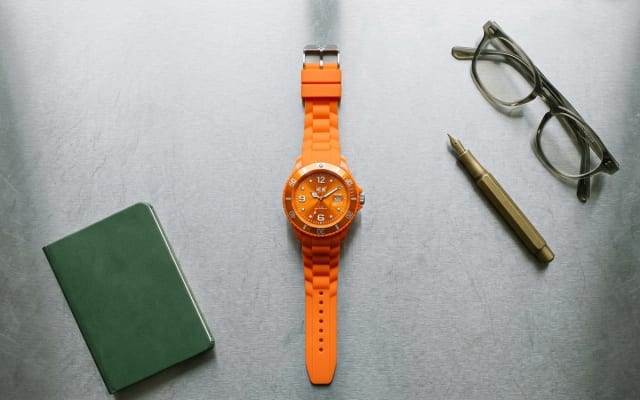
- Silicone or rubber: Ideal for sport and water activities. Easy to clean, very resistant. Resolutely casual look, less suited to formal wear.
3. Dial legibility: function above all
A watch is read in less than a second, or it is not read at all. Several parameters determine legibility:
- Dial colour: White or silver visually enlarges the dial and offers the best contrast with dark hands. Black brings immediate sophistication. Mother-of-pearl varies depending on the angle of light, which is aesthetically appealing but can slightly harm readability in certain conditions.
- Indices: Applied batons are the most legible at a glance. Arabic numerals facilitate quick reading. Roman numerals are elegant but slightly less practical. Diamonds or crystals in place of indices reduce readability: to be evaluated according to your primary use (jewellery or timekeeping instrument).
- Luminescence: If you read the time in low-light conditions (transport, cinema, nocturnal waking), check for the presence of luminescent material (Super-LumiNova) on the hands and indices. This treatment is rare on very fashion models, more frequent on sport or casual ranges.
- Anti-reflective crystal: A sapphire crystal without AR treatment can create annoying reflections in direct light. Simple or double-sided anti-reflective treatment significantly improves readability outdoors.
4. Water resistance: what the figures really mean
The water resistance indication on the dial or case back is often misinterpreted. These values correspond to laboratory tests on a new, stationary watch, not to a depth of use. After eight years testing watches for the press, I repeat this systematically: a watch rated 30 m does not go to the swimming pool, and neither does a 50 m.
- 3 ATM (30 m): Resistance to accidental splashes and rain. Do not wear in the shower, swimming, or washing up.
- 5 ATM (50 m): Withstands quick showers and significant splashes. No bathing or swimming. Hot water and pressure jets can damage seals over time.
- 10 ATM (100 m): Suitable for swimming, snorkelling and recreational water activities. Not suitable for scuba diving.
- 20 ATM and above: Sport diving permitted. These levels are found mainly on sport watches and dive watches.
Two practical rules to remember: never operate the pushers of a chronograph underwater, even on a model rated 100 m. Avoid thermal shocks (sauna followed by a cold plunge) which wear seals much faster than daily use. If in doubt after a shock, consult our guide on fogging and water resistance problems, or our customer service for personalised advice.
For an in-depth read on water-resistant watches, our complete guide to water-resistant watches details the applicable ISO standards and certifications.
5. Versatility: one watch or a collection?
If this watch is your only piece, the selection criteria differ from buying a specialist watch in an already substantial collection: versatility and readability come first.
- Single versatile watch: Opt for a neutral colour (silver, discreet rose gold, black), an intermediate case diameter (36-38 mm), a sober dial and an interchangeable strap. It must work equally well with jeans, office wear or an evening dress.
- Dedicated sport watch: Priority to water resistance (minimum 10 ATM), silicone strap and readability in difficult conditions. Luminescence and case robustness take priority over pure aesthetics.
- Dress watch / special occasion: Design and finishing take priority. Mother-of-pearl dial, slim case, leather or fine Milanese mesh strap. Water resistance is secondary.
- Collection or investment watch: Established watchmaking brands, certified quality movement, original box and papers kept. Resale value depends directly on the completeness of the documentation.
Reading customer reviews: what really matters
Customer reviews are available on Temovio. This is important: an unverified review on a high-involvement purchase like a watch offers no reliability guarantee.
To get the most information from existing reviews, focus on:
- The ownership duration mentioned: A review after six months of daily use is worth more than a review posted on the day of receipt.
- Observations on the strap: This is generally the first failure point on mid-priced watches. A review mentioning strap condition after a year is valuable.
- Movement accuracy: Attentive users mention whether the watch gains or loses time. For a quartz, a drift of more than 30 seconds per month is abnormal. For an automatic, more than 30 seconds per day warrants attention.
- After-sales service: The quality of response in case of a problem says a lot about the seller's reliability. Our team remains available via the contact page for any questions.
Identifying the best value for money according to your profile
Here is how to reason according to your actual profile:
"Reliable everyday" profile (mid-range budget): Prioritise a Japanese quartz movement (Miyota, Seiko), a 316L steel case, a sapphire or reinforced mineral crystal and 10 ATM water resistance. Brands like Citizen or Seiko excel in this configuration. You will get a watch that will last 10 to 15 years with minimal maintenance.
"Fashion accessory" profile (same budget): Major fashion houses (Michael Kors, Emporio Armani, Hugo Boss) offer carefully crafted designs with correct assembly quality. The quartz movement is reliable. Accept that you are paying partly for the name and aesthetics: it is a deliberate choice, not a mistake if it is your priority.
"Accessible watchmaking" profile (a notch higher): Consider an automatic with Miyota or Seiko NH calibre, or a Swiss watch with top-quality Ronda calibre. Tissot offers in this range watches with sapphire crystal, certified movement and a credible watchmaking brand image. This is the best entry point into serious watchmaking.
Profile "investment or exceptional gift" (upper-range budget): Opt for brands with documented Swiss movement, original box and papers, and if possible a sapphire caseback to observe the movement. Counter-intuitively, it is often models below the luxury tier that lose the most on resale due to incomplete documentation: keep every certificate. At this budget, the reference and vintage year matter as much as the dial.

Find your watch
Whether you are looking for your first women's watch, a gift or a piece to complete your collection, our selection covers all ranges with guaranteed authenticity and 2-year warranty.
Frequently asked questions
How much does a good women's watch cost in 2026?
What factors influence the price of a women's watch?
Is an expensive women's watch always better?
What is the best budget for buying a durable women's watch?
How to find a cheap women's watch without sacrificing quality?
Why are automatic watches more expensive than quartz?
Are women's watches from brands like Michael Kors worth their price?
Where to buy a women's watch at the best price in 2026?
Read next
More in this vein
Buying guides
200m Water Resistant Watch: The ideal companion for diving
Buying guides
The materials making a comeback in both watchmaking and creative jewellery
Buying guides
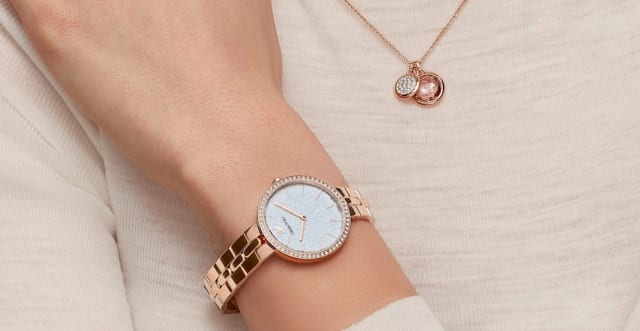
Swarovski watch: crystal, Swiss Made, what you're really paying for
Buying guides
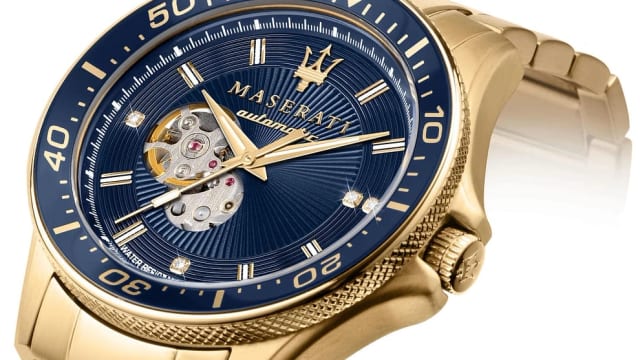
Maserati Sfida R8823140004: autopsy of an open heart NH70
Buying guides
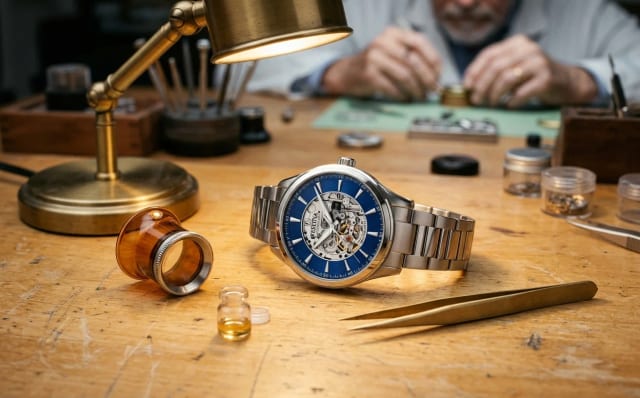
Skeleton watch: the complete guide from a watchmaker (men's, women's, automatic)
Buying guides
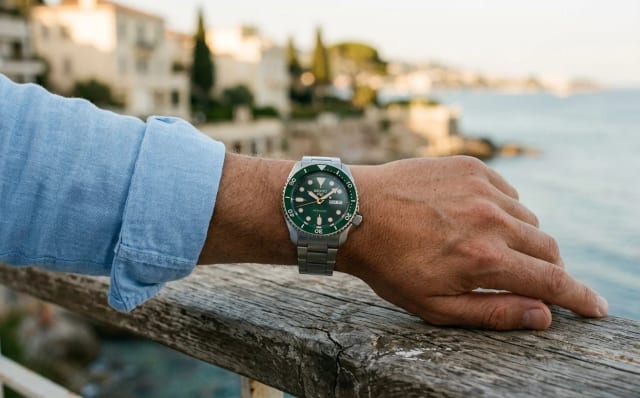
Rolex-style watch: Submariner, Datejust and affordable homages
Buying guides
Rectangular watch: from the Cartier Tank to affordable alternatives
Buying guides