

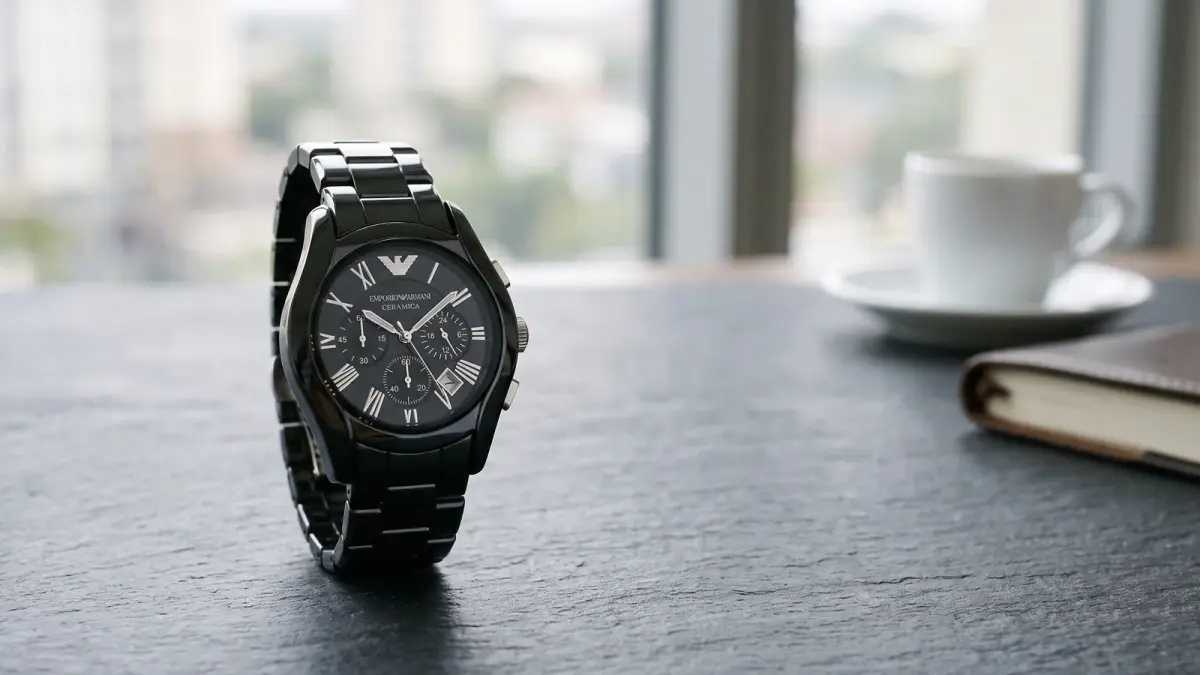
Ceramic is widely seen as the perfect material: scratch-proof, light, gentle on the skin. That is true, but only partly. For this guide, we went through the specification sheets of the 33 ceramic watches in our catalogue one by one, reviewed our shipments over the past twelve months and checked everything against the figures published by the manufacturers. Three popular beliefs do not survive the exercise: a ceramic watch can break, its crystal can scratch, and it is almost never designed for swimming.
What exactly is a ceramic watch?
Nothing to do with earthenware. Watchmaking ceramic is zirconia, a zirconium oxide. Rado, which launched its first watch in this material in 1986, describes the process: zirconium oxide powder injected at 1,000 bar, then sintered at 1,450 °C. During firing, the part shrinks by 25% and reaches a hardness of 1,250 Vickers.
Two consequences follow. The colour is integral to the material: there is no layer to wear away. And the piece comes out of the furnace in its final shape: it cannot be bent, straightened or reshaped.
Mind the vocabulary. A watch described as “ceramic” may be entirely ceramic, case and bracelet, or combine ceramic with steel. Both cases exist in our range: the case material is listed on the product sheet, not in the model name.
Ceramic, steel, titanium: the figures that matter
Sales copy talks about “high technology”. Four physical measurements are enough, however, to understand what the material changes on the wrist.
| Ceramic (zirconia) | 316L steel | Grade 2 titanium | |
|---|---|---|---|
| Hardness (Vickers) | 1,200 to 1,250 | 150 to 220 | around 145 |
| Density (g/cm³) | 6.05 | 8.0 | 4.51 |
| Thermal conductivity (W/m·K) | 2 to 2.5 | around 16 | 16 to 20 |
| Nickel in the material | none | 10 to 14% | none |
| Under impact | chips or breaks | marks, deforms | marks, deforms |
Hardness tells you what scratches what. Dust contains grains of quartz, 7 on the Mohs scale, which are enough to mark steel and mineral crystal (5 to 6). Zirconia opposes them with a hardness six to seven times higher than steel: a ceramic bracelet keeps its polish, whereas a steel bracelet picks up micro-scratches within a few months.
Density determines weight. At equal volume, zirconia weighs 24% less than steel (Rado states “around 30%”) and a third more than titanium. An all-ceramic watch is therefore not a light watch: it is a watch lighter than its steel twin.
Thermal conductivity explains the sensation on the skin. Zirconia conducts heat six to eight times less than steel: it does not chill the wrist, hence the absence of a cold contact in the morning. Grade 2 titanium conducts roughly like steel.
Then there is the last line of the table, the one product sheets leave out. Steel and titanium are metals: under impact, they deform. Ceramic does not deform, it absorbs the blow then breaks. That is the price of its hardness.
The real advantages of a ceramic watch
Three advantages come from the material itself. A fourth, skin tolerance, deserves a caveat.
It stays clean. No micro-scratches, no patina: a ceramic bracelet keeps its polish year after year. This is the decisive argument for a city watch worn every day.
Its colour does not wear off. Black steel is coated steel, most often by PVD treatment, and a coating eventually fades at the edges and on the clasp. Our warranty page also classes the wear of plating or coating among the wear-and-tear that is not covered. On ceramic, there is nothing to wear away: black, white or pink are throughout the material.
It is comfortable. A quarter less weight than steel at equal volume, and no cold sensation: the two figures in the table can be felt from the first wear.
The drawbacks nobody tells you about
Four limitations, all verifiable on our own sheets. None is a deal-breaker, provided you know them before buying.
It cracks rather than bends
A fall from the height of a washbasin onto tiles, and a link can split or an edge can chip. Where steel keeps a mark that can be softened by polishing, ceramic loses a chip that cannot be recovered: as we explain in our polishing guide, it can be neither polished nor repaired.
The piece is replaced, not restored. And that replacement is at your expense: the 2-year warranty covers the movement, not breakage of a bracelet or case, nor impacts.
The crystal will scratch before the bracelet
This is the clearest result of our review: all 33 sheets list a mineral crystal. At 5 to 6 on the Mohs scale, it is far softer than sapphire (9) and than the ceramic case. On a ceramic watch, the first scratch will therefore be on the crystal.
The habit that follows: place the watch clasp side down, never crystal against the table. A light scratch on a mineral crystal can be polished out, unlike a chip in ceramic.
Ceramic does not mean waterproof
The material does not fear water. Seals, crown and pushers are what matter, and they do not depend on the case material. Across our 33 sheets, 15 are rated 3 ATM, 15 at 5 ATM and 3 at 10 ATM.
In short: at 3 ATM, splashes and rain; at 5 ATM, an occasional shower; swimming only starts at 10 ATM. In our selection, the three 10 ATM models are Fossil.
Quartz, almost without exception
Of the 33 product sheets, 32 list a quartz movement and the last one does not specify: none is automatic. This is not a flaw, quartz is accurate and maintenance-free. But if you are looking for a mechanical watch, first read our comparison automatic or quartz: in this range, ceramic does not offer one.
White or black ceramic watch: what our sales show
In our selection, black dominates: 18 black straps against 9 white, then a few pink, blue and grey. More than half of the models are Emporio Armani, mostly black chronographs.
Sales tell the opposite story. Over our shipments of the last twelve months, nearly two in three ceramic watches were white.
Our reading, which is only our opinion: black exists everywhere, in coated steel as well as ceramic. The pure, durable white, on the other hand, exists almost only in ceramic. This is where the material has no competitor.

Cleaning a ceramic watch, step by step
Ceramic does not retain perfume or perspiration: its care comes down to four actions, and no product is needed.

Check the water resistance on the product sheet
It is this that sets the limit, not the material. At 3 ATM, the watch should never go under the tap: a damp cloth is enough. At 5 ATM, a brief rinse is tolerated, with the crown firmly pushed in.
Dust dry between the links
Pass a soft, dry brush between the links and around the clasp. Dust that lodges there does not damage the ceramic, but it eventually marks the steel parts.
Wipe with a barely damp microfibre cloth
A microfibre cloth lightly dampened with clear water restores the ceramic's shine. Focus on the crystal and the caseback, where skin leaves a greasy film.
Dry and store separately
Dry with a dry cloth, then store the watch in its box, away from other watches and jewellery. Ceramic will not be scratched by contact with them: it is ceramic that will scratch gold, silver and polished steel.
To do
- Lay the watch clasp side down, crystal facing up
- Take it off for DIY, gardening or carrying heavy loads
- Store it alone, in its box or a pouch
- Check the water resistance on the product sheet before any contact with water
Never do
- Polishing paste: it can do nothing for ceramic and gets lodged between the links
- Leave it on the edge of a basin or a bedside table
- Soak it or shower with it if it is 3 ATM
- Slip it into a pouch with other jewellery
For steel, leather, silicone and Milanese mesh, the methods change: they are detailed in our guide to cleaning a watch and its strap without damaging them.
Sizing a ceramic bracelet
A ceramic bracelet is shortened by removing links, as with a steel bracelet. The difference lies in the risk: a slipping tool scratches steel, but it can chip ceramic.
Of the 23 product sheets that specify the clasp, all list a deployant buckle. Our advice is simple: have a watchmaker do the sizing, and keep the removed links. They are your spare parts.
Ceramic, steel or titanium: our verdict
Three profiles, three answers
See our ceramic watches
All are authentic, delivered in their original box, with returns within 14 days, return shipping at the customer's expense.
Frequently asked questions
Can a ceramic watch break?
Ceramic or steel: which lasts longer?
How do you avoid scratching a ceramic watch?
Is a ceramic watch suitable for formal wear?
Is ceramic hypoallergenic?
To conclude
Ceramic is not the perfect material, it is a specialised material: unbeatable against wear, vulnerable to knocks. Chosen for the right use, city life and everyday wear, it remains the only watch that will look the same in ten years.
To go further, our guides to men's Emporio Armani watches and women's Emporio Armani cover the Ceramica line, and our article on materials common to watchmaking and jewellery places ceramic among other materials.
Read next
More in this vein

Care & maintenance
Why do all watches show 10:10? Symmetry, legibility and the smile hypothesis
Care & maintenance
Grey market watches: why a genuine watch can differ from the one you saw in a shop
Care & maintenance
Watch anatomy: the name of every part, and what it tells you about your watch
Care & maintenance
How to set the time and date on a watch without breaking anything: the crown, the date, digital watches
Care & maintenance
How to Clean a Watch and its Strap Without Damaging It: Steel, Leather, Silicone, Mesh, and the Moves to Avoid
Care & maintenance
How to Change a Watch Battery: a Watchmaker's Method, and the Step Almost Everyone Forgets
Care & maintenance
Crystals and rhinestones falling from a watch: why, and how to protect them
Care & maintenance