
Water resistance barometer watches 2026: what the French market really sells

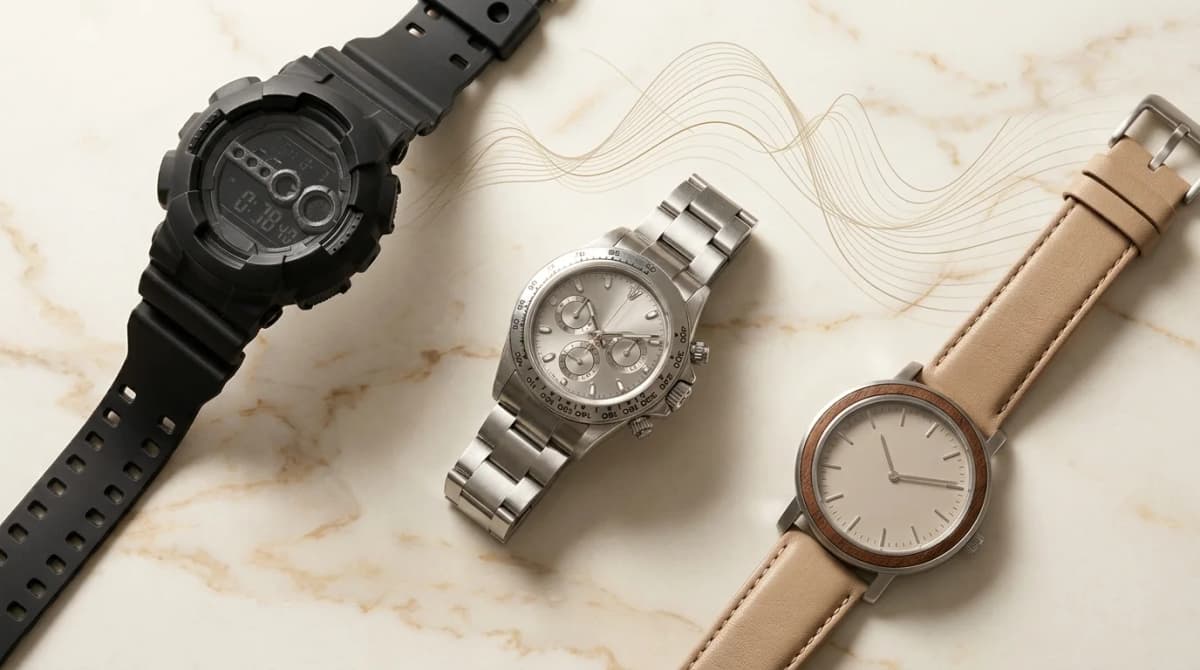
You are looking for a watch to take on holiday, swim in a pool or simply resist everyday splashes. You buy a "water resistant" watch from a major fashion brand. And then you do not really know what you can do with it. This confusion is not accidental: it is structural. Of the 3,893 references in active distribution analysed in the Montres Outlet catalogue on 17 July 2026, 81.3% of watches in the mass-market fashion watch sector display a water resistance threshold of ≤ 5 ATM, a level unsuitable for competitive swimming according to ISO 22810:2010 standard. This barometer, signed by Frédéric Blanc, retail watch consultant, breaks down the raw figures by threshold and by brand, for men's watches as well as women's watches, and gives you the keys to stop buying blind. The results overturn several misconceptions. Let us start with the data.

Diagnosis in 5 seconds
Watch water resistance: the raw figures of the French market in 2026

The first table below summarises the complete distribution of the 3,893 references analysed, classified by standardised water resistance threshold in ATM. The data comes from the Montres Outlet catalogue, extraction 2026-07-17. Each reference has been standardised according to the ATM standard (1 ATM = 10 metres of static pressure), in accordance with ISO 22810:2010 standard which governs the water resistance of non-diving watches.
| Water resistance threshold | Number of references | Market share | Maximum actual use |
|---|---|---|---|
| 5 ATM / 50 m | 2,134 | 54.8% | Rain, splashes, quick shower (no swimming) |
| 3 ATM / 30 m | 1,032 | 26.5% | Light spray, perspiration only |
| 10 ATM / 100 m | 629 | 16.2% | Pool and sea swimming, snorkelling |
| 1 ATM / 10 m | 42 | 1.1% | Minimal splash protection |
| 20 ATM / 200 m | 32 | 0.8% | Recreational diving (with Diver's marking, ISO 6425), recreational freediving |
| 30 ATM / 300 m | 13 | 0.3% | Technical diving, scuba diving |
| Not water resistant | 7 | 0.2% | No contact with water |
The figure to remember: 81.3% of fashion watches on the French market display a threshold of ≤ 5 ATM, a level unsuitable for any form of competitive swimming. Conversely, only 17.3% of references exceed 10 ATM, the threshold from which swimming in a pool and at sea becomes possible without risking damage to the movement. And the sports diving threshold, set at a minimum of 20 ATM by FFESSM (Waterproof equipment guide) and ISO 6425:2018 standard, concerns only 1.4% of the catalogue references (45 refs in total, between the 32 at 20 ATM and the 13 at 30 ATM). These figures on watch water resistance in the market form the basis of this barometer.
Barometer methodology: 3,893 refs, mass-market fashion sector
The working basis of this study is based on the Montres Outlet catalogue in active distribution, extracted on 17 July 2026, comprising 3,893 references with water resistance threshold specified and standardised in ATM. Only brands with at least 20 active references were retained for brand-by-brand statistics, to avoid statistical bias related to small samples. The ATM threshold indicated is that of the manufacturer's official technical sheet, without independent testing carried out by us.
Bias to note: this panel reflects the mass-market fashion watch sector, entry level to accessible upper range segment. Brands specialising in technical watches (Casio G-Shock, Seiko Prospex, Garmin, Citizen Promaster) are structurally under-represented in this catalogue. Rolex, Omega and fine watchmaking houses are absent. This barometer does not claim to measure the entire French watch market: it precisely measures what the average consumer finds on the shelf when looking for a fashion brand watch between entry level and accessible upper range. That is where the real risks of uninformed purchasing lie in terms of water resistance.
The complete ranking by brand: Michael Kors, DW, Maserati and others


Here is the complete table of the 15 brands selected (base ≥ 20 active references), with the breakdown by threshold. Percentages are rounded to the nearest whole number. Links lead to brand pages in the catalogue to view available references at outlet prices.
| Brand | References analysed | Low (1-3 ATM) | Mid (5 ATM) | High (10+ ATM) |
|---|---|---|---|---|
| Michael Kors | 588 | 6% | 62% | 32% |
| Guess | 345 | 51% | 44% | 5% |
| Hugo Boss | 314 | 11% | 73% | 16% |
| Tommy Hilfiger | 279 | 36% | 62% | 2% |
| Emporio Armani | 249 | 27% | 72% | 1% |
| Fossil | 215 | 8% | 77% | 14% |
| Lotus | 203 | 12% | 81% | 7% |
| Maserati | 178 | 0% | 19% | 81% |
| Daniel Wellington | 157 | 93% | 2% | 5% |
| Lacoste | 140 | 34% | 66% | 1% |
| Festina | 130 | 5% | 75% | 21% |
| Diesel | 117 | 41% | 37% | 22% |
| Marc Jacobs | 105 | 16% | 81% | 3% |
| Calvin Klein | 104 | 88% | 13% | 0% |
| Swarovski | 92 | 57% | 42% | 0% |
Three major findings emerge from this table. First finding: Daniel Wellington holds the record for non-swimmable watches, with 93% of its 157 references displaying 3 ATM or less. The Swedish brand's minimalist aesthetic rests on thin cases (often 6 to 8 mm thick) and poorly reinforced seals. The result is a massive commercial paradox: DW is one of the most purchased fashion brands for "active" everyday use, but 93% of its references cannot withstand swimming, or even prolonged showering. Second finding: Maserati surprises with 81% of its references above 10 ATM, making it the technical champion of the ranking, far ahead of other fashion brands. Third finding: Calvin Klein displays 0% of references ≥ 10 ATM and 88% in the low tier, making it the most misleading case for a buyer who associates the CK name with a premium lifestyle product.
Also worth noting: Guess presents a bipolar distribution, with 51% of low references (1-3 ATM) and only 5% above 10 ATM. In other words, Guess sells as many fragile jewellery watches as quasi-technical watches, with no clear signal for the consumer. Swarovski, logically, concentrates 57% of its references in the low tier and 0% beyond 10 ATM: crystal craftsmanship takes priority over seal engineering.
The Michael Kors paradox: women's fashion and surprisingly robust water resistance
With 588 references analysed, Michael Kors is the most represented brand in the panel. And its technical profile is counter-intuitive: 32% of its references reach or exceed 10 ATM, nearly double that of Hugo Boss (16%) and roughly sixteen times more than Emporio Armani (1%). This result is explained by the actual composition of the MK catalogue, often overlooked by the general public.
The Michael Kors men's chronograph range (Runway, Lexington, Oversized series) incorporates 316L steel cases with reinforced silicone seals, consistently reaching 10 ATM (100 metres). Models from the MK Access line (hybrid connected watches) inherit the same case construction, which mechanically pulls the brand upwards. Conversely, women's models with Milanese mesh bracelets or set stones, which represent the most visible part of mass-market sales, remain predominantly at 5 ATM. The paradox is as follows: the buyer who sees "Michael Kors" thinks of a gold bracelet and a set dial, that is, a fragile object. The actual technical reality of the catalogue is far more nuanced.
Daniel Wellington and Calvin Klein: the champions of the non-swimmable
Daniel Wellington is the textbook case of the gap between brand image and technical reality. The Swedish brand built its success on ultra-thin cases, minimalist dials and interchangeable NATO straps, which appealed to millions of buyers seeking a versatile everyday watch. Problem: the thinness of the case (often between 6 and 8 mm) is structurally incompatible with a double-thickness O-ring seal, which requires a minimum of 9 to 10 mm of case height to be effectively compressed. Result: 93% of DW references analysed display 3 ATM or less, a level that allows only resistance to rain and light perspiration, not prolonged showering and certainly not swimming.
The brand does indicate "3 ATM" or "30 M" on its cases, but this mention is regularly misinterpreted as "water resistant to 30 metres underwater whilst swimming". Yet the ISO 22810:2010 standard is explicit: 30 metres under static laboratory pressure does not correspond to 30 metres of actual swimming, where what decides is the crown, the age of the seals and thermal shocks (the dynamic pressure of a swimming stroke is, for its part, very low). This point is detailed in our complete guide to watch water resistance ATM/bar/metres with infographic.
Calvin Klein presents an even more pronounced profile: 88% of its 104 references are in the low tier (1-3 ATM), and 0% reach 10 ATM. The "steel jewellery" aesthetic of the CK Watch range (thin dials, tight mesh bracelets, fine-thickness deployment clasps) is structurally incompatible with the mechanical stresses of a high water resistance case. The practical consequence: virtually all Calvin Klein watches cannot withstand prolonged showering, even brief exposure to hot water (thermal expansion weakens seals at low hot water pressure according to manufacturer recommendations). This is not a manufacturing defect: it is a design choice oriented towards jewellery, not sports watchmaking.
DO
- Remove your Daniel Wellington or Calvin Klein before showering.
- Check the ATM figure engraved on the case back before any purchase if you have water use.
- Consult the technical data sheet by searching for "WR" followed by a figure in metres.
- Have the seals checked by a watchmaker every 2 years if you regularly expose your watch to water (even at 5 ATM).
DON'T
- Swim with a watch displaying "water resistant" alone, without an ATM figure.
- Interpret "30 M" as "I can swim at 30 metres depth".
- Dive in a swimming pool with a 5 ATM watch, even briefly.
- Expose a 3 ATM watch to hot pressurised water (shower, hot tub).
Maserati: the watchmaking surprise at 81% high performance
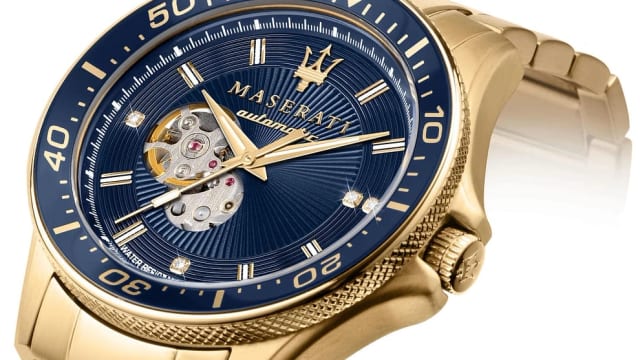
Maserati is the absolute counter-intuition of this barometer. With 81% of its 178 references exceeding 10 ATM and 0% in the low tier, the Italian brand far outperforms all other fashion market players, including brands perceived as "sporty" such as Diesel (22% high) or Festina (21% high). Maserati's "automotive sport-luxury" positioning led its design teams to systematically choose solid steel cases (often 44 to 48 mm, thickness 12 to 14 mm), screw-down crowns and sapphire crystals on the Successo and Traguardo lines, which mechanically implies better structural water resistance.
The Maserati chronograph range (Competizione, Sfida) incorporates sealed pusher mechanisms, a technical constraint that requires a minimum of 10 ATM to obtain manufacturer certification. This is not sports marketing: it is a design constraint. For the consumer, the benefit is real: buying a Maserati in the fashion segment means statistically benefiting from a watch suitable for swimming in a pool and at sea in 81% of cases, without knowing it at the time of purchase.
By way of quantified comparison: Festina, a Spanish brand often associated with cycling and sport, reaches only 21% of high references, compared to 81% for Maserati. Diesel, whose "tough" image suggests all-terrain robustness, caps out at 22% high with 41% of references in the low tier. These gaps illustrate that brand image does not predict actual water resistance.
The truth about 5 ATM (54.8% of the market): what you can really do
With 2,134 references at 5 ATM, or 54.8% of the market analysed, this threshold is by far the most widespread. And it is also the most frequently misinterpreted. The mention "5 ATM" or "50 M" engraved on the case back indicates that the watch has passed a static pressure test equivalent to 50 metres of water column in the laboratory, according to ISO 22810:2010 standard. This test does not simulate actual swimming conditions.
This test is carried out on a new, stationary watch, with the pressure raised slowly in water at constant temperature. Contrary to a very widespread belief, it is not swimming strokes that defeat a 5 ATM watch: the dynamic pressure of entering the water is ½ρv², roughly 0.5 bar at 10 m/s, far below the 5 bar of the test. What lets water in is a crown pulled out or not properly pushed in (no water resistance at all), ageing seals (chlorine, salt, sun cream, soap, temperature cycles, permanent compression), a thermal shock, a cracked crystal or a case back reopened without a new test. A 5 ATM watch, rarely fitted with a screw-down crown, therefore stops at the occasional shower: for the pool and the sea, you need 10 ATM.
For a complete explanation with the infographic of ATM/bar/metres thresholds, consult our watch water resistance reference guide: ATM, bar, metres explained. This guide also details what the water resistance test really measures, and lists thresholds by use (shower, pool, snorkelling, diving).
Practical case: an Emporio Armani watch at 5 ATM (72% of the EA catalogue sits at this threshold) will resist heavy rain, intense perspiration and a splash from the pool edge. It is made neither for a dive from a starting block nor for 30 minutes of front crawl. Hot water makes the situation worse: silicone seals expand differently under heat, and prolonged hot shower with a 5 ATM represents a real risk of infiltration according to specialist watch repairers (repair data from Seiko and Citizen technical guides, transposable to the fashion segment).
What to check before buying: the 3-point method

Point 1: read the case back, not the dial. The water resistance rating is engraved or printed on the case back, not on the visible face. Look for the mention "WR" followed by a figure in metres or ATM. "WR 100M" = 10 ATM = suitable for swimming. "WR 30M" = 3 ATM = showering not recommended. If you only see "Water Resistant" without a figure, the ISO 22810 standard classifies this mention as unquantified minimal protection, or less than 1 ATM in practice. This mention alone is insufficient for any aquatic use.
Point 2: cross-reference with the catalogue technical sheet. The case back may sometimes bear an outdated rating (particularly on end-of-line and outlet clearance models). The technical sheet in the online catalogue is updated according to manufacturer data and is the definitive reference in case of doubt. For references available on montres-outlet.com, water resistance is systematically listed in the technical specifications of each product sheet, verified upon stock receipt.
Point 3: beware of the "water resistant" mention alone. This wording, inherited from pre-standardisation marketing, has been insufficient since the revision of ISO 22810 in 2010. A reputable manufacturer always indicates a figure (ATM or metres). The absence of a figure does not mean the watch is water resistant: it means that water resistance has not been tested according to a standardised protocol. Of the 3,893 references in this survey, only 7 (0.2%) are explicitly classified as "non-water resistant"; all others have an ATM value provided by the manufacturer.
For sports diving watches (≥ 20 ATM), also check for the presence of a screw-down crown and a unidirectional rotating bezel, two elements required by the ISO 6425:2018 standard to obtain "Diver's Watch" certification. Without these elements, a "200 M" mention may be only static pressure resistance, without the standard's trials (overpressure at 125% of the rating, thermal shock) or the checking of every single watch.
Find your watch with water resistance suited to your needs
Montres Outlet offers authentic branded watches at outlet prices, with verified water resistance listed on each product sheet. 2-year warranty, authenticity verified piece by piece, free delivery.
Frequently asked questions about water resistance in branded watches
Which fashion watch brand is the most water resistant in 2026?
Based on the 3,893 references analysed in the Montres Outlet catalogue as of 17 July 2026, Maserati is the most water-resistant fashion brand, with 81% of its 178 references exceeding 10 ATM and 0% in the low tier (1-3 ATM). Festina comes in second place with 21% of references in the high tier and only 5% in the low tier. Michael Kors stands out with 32% of its 588 references above 10 ATM. Conversely, Calvin Klein (0% ≥ 10 ATM), Swarovski (0% ≥ 10 ATM) and Daniel Wellington (5% ≥ 10 ATM) are the least water-resistant brands in the ranking. For an answer to the question "which water-resistant watch brand to choose" for swimming, Maserati or Michael Kors (chronograph line) are the safest choices in the mainstream fashion segment.
Can you swim with a Daniel Wellington or a Calvin Klein?
No, in almost all cases. 93% of Daniel Wellington references display 3 ATM or less, and 88% of Calvin Klein references are in this same low tier. These two brands are designed for jewellery and fashion use, not for sports aquatic use. According to ISO 22810:2010, a threshold of 3 ATM does not permit swimming, nor even prolonged showering in hot water. The rule is simple: if you swim, remove your DW or your CK before entering the water. Non-swimming watches such as these models are not defective; they correspond to dry daily use, which represents the majority of situations for a fashion watch. Consult our complete water resistance ATM guide to understand the thresholds.
Why does Michael Kors resist water better than other fashion brands?
Michael Kors owes its 32% of references at 10 ATM or above to the actual composition of its catalogue, often overlooked by the general public. The men's chronograph range (Lexington, Runway, Oversized) and MK Access connected models incorporate thick 316L steel cases with reinforced silicone seals, which mechanically requires 10 ATM water resistance to obtain manufacturer certification. These are the lines that lift the brand upwards. Conversely, women's models with set dials or Milanese mesh straps, which are often the most visible in shops and online, remain at 5 ATM. The paradox: the general public buys MK for the women's fashion models (5 ATM), but the global MK catalogue is statistically far more robust than Emporio Armani or Tommy Hilfiger.
Does a 5 ATM watch allow you to swim in a pool?
No. A watch displaying 5 ATM (or 50 M) has passed a static pressure laboratory test equivalent to 50 metres of water column, according to ISO 22810:2010. It is not arm movements or entering the water that threaten it (their dynamic pressure stays far below 5 bar): it is the crown, ageing seals and thermal shocks. Swimming in pools and at sea calls for 10 ATM minimum. The 5 ATM threshold covers rain, splashes and the occasional shower, without very hot water. It does not cover swimming, snorkelling or diving. This point is one of the most important confusions in fashion watch water resistance: 54.8% of the market analysed is in this zone of misunderstanding.
How do you verify the actual water resistance of a watch in a shop?
Three points to check in order. 1: read the case back: look for "WR" followed by a figure in metres or "X ATM". The mention "Water Resistant" alone, without a figure, guarantees no standardised threshold. 2: consult the catalogue technical sheet: the ATM figure must appear there in the technical specifications, not only in the marketing description. 3: check for the presence of a screw-down crown if you are looking for water resistance ≥ 10 ATM: a push crown (non-screw-down) on a 10 ATM case is the most frequent weak point in real use according to watch repairers. For sports diving (≥ 20 ATM), the ISO 6425:2018 standard requires, among other things, a unidirectional rotating bezel and the DIVER'S marking; a screw-down crown is the usual construction of diving watches, but the standard does not impose it. Without the DIVER'S marking, an engraved "200 M" is not a diving certification.
Read next
More in this vein
Buying guides
200m Water Resistant Watch: The ideal companion for diving
Buying guides
The materials making a comeback in both watchmaking and creative jewellery
Buying guides
Swarovski watch: crystal, Swiss Made, what you're really paying for
Buying guides
Maserati Sfida R8823140004: autopsy of an open heart NH70
Buying guides
Skeleton watch: the complete guide from a watchmaker (men's, women's, automatic)
Buying guides
Rolex-style watch: Submariner, Datejust and affordable homages
Buying guides
Rectangular watch: from the Cartier Tank to affordable alternatives
Buying guides